Students exploring Islamic education after O Levels have several pathways depending on their academic goals and preferred learning approach:
- Cambridge A-Levels with part-time modular Islamic diploma courses for students balancing both streams.
- Full-time 6-8-year Dars-e-Nizami studies at a traditional seminary.
- Local Intermediate (FA) alongside seminary studies to complete board examinations.
- Integrated dual-track programs combining a traditional Sanad with an accredited university bachelor’s degree under one synchronized schedule.
Completing Cambridge O Levels marks the end of one academic chapter and the beginning of important decisions about the future. For students interested in Islamic education, questions often arise about balancing religious studies with A-Levels, adapting to classical Arabic and Urdu texts, and maintaining academic recognition through IBCC equivalence.
The transition from an English-medium education system to traditional Islamic learning requires careful planning, but your previous academic experience remains valuable. Skills like research, analysis, and critical reading continue to support deeper engagement with Islamic scholarship.
As you explore choosing an Islamic studies path, understanding how different programs align with local education requirements helps you make informed decisions. This guide explains the available pathways for Islamic studies after O Levels and the academic considerations that help you continue your education with clarity.
Islamic Education After O Levels: Understanding Your Options and Requirements
Completing Cambridge O Levels opens the door to several academic pathways. For students interested in Islamic education, the next step often comes with practical questions: How do you continue religious studies while protecting your academic future? How do you transition from an English-medium curriculum to classical Arabic texts? And how does IBCC equivalence affect your next educational move?
Your previous academic journey still holds value. Skills developed through O Levels, including research, analysis, and critical thinking, provide a strong foundation for engaging with Islamic scholarship. The key is understanding which pathway aligns with your goals.
When choosing an Islamic studies path, knowing how Cambridge qualifications connect with Pakistan’s education system helps you plan your next step with confidence. This guide explains the available options for Islamic education after O Levels and the requirements you need to consider before making a decision.
The Regulatory Starting Point: IBCC Equivalence Explained
Before selecting an Islamic education pathway in Pakistan, Cambridge O-Level students need to complete the IBCC equivalence process. Unlike students who complete local Matric examinations, Cambridge graduates must convert their international qualification into an equivalent Pakistani certificate.
For Islamic education O Level students, understanding IBCC requirements is an important first step before selecting a religious studies pathway.
The Inter Board Coordination Commission (IBCC) is responsible for converting foreign secondary qualifications into national grade equivalences. For students holding a Pakistani passport, IBCC requires completion of at least eight O-Level subjects to issue SSC equivalence.
The required subjects include:
- Five compulsory subjects:
English Language, Urdu (First or Second Language), Islamiyat, Pakistan Studies, and Mathematics.
- Three elective subjects:
Selected from Science subjects such as Physics, Chemistry, Biology, or Computer Science, or Humanities subjects including Economics, History, Literature, and Sociology.
Students must submit verified Statements of Results to IBCC before receiving their official SSC Equivalence Certificate.
This certificate plays an important role in future academic planning. Whether you continue with traditional Islamic studies, apply for university admission, or pursue professional education, recognized equivalence keeps your options open.
Comparing the Cambridge pathway with Islamic education after matric helps explain why local board students follow a different documentation process while Cambridge students need to complete IBCC requirements separately.
Transitioning From English-Medium Studies to Classical Islamic Texts
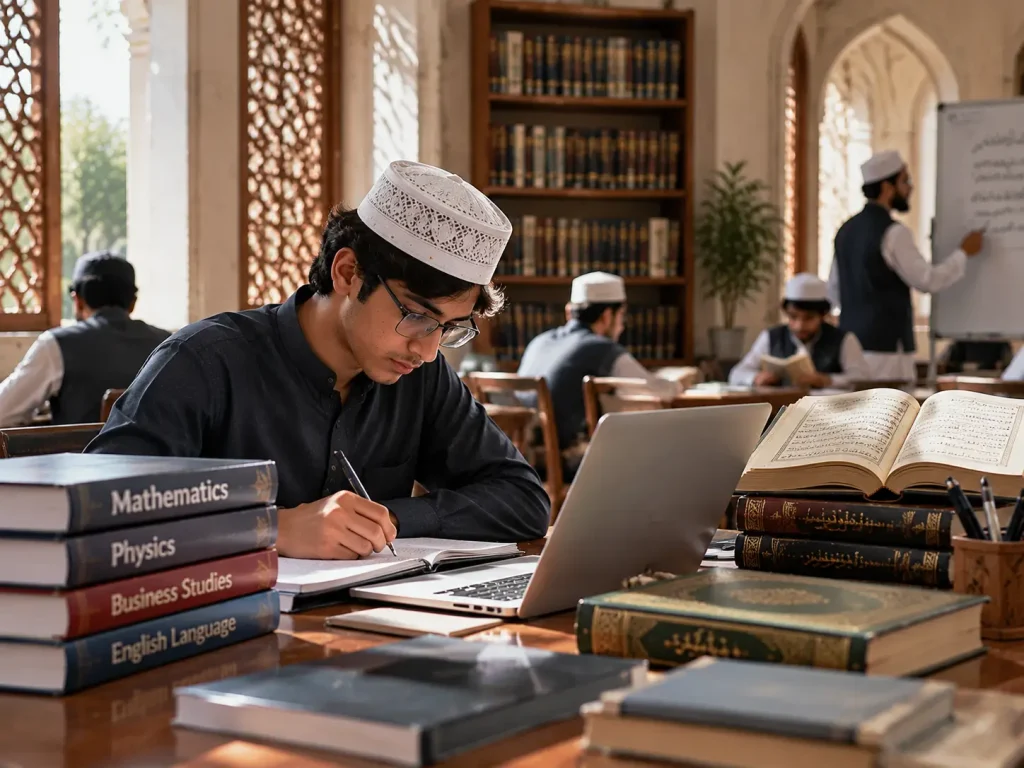
Cambridge O Levels develop strong skills in essay writing, research, and analytical thinking. Islamic education requires those skills along with a new academic foundation: classical Arabic and scholarly Urdu.
Students entering traditional Islamic studies often experience a different style of learning. Instead of analysing texts through English explanations, they gradually learn to engage directly with original Arabic works and classical commentaries.
Moving From Modern English to Classical Arabic
Cambridge assessments usually focus on written arguments, interpretation, and structured responses. Classical Islamic education requires direct engagement with unvoweled Arabic texts.
Students learn areas such as:
- Sarf: Understanding Arabic word patterns and morphological roots.
- Nahw: Learning classical Arabic grammar and sentence structures.
- I’rab: Applying grammatical rules to understand the precise meaning of texts.
These skills help students read and analyse advanced works in Islamic law, theology, and other traditional disciplines.
Understanding the Role of Urdu Commentary
In many South Asian seminaries, lessons, explanations, and discussions take place in formal scholarly Urdu. Students who studied Urdu as a second language or come from English-medium backgrounds may initially find classical religious terminology unfamiliar.
Developing confidence in Urdu vocabulary and comprehension helps students follow detailed explanations and participate effectively in traditional learning environments.
The Foundation Year Solution (Sanah I’dadiyyah)
Many institutions offer a preparatory year designed to help students build the required language foundation before beginning advanced Islamic sciences.
The preparatory stage focuses on:
- Arabic vocabulary development
- Sentence analysis
- Reading comprehension
- Basic understanding of classical texts
The Prophet Muhammad (peace be upon him) highlighted the importance of developing deep understanding of religion:
“When Allah wishes good for someone, He gives him deep understanding (Fiqh) of the religion.” – (Sahih al-Bukhari 71)
Understanding the requirements of dars e nizami vs BS Islamic Studies helps students recognize why classical Arabic preparation plays an important role before advanced studies in Islamic jurisprudence and scholarship.
Option 1: Cambridge A-Levels + Modular / Part-Time Islamic Studies
Students who want to pursue careers in fields such as medicine, engineering, finance, or law often prefer continuing through the Cambridge system. This pathway allows students to complete A-Levels while studying Islamic sciences through part-time programs.
A typical schedule may look like:
- Monday to Friday mornings: Three to four Cambridge A-Level subjects.
- Evenings or weekends: Quranic Arabic, Fiqh fundamentals, Hadith studies, or Islamic diploma courses.
- Final qualification: Cambridge Advanced Level Certificate (GCE).
How the Model Works
Students continue at an A-Level college while joining evening madrasa classes, weekend Islamic programs, or online courses. Their religious studies may include Quran translation, Hadith terminology, and essential Islamic rulings for daily life.
Advantages and Practical Limits
Advantages:
- Keeps access to international universities and professional degrees.
- Allows students to continue developing Islamic knowledge alongside mainstream education.
- Provides flexibility for students with long-term academic goals.
Limitations:
- Part-time study usually provides limited hours compared with full-time seminary education.
- Students may not develop the same level of Arabic fluency required to independently read advanced classical manuscripts.
- Traditional teaching certification (Sanad) usually requires a dedicated full-time pathway.
Students who complete A-Levels can continue toward accredited degrees, as explained in what is BS Islamic Studies, while keeping their broader academic pathway available.
Option 2: Full-Time Seminary Immersion (Dars-e-Nizami)
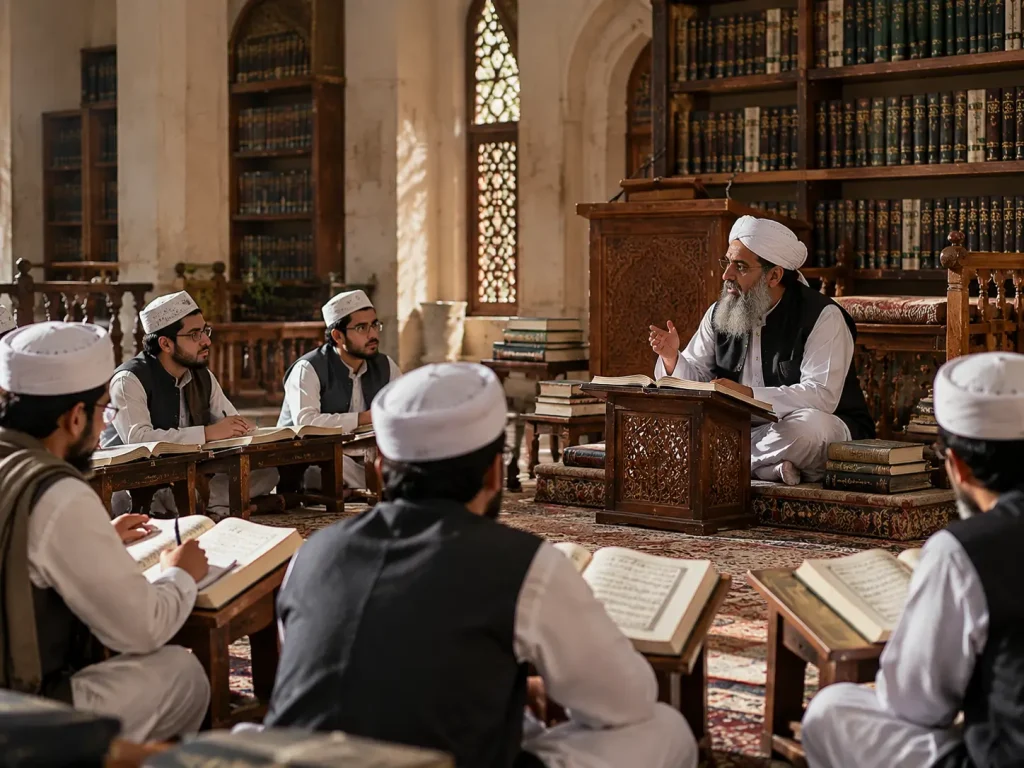
Many students searching for an aalim course after O Levels choose the Dars-e-Nizami pathway because it provides a complete framework for studying Arabic, Fiqh, Hadith, and classical Islamic texts. This pathway focuses on classical disciplines, Arabic mastery, jurisprudence, Quranic interpretation, and Hadith studies.
A traditional progression usually follows:
- Stage 1: Sanawiyyah Aammah: 2 years (Matric level parity)
- Stage 2: Sanawiyyah Khasah: 2 years (Intermediate level parity)
- Stage 3: Aliyah: 2 years (Bachelor level parity)
- Stage 4: Dawrah-e-Hadith: Final year (Master level / Alimiyyah)
Building Classical Scholarship
Full-time students spend six to eight years studying traditional Islamic sciences. Their daily learning includes lectures (Dars), reading sessions (Halqah), and revision discussions (Takrar).
Students gradually progress through classical legal texts, Quranic commentary, and the six major Hadith collections (Sihah Sittah).
Adapting to Seminary Learning
This pathway requires students to adjust from the Cambridge examination style to a traditional academic environment. Learning is usually based around classical texts, annual examinations, and long-term subject progression.
Exploring traditional madrasa vs university education helps students understand the differences between these two educational approaches.
Students can also learn more about certification systems through what is Wifaq certification and how examinations are managed across affiliated institutions.
Option 3: Transitioning to Local Intermediate (FA) + Seminary Studies
Some O-Level graduates prefer to pursue traditional Islamic scholarship while maintaining a pathway that aligns with Pakistan’s local higher education system. For these students, moving from Cambridge to the Intermediate (FA) system alongside seminary studies becomes a practical option.
This route allows students to complete their local board requirements while dedicating significant time to Dars-e-Nizami studies.
The pathway usually involves:
- Step 1: Obtain IBCC SSC equivalence for Cambridge O Levels.
- Step 2: Register as a private candidate with a local Board of Intermediate and Secondary Education (BISE) for FA Humanities.
- Step 3: Complete required board subjects, including English, Urdu, and Pakistan Studies.
- Step 4: Continue full-time Dars-e-Nizami studies at a recognized seminary.
Why Choose the Local Board Route?
Cambridge A-Level examinations involve international registration costs and private tuition expenses. Some students choose FA Humanities through a local board because it offers a more accessible route while allowing them to focus more time on traditional Islamic studies.
The local board pathway also helps students meet academic requirements recognized within Pakistan’s education system.
Understanding the difference between sanad and university degree explains why both qualifications serve different purposes. A Sanad represents traditional Islamic scholarship, while a university degree follows an accredited academic framework.
Learning about what does HEC recognition mean also helps students understand how academic qualifications connect with higher education opportunities.
Option 4: The Integrated Dual-Track Model (Concurrent Degree + Sanad)
For students who want to combine traditional Islamic scholarship with modern higher education, an integrated dual-track model offers a combined academic pathway.
Instead of choosing between a conventional degree and traditional Islamic studies, students follow both tracks together through a synchronized academic plan. The model combines:
| Classical Islamic Sciences | Modern Higher Education |
| Classical Arabic grammar | Academic research writing |
| Fiqh and traditional texts | Intermediate-level academic subjects |
| Hadith methodology | Contemporary social sciences |
| Traditional Sanad pathway | HEC-recognized BS degree |
Combining Classical Learning With Modern Skills
Students in this model continue developing the analytical abilities gained through their Cambridge education while building expertise in Islamic sciences.
Their studies may include classical Arabic texts, Islamic jurisprudence, research methodology, modern academic subjects, and professional skills.
Managing both systems independently can create scheduling challenges. Students exploring can you study dars e nizami and university together often look for programs where academic calendars, classes, and examinations are planned together.
An integrated institution addresses this challenge by bringing both educational pathways under one coordinated system.
Choosing the Right Islamic Education Path After O Levels
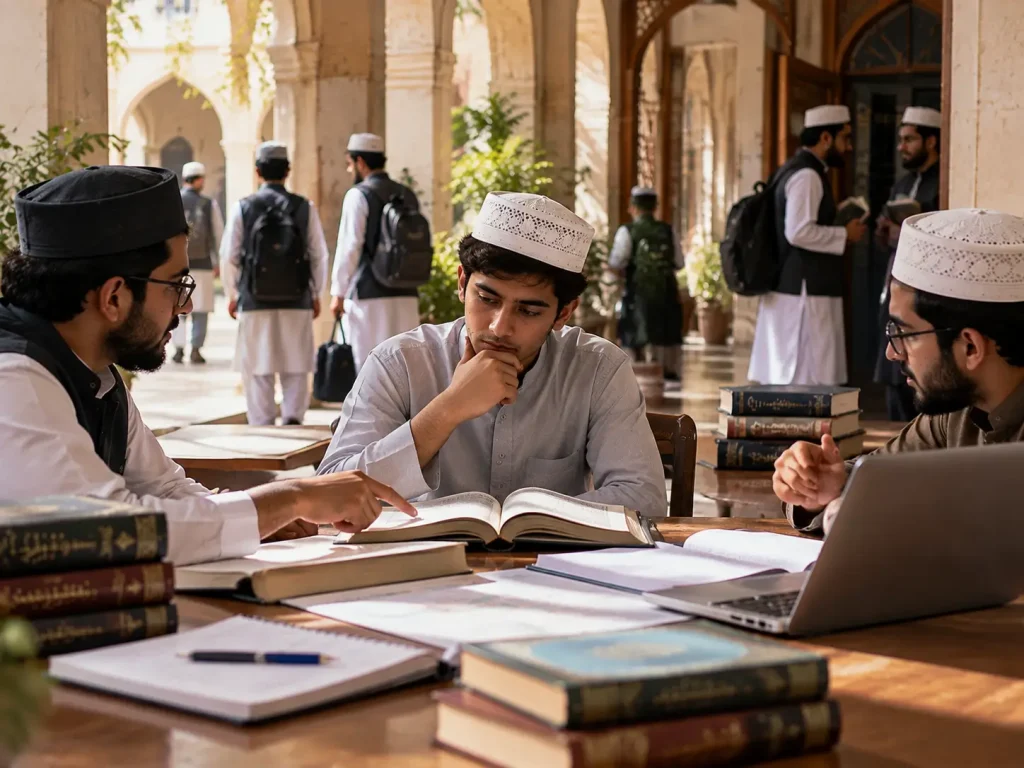
The right pathway depends on your academic goals, career plans, and the level of Islamic scholarship you want to pursue. Students planning for international universities or professional careers may prefer continuing with Cambridge A-Levels while adding Islamic studies alongside them.
Those seeking traditional scholarship may choose full-time Dars-e-Nizami education. Students who want both traditional Islamic learning and university qualifications may consider an integrated dual-track approach. Before making a decision, consider:
- Your long-term academic goals.
- Whether you want a traditional Sanad, a university degree, or both.
- The amount of time you can dedicate to Islamic studies.
- The language preparation required for classical texts.
- The recognition requirements for future education or career plans.
Islamic education after O Levels offers multiple pathways. With proper planning, students can continue their academic journey while developing a deeper connection with Islamic scholarship.
Comparing Your Options After O Levels
Students exploring Islamic education after O Levels usually consider four major pathways: continuing Cambridge A-Levels alongside Islamic studies, joining a full-time Dars-e-Nizami program, moving to Intermediate studies with seminary education, or choosing an integrated academic model.
Each option comes with different commitments, qualifications, and long-term outcomes. Understanding these differences helps you choose a route that matches your goals.
| Pathway | What You Study | Time Commitment | What You Earn | Who It May Suit |
| A-Levels + Modular Islamic Studies | Cambridge A-Levels with weekend Arabic and Fiqh courses | Around 25 hours of college study + 6 hours of Islamic studies weekly | Cambridge A-Level Certificate | Students planning careers in medicine, STEM, business, or international universities |
| Full-Time Dars-e-Nizami | Classical Arabic, Islamic jurisprudence, Hadith, and traditional texts | Around 30–35 hours weekly at a seminary | Traditional Sanad / Wifaq Certificate | Students focused on becoming scholars, teachers, or Islamic researchers |
| FA Intermediate + Seminary Studies | Local Intermediate studies alongside full-time Islamic education | Around 35–45 hours weekly combined | Sanad with local academic pathway | Students who want traditional scholarship while maintaining local academic alignment |
| Integrated Dual-Track Program | Dars-e-Nizami combined with a BS degree | Around 35–42 hours through a combined timetable | Traditional Sanad + Accredited BS Degree | Students who want classical scholarship and recognized university education together |
Combining Islamic Scholarship and University Education at SISL Karachi
Many students who complete O Levels face a difficult choice: should they focus only on traditional Islamic studies, or continue toward a university degree?
Trying to manage both paths separately can become challenging. Different class schedules, examination systems, and registration requirements often create pressure for students who want to pursue both.
The School of Islamic Scholars & Leaders (SISL) in Karachi developed the 8-year Islamic Scholar & Leaders Program (ISLP) to bring these two educational journeys together.
Through this integrated approach, students study the traditional Dars-e-Nizami curriculum while also completing a Bachelor of Science (BS) in Islamic Studies recognized by the Higher Education Commission (HEC).
The program combines:
| Islamic Scholarship | University Education |
| Classical Arabic grammar | HEC-approved BS curriculum |
| Fiqh and traditional texts | Academic research skills |
| Hadith methodology | Contemporary social sciences |
| Traditional Sanad studies | Recognized university degree |
For students coming from Cambridge backgrounds, the approach also helps connect their existing academic skills with classical Islamic learning.
Students develop:
- Traditional scholarship: Through Arabic text study, Fiqh, Hadith, and classical Islamic sciences.
- Academic skills: Through research writing, communication, and university-level learning.
- Modern understanding: Through subjects that help students engage with contemporary issues.
Planning Your Long-Term Academic Journey
The choices you make after O Levels can influence your options in the years ahead. Before selecting a pathway, think about where you want your education to take you. A possible academic journey looks like this:
| Secondary Education |
| Cambridge O Levels + IBCC SSC Equivalence |
| ↓ |
| Undergraduate Education |
| BS Degree OR Recognized Islamic Qualification |
| ↓ |
| Advanced Studies |
| MS / MPhil Research and PhD Opportunities |
If you plan to continue into postgraduate education, having a recognized 16-year qualification becomes important. Programs such as MS Islamic Studies require students to meet specific academic requirements.
Planning your qualifications early helps you avoid challenges later when applying for universities, professional opportunities, or further research programs.
A Checklist Before You Choose Your Program
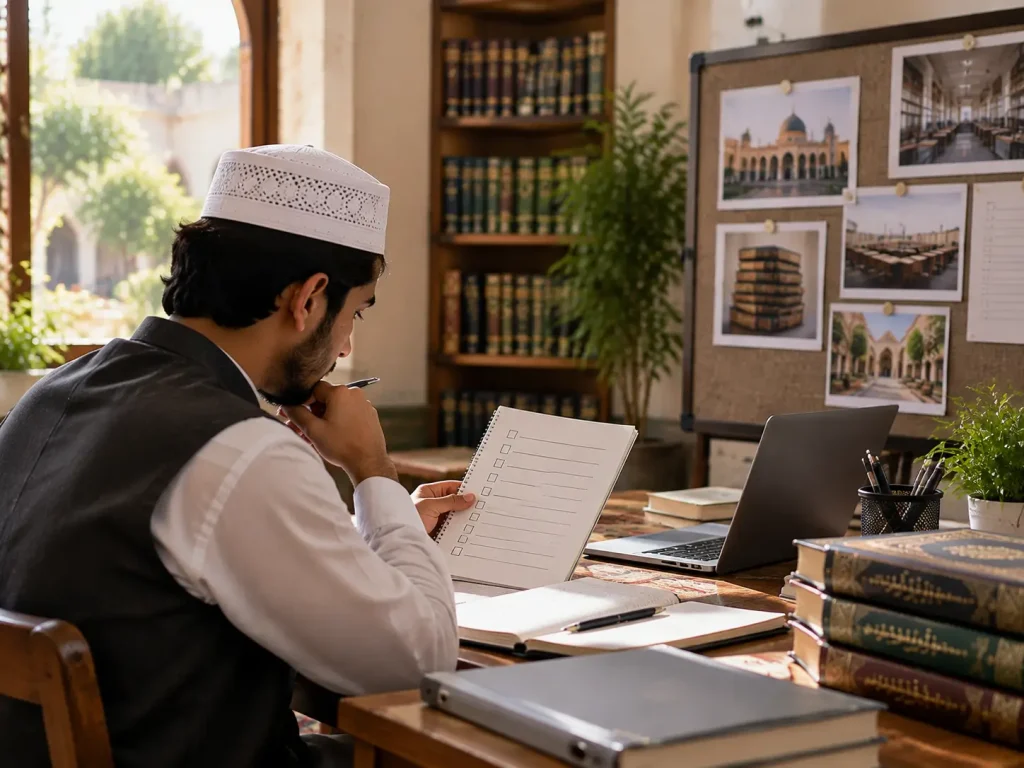
Before enrolling in an Islamic education program, it is worth checking a few important details about your qualifications and the institution. Use this checklist:
- Confirm Your O-Level Subject Requirements
- Complete IBCC Equivalence
- Seminary Board Affiliation
- Verify University Recognition
1. Check Your O-Level Subjects
If you hold a Pakistani passport, make sure your Cambridge results include the required subjects for IBCC equivalence:
- English
- Urdu
- Islamiyat
- Pakistan Studies
- Mathematics
- Three approved elective subjects
Completing these requirements helps you avoid delays when applying for further education.
2. Complete Your IBCC Equivalence
Your Cambridge qualification needs to be converted into a Pakistani equivalent certificate through IBCC.
Having your equivalence completed before applying for higher studies keeps your academic documents ready when you need them.
3. Confirm Seminary Recognition
If you are joining a traditional madrasa, check whether the institution is affiliated with a recognized examination board such as Wifaq-ul-Madaris Al-Arabia.
Board affiliation ensures your examinations and certification follow an established system.
4. Verify University Recognition
If your program includes a university degree, confirm that the institution is recognized and that the degree program meets HEC requirements. Careful verification reflects the Islamic principle of seeking clarity before making important decisions:
“O you who have believed, if there comes to you a disobedient one with information, investigate, lest you harm a people out of ignorance and become, over what you have done, regretful.” – (Surah Al-Hujurat 49:6)
Building Your Future With Islamic and Modern Education
Completing O Levels gives you valuable skills in research, communication, and analytical thinking. These skills remain useful when you begin studying Islamic sciences and engaging with classical texts. The best pathway depends on your personal goals.
If you want to pursue a professional career while continuing Islamic learning, combining A-Levels with modular Islamic studies may suit your plans. If your goal is traditional scholarship, full-time Dars-e-Nizami provides a dedicated route toward deeper Islamic learning.
If you want both classical scholarship and university recognition, integrated programs that combine Islamic and modern education offer a pathway that brings both goals together.
With proper planning, understanding of requirements, and careful selection of your educational route, you can continue your Islamic learning while building qualifications that support your future.
Frequently Asked Questions
Can an O-Level student succeed in Dars-e-Nizami without strong Urdu?
Yes. Many students begin Islamic studies with different language backgrounds. A suitable foundation program helps students build religious vocabulary, understand classical terminology, and gradually improve their ability to engage with scholarly texts.
Do I have to take Cambridge A-Levels if I want to study Dars-e-Nizami?
No. A-Levels are not required for entering Dars-e-Nizami. However, students who want broader access to universities, professional fields, or postgraduate opportunities need recognized qualifications alongside their Islamic studies.
What if I did not take Urdu or Islamiyat in my Cambridge O-Levels?
Missing required subjects can affect the IBCC equivalence process. Students need to complete the missing requirements through approved examination options before receiving full equivalence.
Can an O-Level graduate apply directly to Islamic universities abroad?
Admission requirements depend on the university and country. Many institutions require completion of 12 years of education before undergraduate admission and may also require Arabic language preparation.
How can I study Islam after O Levels?
Students who want to study Islam after O Levels have multiple options, including part-time Islamic courses, full-time Dars-e-Nizami programs, and integrated programs that combine Islamic scholarship with university education.