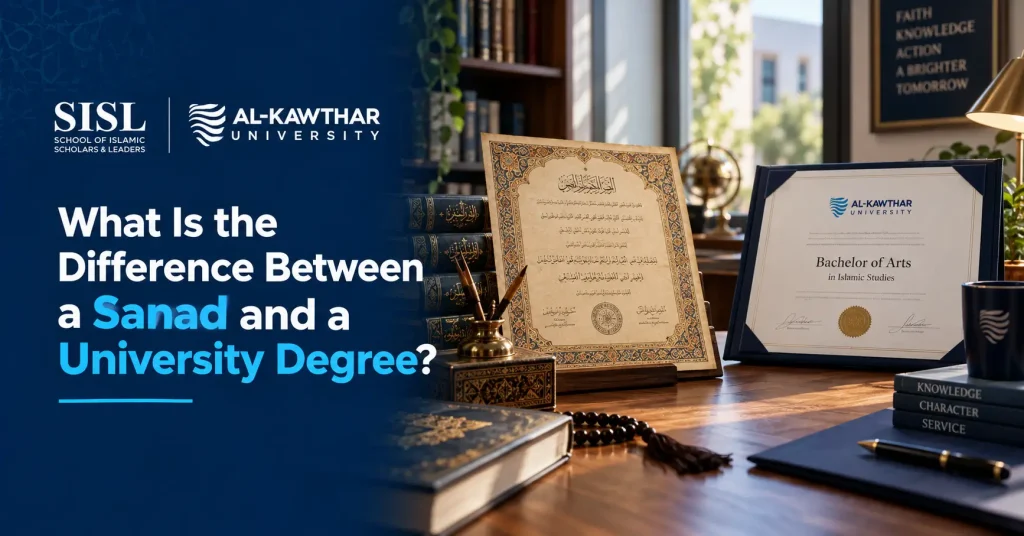
The difference between a Sanad and a university degree lies in what each credential represents:
- Sanad: A traditional Islamic qualification awarded after completing religious study.
- Ijaza: In some contexts, permission to teach or transmit a specific text through a recognised scholarly chain.
- University Degree: A formal academic qualification awarded by a recognised university.
- Recognition: A Sanad serves Islamic scholarly settings, while a degree supports employment and higher education.
- Equivalence: Some Islamic qualifications may receive official academic equivalence.
If you’re comparing Islamic study options, terms like Sanad, Ijaza, Shahadah, and university degree can start to blur together. They may all represent serious study, but they don’t certify the same thing or open the same academic and professional pathways.
The difference between sanad and university degree becomes clearer once you look at who awards each credential, what kind of study sits behind it, and where it is formally recognised.
Questions around aalim sanad meaning, degree equivalence, employment, and postgraduate admission usually arise when students try to compare traditional scholarship with university education. If you’re choosing an Islamic studies path, understanding how these Islamic education credentials differ will make it easier to judge which qualification fits the direction you want to pursue.
What Does a Traditional Sanad Represent?
To understand the difference between sanad and a university degree, it helps to first separate a few terms that often appear together.
In Islamic scholarship, Sanad has more than one usage. In classical Hadith terminology, it relates closely to the chain through which knowledge or narration is transmitted.
In South Asian Islamic education, students and institutions also commonly use Sanad for a certificate showing completion of a particular stage of religious study.
An Isnad refers more specifically to the chain of transmitters or teachers, while an Ijaza is an authorisation granted by a qualified teacher to transmit or teach a particular text, discipline, or narration.
A board-issued qualification such as Shahadat-ul-Alimiyyah serves another purpose. It records that you have completed the required stages and examinations of an approved seminary education system.
So when you’re comparing a sanad vs degree, the first question should be:
What kind of Sanad are you looking at, and who issued it?
Learning Through Teachers and Transmission
Traditional Islamic scholarship places considerable value on learning directly from qualified teachers.
If you study a classical text with a scholar, the relationship involves more than completing a syllabus. Your teacher explains difficult passages, corrects misunderstandings, introduces the scholarly tradition surrounding the text, and assesses how well you’ve understood the material.
In some disciplines, a scholar may later grant an Ijaza confirming that you studied or received permission to transmit a particular work.
The importance of transmission appears clearly in a well-known statement from Abdullah ibn al-Mubarak recorded in the introduction to Sahih Muslim:
“The Isnad is part of the religion. Were it not for the Isnad, anyone could say whatever he wished.”
The statement reflects the care early Muslim scholars placed on knowing where religious reports came from and who transmitted them.
What Does an Aalim Sanad Certify?
If you’re searching for aalim sanad meaning, you’re usually asking about the qualification received after completing an Aalim or Dars-e-Nizami pathway.
In Pakistan, recognised seminary boards award formal certificates at different stages of religious education. The final Shahadat-ul-Alimiyyah records completion of advanced Islamic studies through the relevant board and examination system.
That qualification shouldn’t automatically be equated with every form of Ijaza. A board certificate verifies completion of an academic pathway, while an individual Ijaza may relate to a particular book, Hadith collection, recitation, or scholarly discipline.
The distinction between those credentials also explains some of the differences you’ll encounter when comparing traditional madrasa vs university education.
What Does a University Degree Represent?
A university degree belongs to a different educational system.
When you complete a BS or MS at a recognised university, the qualification confirms that you met the academic requirements of an approved higher education programme.
Your performance is normally recorded through courses, credit hours, grades, examinations, assignments, research work, and an official transcript.
For a university degree Islamic studies programme, you may study:
- Tafsir
- Hadith
- Fiqh
- Islamic history
- Arabic
- Contemporary Islamic thought
- Research methods
- University-wide academic requirements.
If you want a closer look at how the undergraduate programme works, what is BS Islamic Studies explains its subjects, credit hours, and academic approach.
Recognition Comes From the Institution and Programme
A degree’s formal standing depends on the institution and programme through which it was awarded.
In Pakistan, HEC maintains records of recognised universities, degree-awarding institutions, campuses, and qualifications.
Completing a degree through a recognised institution gives you an academic credential that employers, universities, and public bodies may assess when you apply for jobs, further education, or professional opportunities.
A degree doesn’t automatically qualify you for every job or examination. Each employer, university, or recruitment body applies its own eligibility rules.
For students comparing Islamic qualification vs degree, that distinction is worth keeping in mind. Formal recognition tells you how a qualification sits within the education system, while eligibility depends on what you plan to do with it.
Who Awards a Sanad and Who Awards a Degree?
The issuing authority is one of the clearest differences between the two credentials.
| Traditional Seminary System | University System |
| Seminary or madrasa | University or degree-awarding institution |
| Wifaq or another approved religious board may conduct examinations | University conducts assessments under its academic policies |
| Shahadat records completion of religious study | Degree records completion of a higher education programme |
| Individual scholars may grant an Ijaza in particular texts or disciplines | University issues transcripts and degree certificates |
| Religious study follows the seminary’s curriculum | University study follows an approved degree programme |
How Wifaq Boards Fit Into the Picture
Many madaris in Pakistan affiliate with religious examination boards such as Wifaq-ul-Madaris Al-Arabia and other approved Deeni institutions.
These boards oversee examinations and award certificates to students who complete the required stages through affiliated institutions.
For example, Wifaq-ul-Madaris publishes annual examination schedules for its affiliated madaris, while HEC separately maintains a list of approved Deeni institutions whose specified qualifications may enter the equivalence process.
If you want to understand that system more closely, what is Wifaq certification explains the role these boards play in examination and certification.
The board certificate and an individual scholar’s Ijaza still serve different purposes. One records completion through an examination system, while the other relates to scholarly authorisation or transmission in a particular context.
How HEC Fits Into University Education
HEC oversees higher education recognition in Pakistan and maintains records of recognised universities, campuses, and qualifications.
If you’re considering a university programme, checking the institution’s recognition status before enrolling protects you from spending several years on a qualification that may not hold the academic standing you expect.
The same care applies when dealing with Deeni Asnad. HEC has a separate equivalence process for specified religious qualifications awarded by approved Deeni institutions.
A deeper explanation of what does HEC recognition mean will make the distinction between recognition and equivalence easier to follow.
How Does the Learning Experience Differ?
The difference between sanad and university degree goes beyond the certificate you receive at graduation. You also study differently on the way there.
Traditional Dars-e-Nizami education places greater emphasis on classical Arabic texts and disciplines developed within the Islamic scholarly tradition.
University Islamic Studies usually covers many of the same broad subject areas, but students also work through semester courses, academic research, essays, presentations, and subjects drawn from the wider university curriculum.
What You Study in Dars-e-Nizami
A Dars-e-Nizamisanad usually follows several years of study across classical Islamic disciplines. Depending on the institution, your studies may include:
- Arabic Language:
Sarf, Nahw, Balaghah, and vocabulary needed for classical texts.
- Fiqh:
Detailed study of Islamic jurisprudence through established scholarly works.
- Usul al-Fiqh:
Principles used by jurists when deriving and analysing legal rulings.
- Tafsir and Quranic Sciences:
Interpretation of the Quran and methods used in Quranic scholarship.
- Hadith and Hadith Sciences:
Study of Prophetic narrations, terminology, interpretation, and transmission.
- Aqeedah and Related Disciplines:
Study of Islamic theology and other areas included within the seminary syllabus.
Advanced stages may include Dawrah-e-Hadith, where students spend considerable time studying major Hadith collections with their teachers.
The exact syllabus, books, duration, and assessment system differ between madaris and examination boards, so you shouldn’t assume every Dars-e-Nizami programme follows an identical sequence.
What You Study in a University Degree
A university Islamic Studies degree approaches many Islamic subjects through semester-based academic study. You may encounter:
- Quranic Studies and Tafsir
- Hadith and Hadith Sciences
- Fiqh and Usul al-Fiqh
- Seerah and Islamic history
- Arabic
- Comparative religion
- Islamic economics and finance
- Contemporary Islamic thought
- Research methods
- Academic writing
- Quantitative reasoning and other general education courses
Assignments, presentations, research papers, midterms, and final examinations form part of the academic experience alongside classroom learning.
The goal is broader than working through a sequence of classical manuals. You’re also expected to compare sources, engage with contemporary scholarship, and communicate your findings through formal academic writing.
If you’re deciding which learning style suits your goals, Dars-e-Nizami vs BS Islamic Studies compares the two pathways in greater depth.
A traditional Sanad may therefore represent deeper progression through a particular Islamic scholarly curriculum, while a university degree records completion of an accredited higher education programme.
How Does Sanad Equivalence Work in Pakistan?

If you hold a traditional religious qualification and later want to enter formal higher education, you may come across the term equivalence.
Equivalence doesn’t turn a Sanad into a university degree. It establishes how a recognised religious qualification corresponds to a level within Pakistan’s formal education system for specific academic purposes.
HEC currently recognises Shahadat-ul-Almiya fil Uloom al-Arabia wal Islamia awarded by approved Deeni institutions as equivalent to the corresponding MA in Arabic or Islamic Studies involving 16 years of education, subject to its stated requirements.
The recognition is intended for teaching Arabic or Islamic Studies in educational institutions and for pursuing higher studies.
If postgraduate research is part of your plan, what is MS Islamic Studies explains what the next university stage involves.
What Does HEC Require for Equivalence?
HEC doesn’t grant equivalence to every religious certificate automatically.
Applicants with Shahadat-ul-Almiya need documentation from an approved Deeni institution and must complete the verification requirements set by HEC. The process currently includes verified copies of the relevant Asnad and Kashful Darajat, along with IBCC verification of Sanvia Aama and Sanvia Khasa.
Requirements and application procedures may change, so you should always check HEC’s current Deeni Asnad guidance before making academic plans around equivalence.
Equivalence also shouldn’t be confused with employment eligibility. HEC determines the academic standing of recognised Deeni Asnad, while employers, recruitment bodies, and universities set their own criteria for individual posts and admissions.
Why Early Academic Planning Makes Equivalence Easier
If you’re still at Matric or O-Level stage, postgraduate equivalence probably feels far away. The qualifications you complete now, however, affect how smoothly you move between religious and university education later.
If You’re Studying Through the Local Board System
Students following the Matric and Intermediate route may continue formal education while beginning Islamic studies, depending on the timetable and institution they choose.
If you want to keep university and equivalence options open, make sure the qualifications you’re completing meet the requirements of the relevant education authorities rather than relying only on informal assumptions about recognition.
Planning Islamic education after matric early allows you to compare those requirements before committing to a long study pathway.
If You’re Coming From O-Levels
Students from the Cambridge system follow a different administrative route.
You may need IBCC equivalence when moving between international qualifications and Pakistan’s local education system, depending on the stage and programme you’re entering.
If you’re considering Islamic study alongside A-Levels or another higher secondary pathway, Islamic education after O Levels gives you a clearer picture of how those options fit together.
Sanad vs University Degree: Side-by-Side Comparison
The difference between sanad and university degree becomes easier to understand when you compare what each credential actually records.
| Area | Traditional Sanad / Religious Credential | University Degree |
| Who Awards It? | Seminary, Deeni examination board, or qualified scholar depending on the credential | Recognised university or degree-awarding institution |
| What Does It Record? | Completion of religious study, scholarly transmission, or authorisation depending on the type | Completion of an approved higher education programme |
| Learning Approach | Strong emphasis on classical Islamic texts and teacher-led study | Semester courses, research, assignments, and broader academic study |
| Arabic Exposure | Often extensive in Dars-e-Nizami pathways | Varies considerably between university programmes |
| Assessment | May include annual board examinations and teacher assessment | Credit hours, assignments, midterms, finals, and research |
| Formal Academic Recognition | Depends on the qualification, issuing body, and any official equivalence | Depends on recognition of the university and programme |
| Verification | Through the issuing board, seminary, scholar, or relevant authority | Through university records and relevant higher education systems |
The table also shows why comparing Islamic qualification vs degree requires more than asking which credential is “higher.”
They answer different questions.
A university degree tells an institution that you completed a recognised academic programme at a particular level. A traditional credential tells you about religious study completed within a particular scholarly or seminary system.
The exact value of either credential depends on what you’re trying to do next.
Can You Pursue a Sanad and University Degree Together?

You don’t necessarily have to choose one educational system for your entire academic journey.
Some students complete Dars-e-Nizami first and enter university later. Others finish university before beginning advanced religious study. A third option involves pursuing both through an institution that coordinates classical Islamic education with formal university study.
Students exploring this route often ask can you study dars e nizami and university together.
The appeal is straightforward. You may want the Arabic and classical-text exposure associated with traditional scholarship while also developing university research, writing, and professional academic skills.
Learning how to combine Islamic and modern education gives you a way to compare the practical demands of pursuing both.
How the Integrated Approach Works at SISL
The School of Islamic Scholars & Leaders (SISL) follows an integrated model through its eight-year Islamic Scholar & Leaders Program.
Students study Dars-e-Nizami alongside university education within the same broader academic pathway rather than enrolling independently in two unrelated institutions.
The programme brings together areas such as Arabic, Tafsir, Hadith, Fiqh, and Usul al-Fiqh with university-level research, writing, communication, and contemporary subjects.
For a student who wants both forms of education, the main advantage lies in academic coordination. You follow one long-term study plan instead of trying to reconcile two completely separate schedules on your own.
The integrated route still requires a significant commitment. Its value depends on whether classical Islamic scholarship and formal university education are both part of your long-term goals.
Deciding What Comes Next
A sanad vs degree comparison doesn’t need to end with one credential being declared better than the other.
If your goal is deeper traditional Islamic scholarship, Arabic study, and close engagement with classical texts, a Dars-e-Nizami pathway may align more closely with what you want to learn.
If your goals involve university research, postgraduate study, or careers that require a recognised academic qualification, a university degree may be the more direct route.
You may also want both.
The Prophet Muhammad (peace be upon him) said:
“The scholars are the heirs of the Prophets, and the Prophets leave neither dinar nor dirham, leaving only knowledge.” – (Sunan Abi Dawud 3641)
Whichever path you choose, look beyond the name printed on the certificate. Ask what you will study, who will teach you, how the qualification is recognised, and whether it supports the direction you want to pursue.
Those questions give you a far more useful basis for comparing Islamic education credentials than the title of the qualification alone.
Frequently Asked Questions
Is a Sanad the Same as an Ijaza?
Not always. Sanad may refer to a religious certificate or chain of transmission depending on the context, while an Ijaza usually refers to authorisation granted by a qualified teacher to transmit or teach particular material.
Does a University Degree in Islamic Studies Include an Isnad?
Normally, no. A university degree records academic study and assessment, while an Isnad belongs to the traditional system of scholarly transmission.
Is Shahadat-ul-Almiya Equivalent to a University Degree?
HEC recognises qualifying Shahadat-ul-Almiya credentials from approved Deeni institutions as equivalent to a corresponding 16-year MA in Arabic or Islamic Studies for specified academic purposes, subject to current requirements.
Can I Apply for Government Jobs With a Sanad?
Eligibility depends on the job and recruiting authority. HEC equivalence establishes academic standing for recognised Deeni Asnad but doesn’t decide whether you qualify for a particular government post.
Can I Earn a Traditional Sanad After University?
Yes, if you enrol in a suitable Islamic study programme and meet its requirements. The duration and form of certification depend on the institution and course you choose.