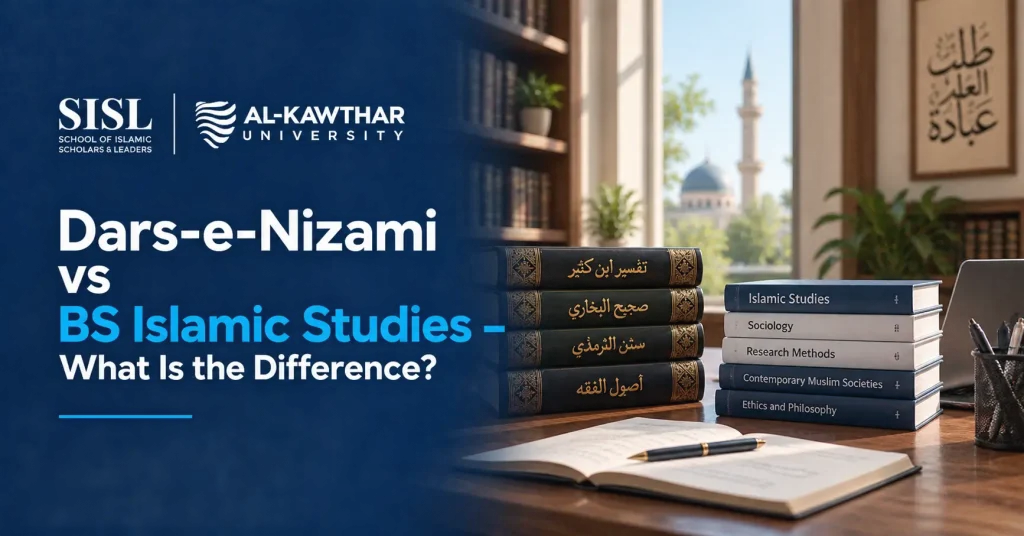
Dars-e-Nizami vs BS Islamic Studies differ in their curriculum, learning methodology, and educational outcomes.
- Dars-e-Nizami: A six-to-eight-year traditional Islamic studies curriculum focused on classical Arabic, Qur’an, Hadith, Fiqh, Usul al-Fiqh, and scholarly transmission through Sanad.
- BS Islamic Studies: A four-year university degree program focused on Islamic history, contemporary issues, research methods, semester-based coursework, and recognised academic qualifications.
Choosing an Islamic education pathway is a decision that shapes how you study, understand, and apply religious knowledge. Many students and families comparing Dars-e-Nizami vs BS Islamic Studies assume both programs follow the same structure because they share a common focus on Islamic learning.
In reality, these two pathways represent different educational traditions. However, at their core, Both paths are connected by the pursuit of knowledge. The Prophet Muhammad (peace be upon him) highlighted the importance of this journey:
“Whoever treads a path seeking knowledge, Allah makes easy for him the path to Paradise.” – (Jami` at-Tirmidhi 2646 )
If you are choosing an Islamic studies path, understanding these differences helps you look beyond the program title and evaluate the curriculum, learning approach, recognition, and opportunities each pathway provides.
Purpose and Educational Philosophy: Different Approaches to Knowledge
To understand Dars-e-Nizami vs BS Islamic Studies, you first need to understand what each program aims to develop. Both study Islam, but they approach learning through different educational traditions.
| Program | Primary Focus |
| Dars-e-Nizami | Textual mastery, legal reasoning, and scholarly responsibility |
| BS Islamic Studies | Academic research, historical understanding, and social analysis |
The Dars-e-Nizami Approach
Dars-e-Nizami is designed to develop scholars who can engage deeply with Islamic texts, understand legal reasoning, and serve their communities through religious guidance.
The curriculum focuses on Arabic mastery, classical texts, spiritual development, and scholarly transmission through teachers.
Students do not study Islamic texts only from a historical perspective. They learn how classical scholars approached interpretation, derived rulings, and addressed religious questions. The Prophet Muhammad (peace be upon him) highlighted the importance of deep understanding of religion:
“When Allah wishes good for someone, He gives him deep understanding (Fiqh) of the religion.” – (Sahih al-Bukhari 71)
The BS Islamic Studies Approach
A BS in Islamic Studies approaches Islamic knowledge through the framework of modern academic study. The program develops skills in research, analysis, and understanding Islamic history, thought, and society through contemporary academic methods.
Rather than focusing on issuing legal guidance or traditional scholarly roles, the degree examines topics such as Islamic civilisation, intellectual history, social development, and contemporary issues.
Understanding the broader difference between traditional madrasa vs university education helps you see how these educational philosophies shape the student experience.
Curriculum Differences Between Dars-e-Nizami and BS Islamic Studies
The biggest difference between both programs appears in how knowledge is organised and studied.
| Program | Curriculum Structure |
| Dars-e-Nizami | Progressive study of classical texts from foundational works to advanced scholarship |
| BS Islamic Studies | Semester-based courses covering Islamic studies, research, and general education subjects |
The Dars-e-Nizami Curriculum
Dars-e-Nizami follows a progressive, text-based sequence over several years. Students study classical books in depth under the guidance of teachers.
| Stage | Areas of Study |
| Early Years | Arabic grammar (Sarf), syntax (Nahw), and classical logic (Mantiq) |
| Intermediate Years | Legal theory (Usul al-Fiqh), jurisprudence (Fiqh), and rhetoric (Balaghah) |
| Advanced Years | Tafsir, comparative jurisprudence, and principles of Hadith (Mustalah al-Hadith) |
| Final Stage | Dawrah-e-Hadith and study of major Hadith collections including Sahih al-Bukhari and Sahih Muslim |
The BS Islamic Studies Curriculum
A BS in Islamic Studies follows a four-year semester system with academic coursework and general education requirements.
| Course Category | Examples |
| Islamic Studies Subjects | Seerah, Islamic Economics, Islamic thought, contemporary Muslim issues |
| General Education | English, mathematics, Pakistan Studies, computer applications, social sciences |
| Research Skills | Academic writing, presentations, and research projects |
Exploring what BS Islamic Studies is provides further detail on how university programs structure these courses.
The Role of Arabic in Dars-e-Nizami and BS Islamic Studies
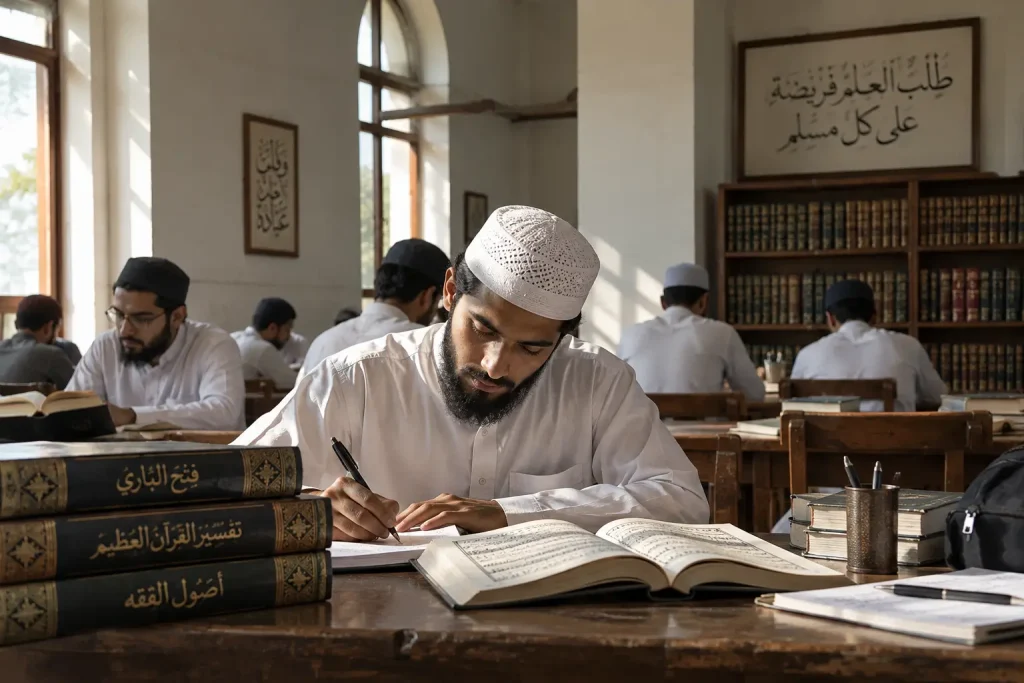
Arabic plays a central role in both programs, but the level and purpose of study differ.
| Program | Arabic Approach |
| Dars-e-Nizami | Intensive study of classical Arabic (Fusha al-Turath) for direct engagement with original texts |
| BS Islamic Studies | Functional Arabic study alongside English or Urdu-based academic learning |
Arabic in Dars-e-Nizami
In Dars-e-Nizami, Arabic is the foundation of scholarship. Students study grammar, sentence structure, and vocabulary to engage directly with classical Islamic texts.
Over time, students develop the ability to read unvowelled Arabic works in areas such as jurisprudence, theology, and Hadith.
Arabic in BS Islamic Studies
In most university programs, Arabic is studied as one part of the broader curriculum. Students develop familiarity with Arabic terminology, Quranic vocabulary, and foundational grammar while using translations and academic resources for wider research.
Teaching Methods: Scholarly Guidance vs Academic Learning
The daily learning environment shapes how students interact with knowledge.
| Program | Learning Environment |
| Dars-e-Nizami | Halqah study circles, peer review (Takrar), and close teacher guidance |
| BS Islamic Studies | Lectures, academic discussions, assignments, and semester assessments |
Learning in Dars-e-Nizami
Traditional Dars-e-Nizami classes often take place in a Halqah format, where students study directly with their teacher through explanation and discussion of classical texts. Students also participate in Takrar, where they review lessons with peers and strengthen their understanding.
This close environment develops not only academic knowledge but also character and discipline through continued interaction with teachers. The Prophet Muhammad (peace be upon him) emphasised the responsibility of preserving and conveying knowledge:
“May Allah brighten the face of a person who hears what I say, retains it, and conveys it as he heard it.” – (Sunan Abi Dawud 3660)
Learning in BS Islamic Studies
University students learn through scheduled lectures, research assignments, presentations, and examinations. The focus is on developing analytical skills, academic writing, and independent study habits through modern educational methods.
Research Methods: Classical Verification vs Academic Research
Both Dars-e-Nizami and BS Islamic Studies involve research, but they train students to approach knowledge through different methods.
| Program | Research Approach |
| Dars-e-Nizami | Textual verification (Tahqiq), narrator evaluation (Ilm al-Rijal), and classical commentary (Hawashi) |
| BS Islamic Studies | Literature reviews, academic analysis, and qualitative or quantitative research methods |
Research in Dars-e-Nizami
Research in Dars-e-Nizami focuses on understanding, verifying, and preserving classical Islamic scholarship. Students develop skills such as:
| Method | Purpose |
| Manuscript Verification (Tahqiq) | Comparing texts to identify variations and establish accurate wording |
| Ilm al-Rijal | Studying narrators and chains of transmission to evaluate reliability |
| Hawashi | Writing explanations and notes to clarify classical discussions |
This method trains students to engage directly with the scholarly tradition and understand how classical scholars approached interpretation and legal reasoning.
Research in BS Islamic Studies
A BS Islamic Studies program uses modern academic research methods to study Islamic history, thought, and society.
| Method | Purpose |
| Literature Reviews | Reviewing existing academic discussions and research |
| Social Research Methods | Studying communities and contemporary issues through interviews, surveys, and analysis |
| Academic Writing | Producing research papers using recognised citation methods |
Exploring what is MS Islamic Studies helps you understand how these research skills continue into postgraduate study.
Accreditation and Qualifications: Sanad vs University Degree
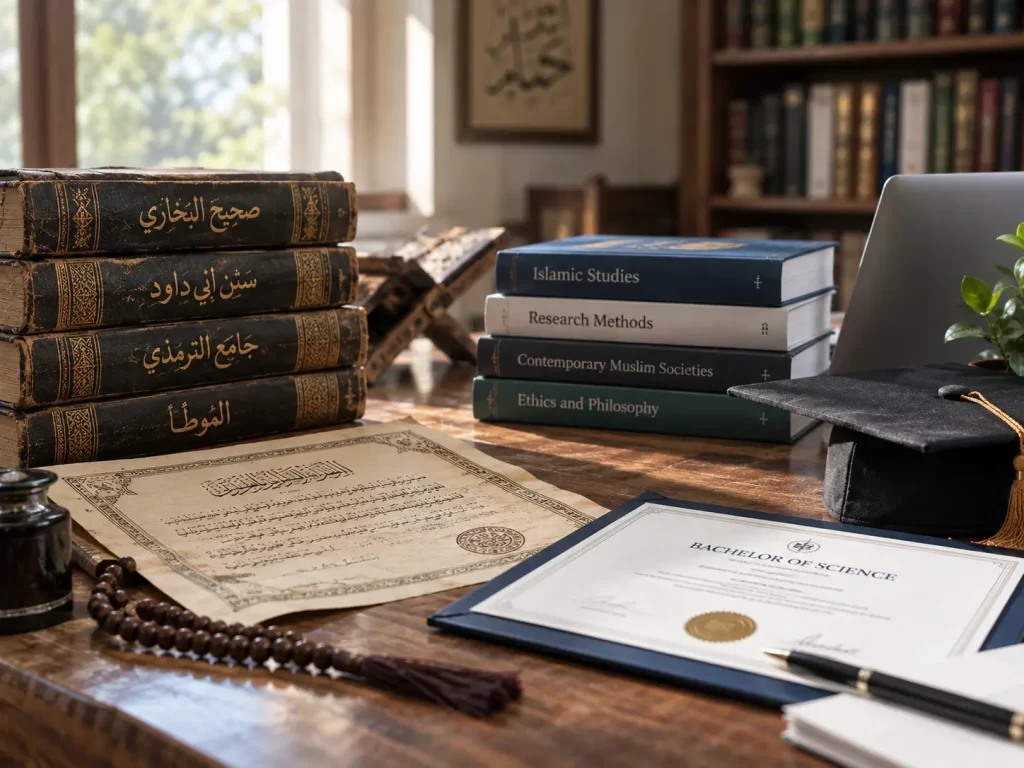
Understanding how each qualification is recognised helps you evaluate the long-term opportunities associated with each pathway.
| Qualification | Recognition Framework |
| Dars-e-Nizami | Shahadat-ul-Alimiyyah, issued through recognised seminary boards with Sanad transmission |
| BS Islamic Studies | University degree recognised through the higher education system |
The Dars-e-Nizami Qualification
After completing Dars-e-Nizami, students sit examinations through recognised seminary boards such as Wifaq-ul-Madaris. Successful completion leads to the Shahadat-ul-Alimiyyah, along with the traditional scholarly chain of transmission (Sanad or Ijazah).
The Sanad represents a connection between students, teachers, and the wider scholarly tradition. Understanding what Wifaq certification is provides more detail on how traditional seminary examinations are organised.
The BS Islamic Studies Qualification
A BS in Islamic Studies is awarded by a chartered university and follows the recognised semester-based degree system.
The qualification provides a formal academic record through credit hours, examinations, and transcripts. It also supports progression into postgraduate education and professional pathways that require university credentials.
Understanding the difference between sanad and university degree highlights how each qualification serves a different purpose.
Connecting Traditional and Academic Recognition
A Dars-e-Nizami graduate may pursue academic equivalence through the relevant regulatory process. This allows traditional scholars to access wider academic pathways while preserving their classical training.
Choosing Between Dars-e-Nizami and BS Islamic Studies
The choice between Dars-e-Nizami vs BS Islamic Studies depends on the type of learning experience and future contribution you want to pursue.
| If You Want To… | Choose… |
| Develop deep Arabic ability and engage directly with classical texts | Dars-e-Nizami |
| Study Islamic thought through academic research methods | BS Islamic Studies |
| Combine classical scholarship with modern academic skills | An integrated approach |
Dars-e-Nizami offers deep engagement with the classical Islamic sciences through Arabic, traditional texts, and scholarly guidance. A BS in Islamic Studies develops research abilities, academic understanding, and recognised university qualifications.
However, you do not have to view these as competing choices. Combining both approaches allows you to preserve the depth of traditional scholarship while gaining the skills needed to engage with contemporary institutions and challenges.
For students seeking to build a strong foundation in Islamic knowledge while preparing for broader academic and professional roles, an integrated model provides the opportunity to benefit from both educational traditions.
Program Duration and Admission Requirements
The time required to complete your education depends on the pathway you choose and when you begin your studies.
| Program | Duration | Typical Entry Point |
| Dars-e-Nizami | 6 to 8 years | After Matric, O-Levels, or Hifz (typically ages 15–16) |
| BS Islamic Studies | 4 years (8 semesters) | After Intermediate or A-Levels (typically ages 18–19) |
Starting Dars-e-Nizami
A complete Dars-e-Nizami program generally takes six to eight years. The duration depends on your prior Arabic preparation. Students with limited Arabic background may begin with preparatory language studies before moving into the main curriculum.
Many students enter after completing Hifz or secondary education. Starting at this stage allows students to build Arabic foundations before progressing into advanced Islamic sciences.
Planning your education through Islamic education after matric or O Levels helps you understand the available pathways.
Starting BS Islamic Studies
A BS in Islamic Studies follows a four-year semester-based university structure. Students typically enter after completing twelve years of formal education through Intermediate or A-Levels. Admission requirements vary by institution and may include academic eligibility criteria and entrance assessments.
Dars-e-Nizami vs BS Islamic Studies: Complete Comparison
The following table highlights the major differences between both educational pathways:
| Area | Dars-e-Nizami | BS Islamic Studies |
| Primary Goal | Classical text mastery, scholarly training, and legal reasoning | Academic study, research, and analysis of Islamic thought |
| Language | Classical Arabic (Fusha al-Turath) immersion | English, Urdu, or functional Arabic |
| Duration | 6 to 8 years | 4 years (8 semesters) |
| Curriculum Style | Sequential study of classical texts | Semester-based courses and credit hours |
| General Education | Limited focus on modern academic subjects | Includes English, mathematics, computing, and Pakistan Studies |
| Learning Environment | Halqah study circles and Takrar | Lectures, assignments, and academic research |
| Qualification | Shahadat-ul-Alimiyyah with Sanad | Chartered BS degree |
| Entry Point | Post-Matric, O-Levels, or Hifz | Post-Intermediate or A-Levels |
| Recognition | Requires equivalence procedures where applicable | Direct university recognition |
Career Opportunities After Dars-e-Nizami and BS Islamic Studies
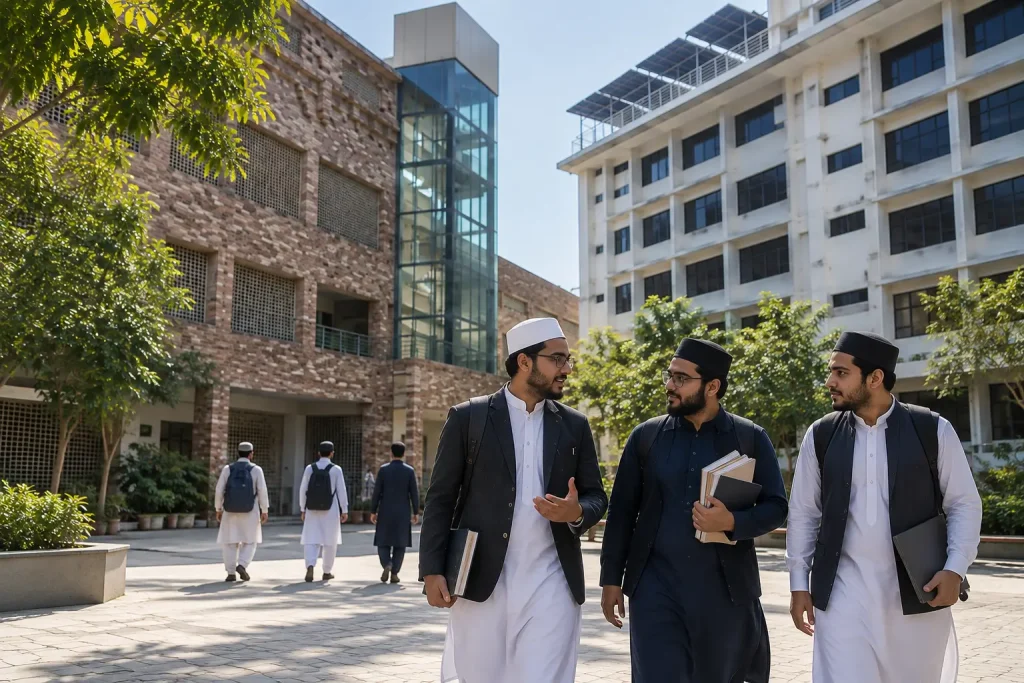
Both pathways prepare students for meaningful contributions, but they generally lead toward different professional environments.
| Pathway | Common Career Areas |
| Dars-e-Nizami | Religious teaching, mosque leadership, Ifta, and community guidance |
| BS Islamic Studies | Education, research, civil service, and academic careers |
| Combined Skills | Islamic banking, Shariah compliance, publishing, and community organisations |
Career Paths After Dars-e-Nizami
Dars-e-Nizami graduates are trained for roles connected with traditional Islamic scholarship. Common pathways include:
- Teaching Islamic Sciences:
Teaching subjects such as Arabic, jurisprudence, and Hadith within Islamic institutions.
- Mosque Leadership:
Serving as an Imam, Khateeb, and community educator.
- Specialised Jurisprudence (Ifta):
Pursuing advanced training to develop expertise in issuing legal opinions.
- Community Guidance:
Helping individuals and families with religious and social matters.
Career Paths After BS Islamic Studies
A BS Islamic Studies degree prepares students for academic and institutional roles.
Potential pathways include:
- School Education:
Teaching Islamic Studies, ethics, and related subjects.
- Civil Service:
Pursuing government examinations and administrative careers.
- Research Organisations:
Working with research institutions, NGOs, and policy organisations.
- University Academia:
Continuing into MS, MPhil, and PhD programs.
Fields Requiring Both Skill Sets
Some areas benefit from professionals who understand both classical Islamic scholarship and modern institutional systems.
Islamic banking, Shariah auditing, and Halal certification require knowledge of Islamic commercial law (Fiqh al-Mu’amalat) alongside modern finance, accounting, and regulatory frameworks.
Why Students Seek an Integrated Islamic Education
Both Dars-e-Nizami and BS Islamic Studies offer valuable strengths.
| Dars-e-Nizami Strengths | BS Islamic Studies Strengths |
| Classical Arabic understanding | Academic research skills |
| Direct scholarly transmission (Sanad) | Contemporary social understanding |
| Deep legal and textual knowledge | Recognised academic qualification |
Studying either pathway alone provides important knowledge, but each also has areas where the other approach adds value.
A Dars-e-Nizami graduate may have deep textual understanding while needing further development in academic research methods or institutional settings.
A BS Islamic Studies graduate may have strong analytical skills while requiring additional training to independently engage with advanced classical Arabic texts.
This is why many students explore options such as studying Dars-e-Nizami and university together to learn how to combine Islamic and modern education.
Bringing Classical Scholarship and Modern Education Together
The School of Islamic Scholars & Leaders (SISL) brings together both educational traditions through its Islamic Scholar & Leaders Program (ISLP).
| Program Feature | What It Provides |
| Dual Qualification | Dars-e-Nizami studies alongside an HEC-recognised BS Islamic Studies degree |
| Classical Scholarship | Study of Arabic, Qur’an, Hadith, Fiqh, Usul, and other Islamic sciences |
| Modern Skills | Academic writing, communication, leadership, and research development |
| Digital Research | Modern tools for accessing and verifying scholarly sources |
This approach allows you to develop classical depth while gaining the academic skills required to engage with contemporary institutions and challenges.
Building a Foundation for Your Future
Dars-e-Nizami vs BS Islamic Studies is not simply a comparison between two qualifications. It is a comparison between two approaches to developing knowledge.
Dars-e-Nizami provides deep engagement with classical Islamic scholarship, while BS Islamic Studies develops academic research skills and broader institutional understanding.
For students who want both classical depth and modern academic preparation, an integrated approach creates an opportunity to develop both without leaving either tradition behind.
By choosing an educational path aligned with your goals, you can build the knowledge, skills, and character needed to serve your community with confidence and responsibility.
“Indeed, the scholars are the inheritors of the Prophets. The Prophets did not leave behind dinars or dirhams, but they left behind knowledge, and whoever takes it has taken a bountiful share.” – (Jami` at-Tirmidhi 2682)
Frequently Asked Questions
Is Dars-e-Nizami harder than a BS in Islamic Studies?
Both programs require different types of commitment. Dars-e-Nizami requires intensive Arabic study, memorisation, classical text analysis, and continuous review. A BS in Islamic Studies requires academic writing, research assignments, presentations, and semester-based evaluation.
Can a BS Islamic Studies graduate become a Mufti?
A BS Islamic Studies degree alone does not qualify someone as a Mufti. Advanced jurisprudential training requires deep study of classical Arabic, legal theory, and specialised Ifta education.
Does Dars-e-Nizami automatically qualify someone for CSS?
A Dars-e-Nizami qualification may require academic equivalence procedures before meeting eligibility requirements for certain examinations.
Can you study Dars-e-Nizami and university together?
Combining both pathways requires careful planning because their structures differ. Integrated programs allow students to pursue classical scholarship alongside university education within one academic framework.