An MS in Islamic Studies is a postgraduate research degree completed after a 16-year bachelor’s qualification or recognised equivalent. It typically includes:
- Duration: Around 1.5 to 2 years.
- Credit Hours: Usually 30 to 36 credit hours.
- Research Focus: Qualitative and quantitative research methods.
- Core Study Areas: Classical Arabic textual analysis, contemporary Islamic thought, and socio-religious ethics.
- Thesis: An independent master’s research thesis or equivalent research project.
- Progression: Prepares graduates for PhD study, university teaching, research, public policy, and related professional roles.
Finishing a bachelor’s degree or advanced seminary study often changes the kind of questions you start asking.
You may no longer be looking for a broad introduction to Islamic subjects. Instead, you may want to investigate a specific issue in depth, work closely with primary sources, publish academic research, or prepare for teaching and further study.
That is where understanding what is MS Islamic Studies becomes useful. Postgraduate Islamic studies expects you to move beyond absorbing established material and begin developing research questions, comparing scholarly positions, and building arguments that can stand up to academic scrutiny.
The Quran captures the continuing pursuit of knowledge in the supplication:
“And say: My Lord, increase me in knowledge.” – (Surah Taha 20:114)
If you’re choosing an Islamic studies path, an Islamic studies research degree may be worth considering if you want your next stage of study to focus on original inquiry rather than another general survey of the field.
How an MS in Islamic Studies Is Usually Organised
Once you move into postgraduate Islamic studies, the way you study changes noticeably. Undergraduate courses introduce you to a wide range of subjects, while an MS asks you to narrow your focus, work more closely with research, and spend greater time examining particular questions in depth.
Under HEC’s current framework for Islamic Studies, the MS/MPhil programme has a minimum academic requirement of 30 credit hours. A common model includes 24 credit hours of coursework followed by at least 6 credit hours of research or thesis work.
The minimum completion period is three regular semesters, or 1.5 years, although individual universities may spread the programme across a longer period. A typical progression may look like this:
| Stage | Main Academic Focus |
| Early Semesters | Advanced research methods and graduate-level Islamic Studies courses |
| Later Coursework | Specialised subjects based on your chosen area of study |
| Research Stage | Proposal development, source review, research, and thesis writing |
| Final Assessment | Thesis evaluation and defense according to university requirements |
The exact course sequence varies between universities, so you shouldn’t expect every MS programme to follow the same semester-by-semester plan.
If you’ve already explored what is BS Islamic Studies, the difference becomes easier to see. A bachelor’s degree gives you broad exposure across Islamic Studies, while an Islamic studies research degree asks you to concentrate on a narrower academic area and investigate it in far greater depth.
What Subjects Do You Study at MS Level?
The MS Islamic Studies subjects you encounter depend partly on the university and partly on the area you choose to pursue.
HEC’s current curriculum includes advanced research methodology, the history and methods of Ijtihad, and critical study of Orientalism, alongside courses selected from a student’s area of specialisation.
Depending on the programme, your studies may also include areas such as:
- Quran and Uloom al-Quran
- Hadith and Uloom al-Hadith
- Fiqh and Islamic jurisprudence
- Seerah studies
- Islamic thought and civilisation
- Comparative religion
- Islamic finance
- Contemporary social, political, and ethical questions
At this stage, the expectation goes beyond learning established definitions or reproducing textbook explanations.
You’re expected to compare arguments, examine how scholars reached their conclusions, question the strength of available evidence, and develop your own academically supported position.
Research Methods Become a Major Part of Your Studies
Research methodology sits at the centre of an MS programme because your degree eventually requires you to investigate a question independently. You learn how to:
- Develop a focused research question
- Locate and assess primary and secondary sources
- Compare classical and contemporary scholarship
- Use qualitative, quantitative, or mixed research methods where appropriate
- Conduct textual, historical, or field-based analysis
- Reference academic sources accurately
- Present your findings in formal academic writing
The method you use depends on your research question.
A student studying a classical Tafsir work may rely heavily on textual analysis and Arabic sources. Someone researching Muslim attitudes towards artificial intelligence may use interviews or surveys alongside existing scholarship.
A project in Islamic finance may examine legal texts, contemporary regulations, and current financial practices. That variety is one of the main differences between higher Islamic studies at university level and earlier subject-based learning.
Specialisation Gives Your Degree a Clearer Direction
An MS also gives you greater freedom to concentrate on the area of Islamic Studies that interests you most.
You may focus on:
- Quranic Studies
- Hadith
- Fiqh
- Seerah
- Islamic thought
- Comparative religion
- Islamic finance
- Another area offered by your university.
Your coursework then provides the academic background needed for the research question you eventually pursue.
Someone interested in bioethics, for example, may study how Islamic legal principles interact with questions surrounding medical technology.
Your specialisation therefore shapes far more than the title of your thesis. It influences the sources you read, the academic conversations you enter, and the expertise you begin developing.
What Is Expected From the MS Thesis?
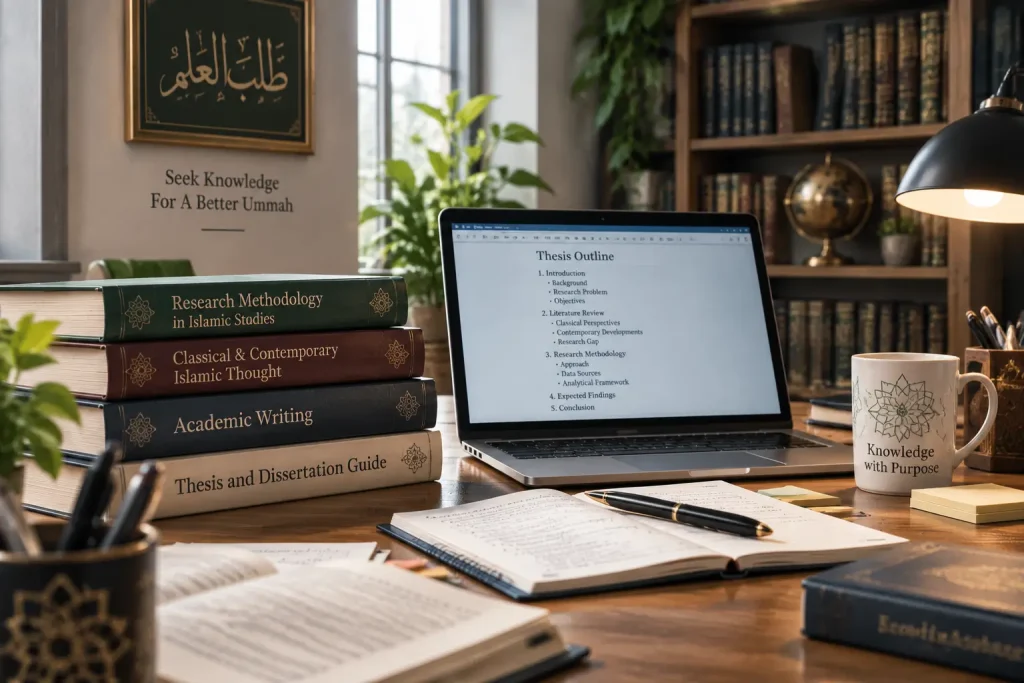
For many students, the thesis is the biggest change between undergraduate and postgraduate study.
You’re no longer completing an assignment where the question has already been chosen for you. You need to identify a research problem, explain why it deserves investigation, review what other scholars have already written, select an appropriate research method, and develop a supported conclusion.
A typical research process includes:
- Choosing a Research Area:
Identifying a subject you want to investigate in greater depth.
- Narrowing the Question:
Turning a broad interest into a question that is realistic for postgraduate research.
- Preparing a Proposal:
Explaining your question, research method, sources, and intended contribution.
- Reviewing Existing Scholarship:
Establishing what has already been written and where your research fits.
- Conducting the Research:
Analysing texts, documents, interviews, surveys, or other relevant evidence.
- Writing the Thesis:
Presenting your argument, findings, evidence, and conclusions in formal academic form.
- Evaluation and Defense:
Completing the assessment process required by your university.
Exact thesis length and evaluation procedures differ between institutions, so there isn’t one identical defense format followed by every MS Islamic Studies programme.
Choosing a Research Question You Can Actually Investigate
A strong thesis begins with a question specific enough to research properly.
“Islamic finance” would be far too broad for a master’s thesis. A more focused project might examine how a particular Shariah principle applies to a defined financial product, market, or regulatory issue.
The same principle applies to:
- Quranic Studies
- Hadith
- Islamic history
- Ethics
- Contemporary thought.
Your research should engage seriously with pre-existing scholarship while making a clear contribution independently.
That contribution doesn’t need to transform the entire field. It may offer a new comparison, analyse an overlooked source, apply an established framework to a new issue, or bring new evidence into an existing discussion.
Research Requires Careful Source Verification
Islamic Studies research often involves claims about revelation, history, scholarship, law, and society, which makes source verification especially important.
The Quran instructs believers:
“O you who have believed, if there comes to you a disobedient one with information, investigate, lest you harm a people out of ignorance and become, over what you have done, regretful.” – (Surah Al-Hujurat 49:6)
At postgraduate level, careful verification means checking where information comes from, distinguishing primary evidence from later interpretation, citing sources accurately, and representing other scholars’ arguments fairly.
Researchers exploring how scholars combine Islamic and modern education may work across classical sources and contemporary academic literature, which makes careful source handling even more important.
MS Islamic Studies vs Traditional Takhassus
If you already have a background in traditional Islamic education, you may be deciding between an MS and an advanced seminary specialisation such as Takhassus fi al-Ifta. Both take you beyond foundational Islamic study, but they develop different forms of expertise.
| MS Islamic Studies | Traditional Takhassus |
| University research and academic writing | Advanced traditional scholarly study |
| Research methodology and thesis work | Close engagement with classical texts |
| Academic analysis of historical and contemporary questions | Applied study within a chosen Islamic discipline |
| May lead towards PhD research and university academia | May lead towards advanced scholarly or Ifta work |
| Assessed through university academic requirements | Assessed through the seminary’s scholarly system |
What an MS Prepares You to Do
An MS trains you to participate in academic research. You learn how to:
- Examine existing literature
- Compare scholarly approaches
- Develop a research method
- Write for academic audiences
- Produce an independent thesis.
That background is especially relevant if you want to continue a PhD, work in university research, contribute to academic publications, or examine Islamic questions through history, sociology, law, ethics, economics, or other academic fields.
What a Traditional Takhassus Focuses On
A Takhassus takes place within the traditional Islamic scholarly pathway and focuses deeply on a particular discipline.
In Takhassus fi al-Ifta, for example, students work extensively with classical Fiqh texts, legal principles, previous Fatwas, and applied legal questions under qualified scholars. Other specialisations may concentrate on Hadith, Tafsir, Arabic, or another Islamic science.
The Prophet Muhammad (peace be upon him) said:
“When Allah wishes good for someone, He gives him deep understanding of the religion.” – (Sahih al-Bukhari 71)
If you compare Dars-e-nizami vs BS Islamic Studies alongside traditional madrasa vs university education, you’ll see the same broader distinction at the postgraduate level.
The MS develops academic research skills, while a traditional specialisation develops deeper expertise within its own scholarly discipline. Some students eventually pursue both, particularly when their goals involve classical scholarship alongside university research.
Who Can Apply for an MS in Islamic Studies?
If you’re considering higher Islamic studies, your previous qualification determines whether you meet the entry requirements for an MS/MPhil programme. Under HEC’s current Islamic Studies curriculum, the main admission routes are:
| Academic Background | Admission Route |
| BS or equivalent Level 6 qualification in Islamic Studies | Eligible to apply for MS/MPhil Islamic Studies |
| Shahadat-ul-Almiya with recognised equivalence | Eligible to apply |
| Other academic backgrounds | Depends on the university and whether the previous qualification meets its approved admission criteria |
Universities also require an admission test with at least 50% marks or may accept a GRE, HAT General, or equivalent test. Individual institutions may set a higher threshold as part of their own admission process.
If You Have a BS in Islamic Studies
A four-year BS in Islamic Studies gives you the most direct academic route into postgraduate Islamic studies.
You already have the undergraduate background needed to move into advanced coursework and research. Your university may still assess your academic record, admission-test performance, and research interests before offering admission.
If you’re still comparing undergraduate and postgraduate study, what is BS Islamic Studies explains what the earlier degree covers and how it prepares you for advanced research.
If You Have a Traditional Alimiyyah Qualification
A traditional seminary background may also lead into an MS Islamic Studies programme when your final qualification has the required HEC equivalence.
HEC recognises Shahadat-ul-Almiya fil Uloom al-Arabia wal Islamia from approved institutions as equivalent to a corresponding master’s degree in Arabic or Islamic Studies involving 16 years of education for higher-study purposes.
The equivalence process requires the relevant seminary certificates and supporting documentation to meet HEC requirements.
If you’re coming through this route, you may also want to understand what is Wifaq certification and the difference between sanad and a university degree before planning your postgraduate application.
What If Your Bachelor’s Degree Is in Another Subject?
A degree in Engineering, Business, Computer Science, or another unrelated field doesn’t automatically qualify you for an MS in Islamic Studies under the current HEC Islamic Studies curriculum.
Admission policies differ between universities, and any route from another discipline depends on the institution’s approved criteria and how it evaluates your previous academic preparation.
If you’re considering a major change of field, contact the department directly before assuming that a set of deficiency courses will make you eligible.
Planning the Route to Postgraduate Study
Most students only start thinking seriously about an MS once they’re close to finishing their bachelor’s degree, but the qualifications you choose earlier influence the routes available later.
A student following the local education system may move from Matric and Intermediate into a BS Islamic Studies programme before progressing to an MS. Someone coming through the Cambridge system will need the relevant equivalence documentation before entering recognised university education in Pakistan.
BS vs MS vs Traditional Takhassus
If you’re comparing Islamic education pathways, a BS, an MS, and a traditional Takhassus represent different stages and goals.
| Area | BS Islamic Studies | MS Islamic Studies | Traditional Takhassus |
| Academic Level | Undergraduate | Postgraduate | Post-Alimiyyah specialisation |
| Typical Duration | 4 years | Minimum 1.5 years under HEC framework | Varies by institution and discipline |
| Main Focus | Broad Islamic Studies education | Advanced coursework and independent research | Deep traditional study within a chosen Islamic discipline |
| Research | Assignments and undergraduate research | Graduate research and thesis | Depends on the specialisation |
| Qualification | University bachelor’s degree | University MS/MPhil degree | Seminary qualification |
| Common Next Step | MS/MPhil, employment, further training | PhD, research, academic or professional work | Advanced scholarly service or further specialisation |
A Master’s Islamic studies route makes the most sense when your interests are moving towards university research, academic writing, or a focused investigation of Islamic thought and society.
A traditional Takhassus makes more sense when your goal requires deeper training within a particular classical discipline.
What Can You Do After an MS in Islamic Studies?
Your degree doesn’t lock you into one profession. The research, writing, source analysis, and subject expertise you develop may support several academic and professional directions.
Your eventual options also depend on your specialisation, previous education, practical experience, and any additional qualifications required by the role.
1. Continue to a PhD
Doctoral study is one of the clearest academic routes after an MS or MPhil. If you enjoy developing research questions, working independently with sources, and contributing to academic discussions, a PhD allows you to take that work considerably further.
Admission isn’t automatic after completing an MS. Universities set additional requirements for doctoral applicants, including academic performance, admission testing, research proposals, and other criteria.
2. Work Towards University Teaching and Research
An MS or MPhil may form part of the academic preparation required for teaching and research roles in higher education.
You may work on research projects, assist with academic publications, teach within relevant departments where you meet appointment criteria, or continue building the qualifications needed for a longer-term academic career.
If university teaching is your goal, look at the current faculty appointment requirements alongside the degree rather than assuming the qualification alone guarantees a lecturer position.
3. Research, Policy, and Community Organisations
Your research skills may also apply outside universities.
Think tanks, research centres, non-profit organisations, educational organisations, and community institutions may need researchers who understand Islamic thought alongside contemporary social questions.
A thesis focused on family law, education, bioethics, interfaith relations, Muslim communities, or public policy may also give you subject knowledge that supports later research work in the same area.
4. Islamic Finance and Related Research
If you specialise in Islamic commercial law or finance, your research background may support work connected with Islamic banking, financial research, publishing, compliance, or policy analysis.
An MS alone doesn’t make someone a Shariah board scholar or Mufti. Roles involving formal Shariah rulings generally require additional scholarly qualifications and expertise beyond a university research degree.
5. Academic Writing, Editing, and Publishing
If research and writing are among your strengths, publishing offers another direction.
Academic journals, research organisations, educational publishers, and digital platforms need people who can evaluate sources, edit scholarly writing, check references, and communicate difficult ideas clearly.
Students with strong Arabic alongside university research training may also explore translation and editing work involving classical or contemporary Islamic texts.
Combining Classical Scholarship With University Research
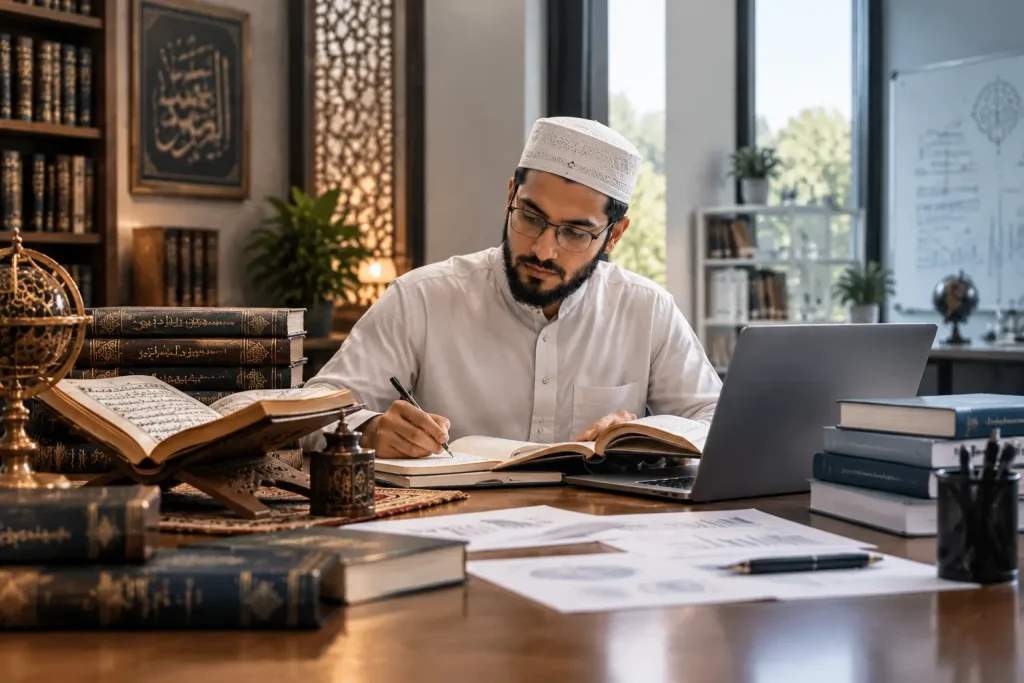
You may reach postgraduate study with strong academic research skills, strong classical training, or some experience of both. Each background shapes the way you approach an Islamic studies research degree.
A student trained through Dars-e-Nizami may already feel comfortable working with Arabic texts, Fiqh literature, or Hadith sources but have less experience with literature reviews, academic citation, or university research methods.
A university graduate may be confident with research papers and contemporary scholarship while needing more time with advanced classical Arabic sources.
Students interested in both paths often ask whether you can study dars e nizami and university together.
Exploring how to combine Islamic and modern education may also be useful if your long-term goal involves classical scholarship alongside academic research.
Is an MS in Islamic Studies the Right Next Step for You?
An MS makes sense when you’re ready to move from broad subject learning into focused research.
You may already have a question you want to investigate, an area of Islamic Studies you want to specialise in, or a longer-term goal involving research, academia, writing, policy, or doctoral study.
If your ambitions lie primarily in advanced traditional scholarship, an MS may not replace the deeper seminary training required for that path. If academic research is where you want to develop, postgraduate Islamic studies provides a clear route into that kind of work.
The Prophet Muhammad (peace be upon him) said:
“When a person dies, his deeds come to an end except for three: ongoing charity, beneficial knowledge, or a righteous child who prays for him.” – (Riyad as-Salihin 1383)
The value of the degree ultimately depends on what you do with the research skills and knowledge you develop.
Choose it because the questions you want to pursue require deeper study, not simply because an MS appears to be the automatic next qualification after your bachelor’s degree.
Frequently Asked Questions
Can an Aalim Apply for an MS in Islamic Studies?
Yes, if the applicant holds recognised Shahadat-ul-Almiya equivalence and meets the university’s admission requirements.
Does an MS in Islamic Studies Make You a Mufti?
No. An MS is an academic research degree. Becoming a Mufti requires specialised traditional training in Ifta under qualified scholars.
Is a Thesis Required for an MS in Islamic Studies?
Under HEC’s current Islamic Studies framework, the standard MS/MPhil programme includes at least 6 credit hours of research or thesis work. Check the university’s approved programme requirements before applying.
Can I Apply With a Degree in Engineering, Business, or Computer Science?
Not automatically. HEC’s current Islamic Studies curriculum specifies an undergraduate qualification in Islamic Studies or recognised Shahadat-ul-Almiya equivalence. Any alternative entry route depends on the university’s approved admission policy.
Can I Pursue a PhD After an MS in Islamic Studies?
Yes, an MS/MPhil may provide the academic foundation for PhD admission, provided you also meet the doctoral programme’s academic, testing, and research requirements.