A BS in Islamic Studies is a four-year undergraduate degree combining classical Islamic subjects with modern university education. It typically includes:
- Duration: Four years across eight semesters.
- Credit Hours: Usually around 124 to 136 credit hours.
- Classical Subjects: Tafsir, Hadith sciences, Fiqh, and other core Islamic disciplines.
- University Subjects: Academic writing, research methods, quantitative reasoning, and social sciences.
- Academic Approach: Islamic scripture, law, civilization, and contemporary thought are studied through formal university methods.
If you’re considering a BS in Islamic Studies, you may be wondering what the degree actually looks like beyond its title. Is it similar to the religious studies you’ve already encountered at school, or does university-level Islamic Studies approach the subject differently?
At undergraduate level, you study Islam through both classical disciplines and modern academic methods. Subjects such as Tafsir, Hadith, Fiqh, Islamic history, and ethics sit alongside research writing, social sciences, computing, and other university requirements.
The pursuit of knowledge also carries deep importance in Islamic tradition. The Prophet Muhammad (peace be upon him) said:
“Whoever treads a path seeking knowledge, Allah makes easy for him the path to Paradise.” – (Jami` at-Tirmidhi 2646)
If you’re choosing an Islamic studies path, understanding how the degree is organised, what subjects you’ll study, and where it may lead academically or professionally will make your decision clearer.
This blog explains the four-year degree format, core subjects, language expectations, credit hours, and how university Islamic Studies differs from other forms of Islamic education.
How a BS in Islamic Studies Is Organised
If you’re considering a BS in Islamic Studies, one of the first things you’ll want to understand is how the degree is organised across four years.
Most programmes follow the university credit-hour system and run across eight semesters. Instead of relying mainly on annual examinations, your progress is measured through semester coursework, assignments, presentations, midterms, finals, and research tasks.
A typical four-year progression looks like this:
| Stage | Main Focus |
| Semesters 1–2 | General education subjects such as English, Mathematics, Computing, and Ethics |
| Semesters 3–4 | Foundation courses in Arabic, Fiqh, Quranic Sciences, and Islamic history |
| Semesters 5–7 | Advanced study in Usul al-Fiqh, Hadith, Tafsir, and contemporary Islamic thought |
| Semester 8 | Research project, thesis, elective study, or internship, depending on the university |
Under HEC-aligned degree frameworks, a BS programme generally falls within a defined credit-hour range, with those credits distributed across general education, foundation subjects, major courses, and final-year research.
How the Credit Hours Are Divided
Your degree usually includes several different types of courses rather than focusing only on Islamic subjects.
- General Education Courses:
English, quantitative reasoning, digital literacy, social sciences, and other university requirements.
- Foundation Courses:
Introductory Arabic, Islamic history, Fiqh, Quranic Sciences, and basic research skills.
- Major Courses:
More advanced study in Tafsir, Hadith, Usul al-Fiqh, Islamic thought, ethics, and related areas.
- Final-Year Research:
A research project or thesis completed under faculty supervision, depending on the programme.
Once you complete the degree, you graduate with a recognised 16-year academic qualification. Understanding what does HEC recognition mean is important because university recognition affects postgraduate admission, employment eligibility, and the formal value of your degree.
What Do You Actually Study in a BS in Islamic Studies?
A BS in Islamic Studies usually combines classical Islamic disciplines with subjects that examine modern intellectual, social, legal, and economic questions.
| Classical Islamic Studies | Applied and Contemporary Areas |
| Tafsir and Quranic Sciences | Islamic Economics and Banking |
| Hadith and Usul al-Hadith | Human Rights and Public Policy |
| Fiqh and Usul al-Fiqh | Islam and Contemporary Thought |
| Seerah and Islamic History | Academic Research Methods |
Most programmes give you exposure to both the classical foundations of the subject and the questions Muslims face in modern academic and social settings.
1. Classical Islamic Sciences
A major part of your degree focuses on the core disciplines that have shaped Islamic scholarship for centuries.
Quranic Sciences and Tafsir
You’ll study how the Quran was preserved and transmitted, the principles scholars use when interpreting revelation, and selected classical and contemporary Tafsir works.
The aim is to understand not only what a verse says, but also how scholars approach language, context, interpretation, and differing scholarly views.
Hadith and Usul al-Hadith
Hadith courses introduce you to the terminology used by Hadith scholars, methods of evaluating narrators, and the principles used to assess reports. You’ll also examine selected Hadith from major collections and learn how scholars analyse meaning, authenticity, context, and application.
Fiqh and Usul al-Fiqh
Fiqh introduces you to Islamic legal rulings, while Usul al-Fiqh focuses on the principles scholars use to derive those rulings from the Quran, Sunnah, and other recognised sources.
Depending on the programme, you may also compare different schools of Islamic law and study legal maxims such as Al-Qawa’id al-Fiqhiyyah.
Seerah and Islamic History
Seerah courses examine the life of the Prophet Muhammad (peace be upon him), including the Makkan and Madinan periods.
Islamic history courses may then take you through the era of the Rightly Guided Caliphs and later political, intellectual, and cultural developments across Muslim societies.
The Prophet Muhammad (peace be upon him) said:
“When Allah wishes good for someone, He gives him deep understanding of the religion.” – (Sahih al-Bukhari 71)
For a university student, that deeper understanding develops through reading, discussion, comparison, research, and repeated engagement with both primary and secondary sources.
2. Applied and Contemporary Subjects
A university degree also asks you to consider how Islamic principles relate to questions outside classical textbooks. Depending on the institution, you may study subjects such as:
- Islamic Economics and Finance:
Riba, Gharar, contracts, Islamic banking, and contemporary financial questions.
- Human Rights, Ethics, and Law:
Family law, minority rights, social justice, individual responsibilities, and comparisons with modern legal frameworks.
- Islam and Contemporary Thought:
Secularism, materialism, modern philosophy, bioethics, and other intellectual questions affecting Muslim societies.
These subjects matter if you want to understand how Islamic thought engages with issues beyond the classroom and how scholars respond to questions that arise in law, economics, ethics, public policy, and society.
How Much Arabic Will You Study?
Arabic is one of the biggest areas students ask about before choosing a BS in Islamic Studies. The important point is that Arabic in a university degree usually serves a different purpose from Arabic in a traditional seminary programme.
In many BS programmes, Arabic is taught through a limited number of semester courses. You study enough grammar and vocabulary to engage with selected Islamic texts, Quranic passages, Hadith, and academic material, but the entire degree usually isn’t taught through Arabic.
A typical Arabic component may include:
- Quranic morphology, or Sarf
- Basic Arabic syntax, or Nahw
- Vocabulary used in Quranic and Islamic texts
- Modern Standard Arabic for reading
- Use of Arabic dictionaries and reference works
What Level of Arabic Should You Expect?
Your Arabic classes usually focus on functional reading and comprehension. You may learn:
- How to identify grammatical patterns
- Understand key terms
- Read selected passages
- Use dictionaries when working with Islamic texts.
University courses often rely on a mixture of Arabic originals, translations, academic textbooks, and secondary sources. Lectures and examinations may also take place in English or Urdu. .
That makes the language experience different from a traditional Dars-e-Nizami setting, where students spend far more time working directly with classical Arabic texts. If Arabic proficiency is an important factor in your decision, comparing Dars-e-Nizami vs BS Islamic Studies will make the difference between the two pathways much clearer.
How Research Works in a BS in Islamic Studies
University study doesn’t stop at learning what earlier scholars wrote. You’ll also be expected to investigate questions, compare arguments, work with academic sources, and explain how you reached your conclusions.
Research usually becomes more important as you move into the later semesters of the degree. You may work through a process such as:
| Research Stage | What You Do |
| Literature Review | Read existing books, journal articles, and earlier research |
| Research Method | Choose an appropriate way to investigate your question |
| Analysis | Compare texts, arguments, historical evidence, or collected data |
| Referencing | Cite your sources using an academic citation system |
| Final Research Project | Present an extended piece of independent research |
The Quran also emphasises the importance of verifying information:
“O you who have believed, if there comes to you a disobedient one with information, investigate, lest you harm a people out of ignorance and become, over what you have done, regretful.” – (Surah Al-Hujurat 49:6)
Within university study, careful investigation means learning how to assess sources, distinguish between arguments, document evidence, and avoid making claims without support.
What Research Skills Will You Develop?
As you progress through the degree, you’ll usually work on several academic skills:
- Literature Reviews:
Reading previous research to understand what scholars have already discussed and where further questions remain.
- Textual Analysis:
Examining language, context, argument, and meaning within Islamic and academic texts.
- Academic Referencing:
Learning citation systems such as Chicago or APA so your sources are documented correctly.
- Final-Year Research:
Completing an extended research project under academic supervision.
Those skills become especially important if you plan to continue into postgraduate education. The research expectations discussed in what is MS Islamic Studies build directly on the abilities you begin developing during your bachelor’s degree.
Why the University You Choose Matters
Two students may both graduate with a BS in Islamic Studies yet have quite different academic experiences. The university you choose affects class size, teaching style, Arabic exposure, research opportunities, elective options, and the way classical and contemporary subjects are balanced.
| University Type | What You May Experience | Common Academic Focus |
| Public University | Larger classes and established departments | Islamic history, comparative religion, and broad academic study |
| Private University | Smaller classes and more interdisciplinary options | Islamic Studies alongside areas such as business, media, or technology |
| Faith-Based University | Greater emphasis on Islamic learning and scholar interaction | Classical texts, Arabic, Islamic values, and university-level study |
Public Universities
Public universities often offer established Islamic Studies departments, larger student cohorts, and comparatively affordable tuition. You may encounter a broad syllabus covering Islamic history, comparative religion, Quranic Studies, Hadith, Fiqh, and contemporary issues.
Private Universities
Private institutions may offer smaller classes and more opportunities to combine Islamic Studies with courses from other departments. Depending on the university, you may study subjects connected with media, management, technology, communication, or other professional areas alongside your main degree.
Islamic Universities
Islamic institutions usually place greater emphasis on connecting university education with Islamic learning. You may receive more exposure to:
- Arabic
- Classical texts
- Scholar mentorship
- Religious development
Alongside the academic requirements of a recognised university degree.
Comparing traditional madrasa vs university education is useful here because it influences:
- How you study
- Who teaches you
- How much classical material you encounter
- What kind of academic environment you experience over the next four years.
What Does Your BS Degree Actually Count For?

If you’re considering a BS in Islamic Studies, you’ll naturally want to know what the qualification means outside the classroom.
A four-year BS awarded by a recognised university gives you a formal undergraduate qualification within the higher education system. Your transcript records your courses, credit hours, grades, and GPA, which universities, employers, and other institutions use when assessing your academic background.
A traditional seminary qualification follows a different system.
| University Degree | Traditional Seminary Qualification |
| Four-year undergraduate qualification | Qualification in traditional Islamic scholarship |
| Semester-based credit hours and GPA | Seminary examinations and scholarly assessment |
| Used for university admissions and formal employment | Used within traditional Islamic scholarship and teaching |
| Issued by a recognised university | Issued through a seminary or recognised Islamic board |
Each qualification serves a different purpose. A university degree documents your progress through formal higher education, while a traditional Sanad reflects your study of Islamic sciences through a scholarly learning system.
If you want to understand that difference in more depth, the difference between sanad and university degree explains how both qualifications are recognised within their respective educational settings.
You may also come across Wifaq qualifications while comparing Islamic education options. Understanding what is Wifaq certification makes it easier to see how central madrasa boards examine students and award traditional qualifications.
What Do You Need to Apply for a BS in Islamic Studies?
Because a BS in Islamic Studies is an undergraduate degree, you generally need to complete 12 years of formal education before applying. Your exact admission requirements depend on the university, but students usually enter through one of the following routes:
| Academic Background | Typical Entry Route |
| FA, FSc, I.Com, or ICS | Apply after completing Intermediate |
| Cambridge A-Levels | Apply with the required IBCC equivalence |
| Other recognised qualifications | Considered according to university admission rules |
Some universities may also require an entrance test, aptitude assessment, interview, or another form of admission evaluation.
If You’re Coming From the Local Board System
Students with FA, FSc, I.Com, ICS, or another recognised HSSC qualification may apply once they meet the university’s minimum marks and admission requirements.
Your Intermediate subjects also don’t always need to come from a religious studies background. Students from:
- Science
- Commerce
- Humanities
May still qualify depending on the university’s admission policy. If you’re planning your education earlier, Islamic education after matric explains how your choices after secondary school may affect the route you take into higher education.
If You’re Coming From A-Levels
If you’ve completed Cambridge A-Levels, universities usually require the relevant equivalence documentation from the Inter Boards Coordination Commission (IBCC).
Your A-Level subjects, grades, and equivalence determine whether you meet the university’s undergraduate admission criteria.
Students who are still planning their route after O-Levels may find Islamic education after O-Levels useful when deciding how to continue formal education alongside Islamic learning.
The important thing is to check admission requirements early. Waiting until application season to understand equivalence, subject requirements, or documentation may create avoidable delays.
What Skills Do You Develop During the Degree?
A BS in Islamic Studies gives you more than subject knowledge. Across four years, you spend considerable time:
- Reading
- Researching
- Writing
- Comparing arguments
- Discussing different interpretations
- Presenting ideas clearly.
Those abilities remain useful even if your career eventually takes you beyond a conventional Islamic Studies role. Some of the main skills you may develop include:
- Source Analysis:
Learning how to evaluate historical texts, translations, arguments, and context.
- Academic Writing:
Producing essays, research papers, literature reviews, and referenced assignments.
- Ethical Reasoning:
Examining how Islamic principles relate to contemporary questions.
- Research:
Finding credible sources, comparing scholarly positions, and building evidence-based arguments.
- Communication:
Explaining complex religious and academic ideas to different audiences.
The value of those skills becomes clearer when you look at the careers graduates may pursue.
What Can You Do After a BS in Islamic Studies?
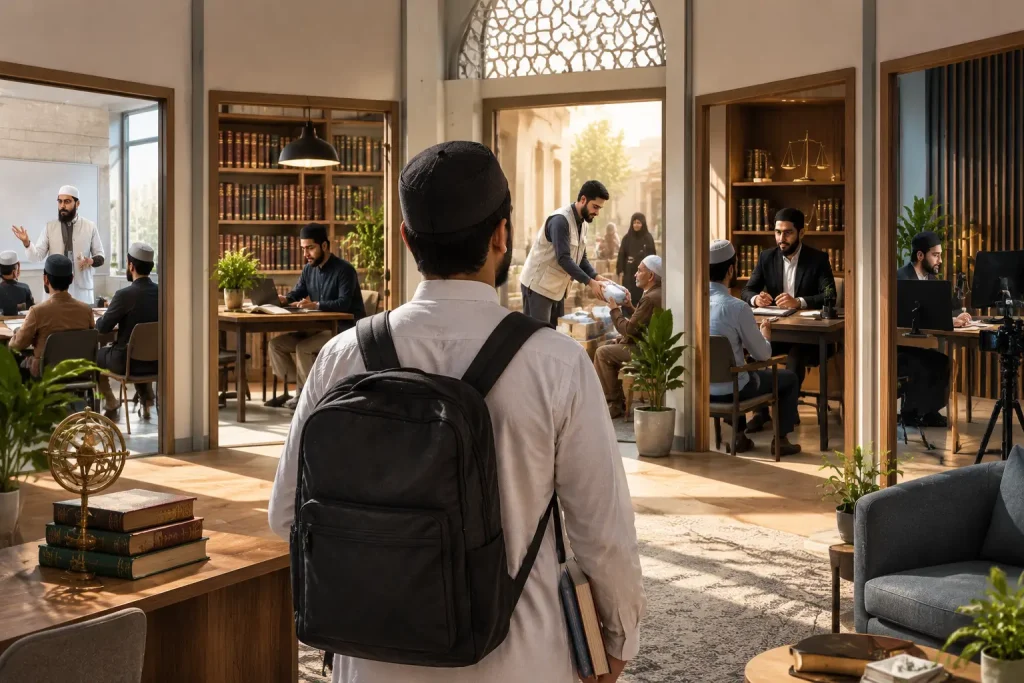
Your career options depend on your electives, additional qualifications, practical experience, and the direction you choose after graduation. A BS in Islamic Studies may lead into several areas.
Education
Teaching remains one of the more familiar routes. Depending on the institution and any additional teaching qualifications required, graduates may work in:
- Schools
- Colleges
- Educational organisations
- Islamic learning programmes.
Your academic background may also prepare you to teach or support subjects such as Islamic Studies, history, civics, or related humanities areas.
Civil Service and Public Administration
A recognised bachelor’s degree may also allow you to apply for competitive examinations where your qualification meets the stated eligibility criteria. Students interested in public administration may explore federal or provincial competitive examination routes after graduation.
Your degree subject doesn’t lock you into religious employment alone. Formal undergraduate education may keep wider public-sector options available depending on the recruitment requirements of the position.
Research and Non-Profit Work
If you enjoy research, writing, social questions, or community development, you may find opportunities in:
- Research organisations
- NGOs
- Charitable foundations
- Policy-focused institutions.
Your ability to analyse ethical, religious, historical, and social issues may prove useful in research support, programme coordination, community education, or related work.
Islamic Finance and Corporate Support
Graduates interested in Islamic finance may explore supporting roles within:
- Shariah compliance
- Islamic banking
- Research
- Publishing
- Corporate social responsibility.
A bachelor’s degree alone doesn’t qualify someone as a Shariah scholar or Mufti, but it may provide an academic foundation for further specialisation.
Postgraduate Study
If academic research interests you, the degree also provides a route into higher education. You may continue into an MS, MPhil, and eventually a PhD, subject to the admission requirements of the university and programme.
Postgraduate study becomes especially relevant if your goal is university teaching, advanced research, or deeper academic specialisation.
Where Does a BS in Islamic Studies Have Limits?
Understanding the strengths of a degree also means being realistic about what four years of university study may not cover in depth.
A BS in Islamic Studies develops academic research skills, introduces major Islamic disciplines, and gives you a recognised university qualification.
It doesn’t automatically provide the same level of classical Arabic immersion associated with several years of traditional seminary study.
| BS Islamic Studies Strengths | Areas That May Need Further Study |
| Academic research and writing | Advanced reading of unvowelled Arabic texts |
| Contemporary social and intellectual analysis | Detailed study of classical Fiqh manuals |
| Recognised university qualification | Advanced Hadith chains and narrator studies |
| Exposure to multiple disciplines | Extended traditional scholarly training |
Both educational models develop different strengths. That difference is one reason students increasingly ask can you study dars e nizami and university together.
For students who want classical Islamic learning alongside a recognised academic qualification, exploring how to combine Islamic and modern education may provide another route to consider.
Is a BS in Islamic Studies the Right Choice for You?
The answer depends on what you want from your education. If you want to study Islam within a university environment while developing research, writing, analytical, and professional academic skills, a BS in Islamic Studies may fit your goals well.
If your main ambition is advanced command of classical Arabic texts, detailed traditional Fiqh, Hadith chains, and later specialisation in areas such as Ifta, you may need deeper seminary training alongside or after university study.
If both outcomes matter to you, an educational pathway that combines university study with traditional Islamic scholarship may deserve serious consideration.
The Prophet Muhammad (peace be upon him) described the lasting value of beneficial knowledge:
“When a person dies, his deeds come to an end except for three: ongoing charity, beneficial knowledge, or a righteous child who prays for him.” – (Sahih Muslim 1631)
Your degree should ultimately take you closer to the kind of contribution you want to make.
Choosing well means looking beyond the degree title and asking what you want to understand deeply, which skills you want to develop, and where you hope your education will take you after graduation.
Frequently Asked Questions
Do I Need to Know Arabic Before Starting a BS in Islamic Studies?
No. Most programmes introduce Arabic from the basics, covering grammar, vocabulary, Quranic terminology, and reading skills.
Can a BS Islamic Studies Graduate Become a Mufti?
No. A BS alone doesn’t qualify you to issue Fatwas. Becoming a Mufti requires advanced traditional study and specialised Ifta training.
Can I Apply for CSS or PMS After a BS in Islamic Studies?
Yes, if your degree meets the current eligibility requirements of the relevant examination authority. Always check the latest criteria before applying.
How Is a BS in Islamic Studies Different From the Old Two-Year BA?
A BS usually runs for four years across eight semesters and includes coursework, research, assignments, and continuous assessment. The older BA generally followed a two-year annual examination model.
Can I Study Subjects Outside Islamic Studies?
Yes, depending on the university. Some programmes offer electives in areas such as Education, Psychology, Political Science, Media, Business, or International Relations.