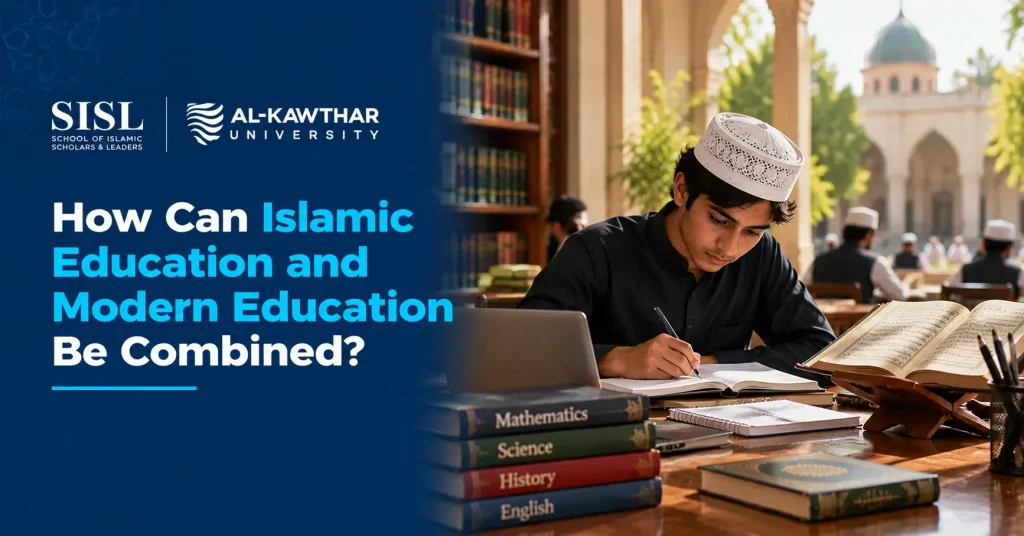
Islamic and modern education can be combined through several study models, depending on how much time you can commit and whether you want to pursue both systems together or separately.
- Sequential model: Complete university before or after traditional seminary studies.
- Parallel self-directed model: Study in a madrasa while sitting college exams privately.
- Modular adult model: Take evening or weekend Islamic diploma courses alongside other commitments.
- Integrated dual-track model: Study Dars-e-Nizami alongside an accredited university degree through one synchronized curriculum.
Islamic and modern education can work together when students follow a learning model that gives serious attention to both. You can study classical Arabic, Fiqh, Hadith, and other Islamic sciences while also developing research skills, earning recognized academic qualifications, and preparing for professional life.
For many students and parents, the challenge is finding an educational pathway that does justice to both goals.
Traditional seminaries offer the depth needed to engage seriously with classical Islamic scholarship, while universities provide academic qualifications, research training, and access to wider professional fields. Choosing one often means giving up important parts of the other.
A student who wants to combine Islamic and modern education does not necessarily have to make that trade-off. Different educational models now allow students to pursue Islamic education with modern education through parallel study, part-time learning, sequential programs, or an integrated curriculum.
The right option depends on how deeply you want to study Islamic sciences, how much time you can commit, and which qualifications you want to hold at the end of your studies. The Quran encourages believers to seek goodness across both their worldly and spiritual lives:
“Our Lord, give us in this world [that which is] good and in the Hereafter [that which is] good and protect us from the punishment of the Fire.” – (Surah Al-Baqarah 2:201)
For students pursuing traditional and modern Islamic education together, the real challenge lies in planning the academic journey well. When choosing an Islamic studies path, you need to look beyond the course titles and consider the workload, timetable, qualifications, language requirements, and long-term academic opportunities attached to each option.
Understanding how both education systems work makes that decision much easier.
Why Islamic and Modern Education Developed Into Separate Paths
Before deciding how to combine the two, it helps to understand why religious and academic education often operate separately.
A traditional seminary and a modern university usually prepare students for different kinds of learning. The seminary concentrates heavily on classical texts, Arabic language, Islamic jurisprudence, and scholarly transmission. The university places greater emphasis on academic research, broader subject exposure, formal qualifications, and professional application.
Both approaches offer valuable skills, but neither automatically provides everything a student seeking balanced Islamic education might want.
| Traditional Seminary | Modern University |
| Classical textual study | Academic research and critical inquiry |
| Advanced Arabic reading | English academic writing |
| Detailed Fiqh study | Multidisciplinary subjects |
| Traditional examination systems | Semester and credit-hour systems |
| Sanad and scholarly training | Recognized university qualifications |
Understanding these differences also explains why simply placing two courses side by side does not automatically create meaningful integration. A student needs enough time, academic support, and progression in both streams for integrated Islamic education to work effectively.
What Traditional Islamic Education Gives You
Traditional Islamic education focuses on developing the skills needed to engage directly with classical scholarship.
Students spend years building proficiency in Arabic grammar, morphology, Fiqh, Tafsir, Hadith, and other Islamic sciences. As their language skills develop, they move from introductory material toward increasingly advanced classical texts.
Personal instruction also plays an important role. Students learn how scholars interpret texts, connect legal principles, work through linguistic details, and understand arguments within the wider Islamic scholarly tradition.
For someone seeking deep religious scholarship, that level of textual engagement is difficult to achieve through occasional Islamic Studies courses alone.
However, many conventional seminary pathways devote less academic time to areas such as modern research methodology, professional English communication, contemporary economics, technology, and other subjects commonly taught through university education.
That gap becomes important for students who want to participate confidently in both scholarly and professional settings.
What Modern University Education Gives You
University education develops a different set of abilities.
Students learn how to research a question, evaluate sources, construct academic arguments, cite evidence, complete projects, and communicate their findings clearly. They also study within broader disciplines that connect their subject to history, society, economics, technology, and contemporary professional practice.
Recognized university qualifications also play an important role for students planning to continue into postgraduate education or enter professions that require formal academic credentials.
However, university-based Islamic Studies usually operates within semester and credit-hour limits. That leaves less time for the intensive Arabic training and repeated engagement with classical texts found in a traditional seminary.
A student studying Islamic studies with university therefore gains a strong academic foundation, but the depth of classical textual training depends heavily on the curriculum.
The comparison between traditional madrasa vs university education becomes useful here. One pathway develops intensive engagement with the classical scholarly tradition, while the other develops research, academic communication, and recognized higher education.
A strong model for integrated Islamic education brings these strengths together through deliberate curriculum planning. Students need enough time to develop genuine competence in the Islamic sciences while also building the academic and professional skills required beyond the seminary.
The Four Models of Combining Islamic and Modern Education
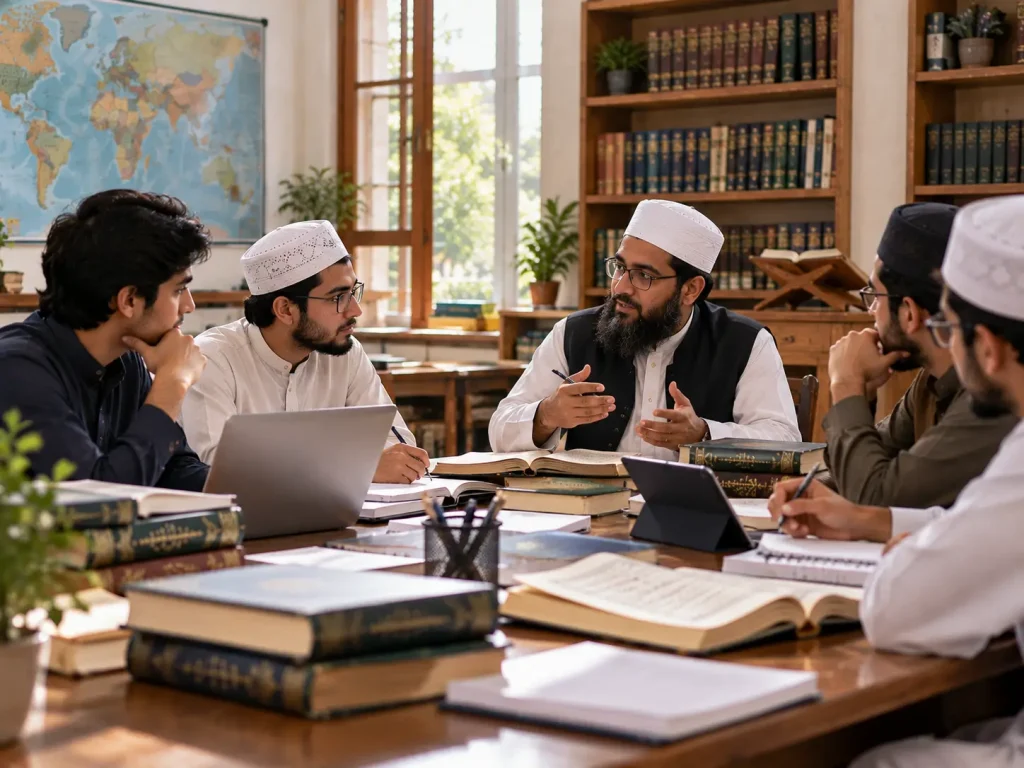
If you are exploring Islamic studies with university education, you will find that there is no single way to combine both. Different students choose different models depending on their goals, available time, preferred learning style, and the qualifications they want to earn.
Some students complete one educational path before moving to the other. Others study both together through parallel or integrated programs. The four common approaches to combining Islamic education with modern education are:
| Four Models of Educational Integration | |||
| Model 1 | Model 2 | Model 3 | Model 4 |
| Sequential Pathway | Self-Directed Parallel Model | Modular Continuing Education | Integrated Dual-Track Model |
| Complete one full-time program before starting the next | Study at a madrasa while completing academic qualifications separately | Continue university or work while studying Islam through flexible courses | Study Dars-e-Nizami alongside an accredited university degree through one system |
The Sequential Model: Completing One Path Before the Other
In the sequential model, you focus on one educational journey at a time.
For example, a student may complete a bachelor’s degree in fields such as business, engineering, or computer science before enrolling in a full-time Dars-e-Nizami program. Another student may complete traditional Islamic studies first and later continue into university education.
Benefits
- You can give full attention to one field without managing two demanding schedules.
- Each stage of learning receives dedicated time and focus.
- Students can approach their second qualification with greater maturity and clarity.
Challenges
- Completing both pathways requires a long-term commitment.
- The combined journey may take many years before both qualifications are completed.
- Career plans and personal responsibilities need careful consideration.
This approach suits students who prefer complete immersion in one learning environment before moving to the next.
The Self-Directed Parallel Model: Managing Two Educational Paths Separately
Some students choose to study traditional Islamic sciences while continuing their academic qualifications independently. In this model, a student may enroll in a madrasa while completing college or university requirements through private examinations or separate institutions.
Benefits
- Students continue their Islamic studies without pausing their academic journey.
- They can work toward both religious and academic qualifications at the same time.
Challenges
- Managing two separate systems requires strong time management.
- Examination schedules, admission requirements, and academic calendars may not always match.
- Students are responsible for coordinating both pathways themselves.
For students wondering can you study dars e nizami and university together, the answer depends largely on how well both systems can be managed alongside each other.
The Modular Continuing Education Model: Learning Alongside Work or Studies
Not every student wants to pause their existing education or career. The modular model allows people to study Islamic sciences through evening classes, weekend programs, or online courses. This approach is common among:
- University students
- Working professionals
- Individuals who want to strengthen their Islamic knowledge alongside another career path
Students may study subjects such as:
- Arabic foundations
- Quranic studies
- Basic Fiqh
- Islamic history
- Introduction to Hadith sciences
Benefits
- Flexible scheduling makes learning accessible.
- Students can continue their existing education or profession.
- It allows gradual development of Islamic knowledge.
Challenges
- Limited weekly hours may not provide the same depth as full-time traditional scholarship.
- Students usually need additional study time outside classes.
- The pathway may not lead to a traditional teaching qualification (Sanad).
This model works well for students seeking a balanced Islamic education alongside other responsibilities.
The Integrated Dual-Track Model: Studying Both Through One Curriculum
The integrated model brings Islamic scholarship and modern education together within a single academic framework.
Instead of managing two separate institutions, students follow a coordinated curriculum where classical Islamic sciences and university subjects are planned together.
An effective integrated Islamic education model considers:
- Daily timetable
- Examination schedules
- Academic workload
- Language development
- Research training
Benefits
- Students study both pathways through a coordinated system.
- Academic and religious learning support each other.
- Students can work toward both traditional and university qualifications.
Challenges
- The workload requires consistent effort and discipline.
- Institutions need qualified teachers for both classical and modern subjects.
- The curriculum must be carefully designed to avoid overloading students.
A successful integrated approach is not simply adding more subjects to a timetable. It requires thoughtful planning so students can develop both religious understanding and academic ability.
How Integrated Islamic Education Is Designed
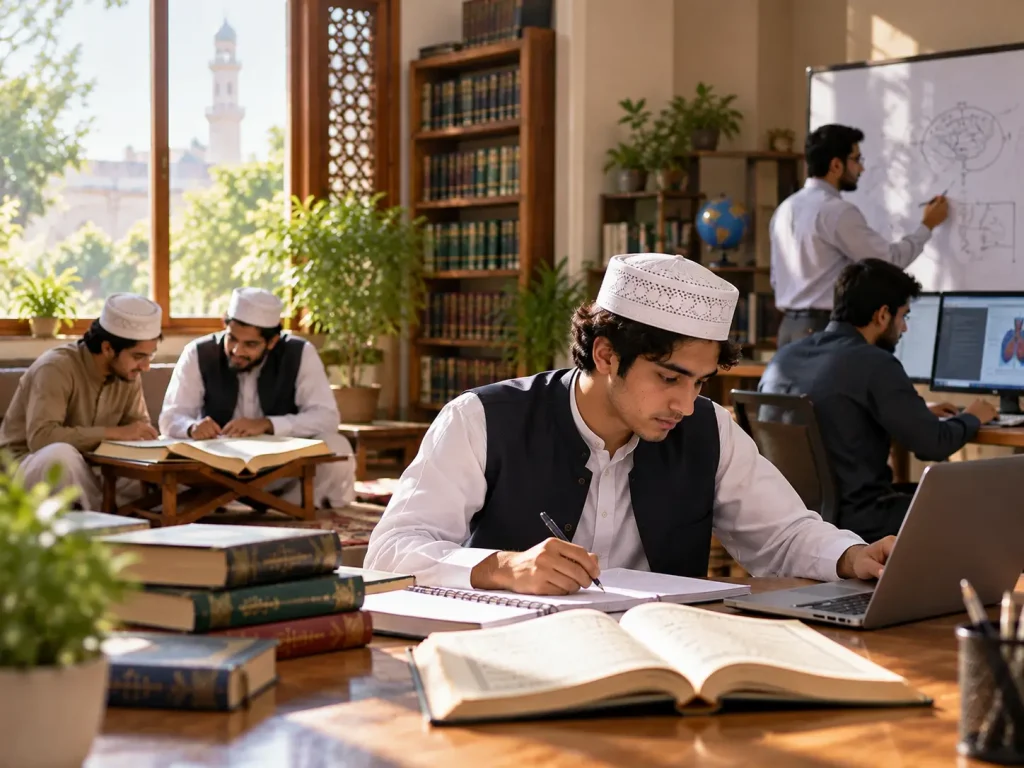
Combining religious and academic education requires more than placing two courses together. A strong model considers how students learn, how much workload they can manage, and how different subjects connect. A typical integrated timetable may include:
| How an Integrated Learning Schedule Works | ||
| Morning | Afternoon | Evening |
| Classical Arabic grammar | Academic research | Review sessions (Takrar) |
| Arabic text analysis | General education subjects | Discussion circles |
| Fiqh studies | Social sciences | Academic projects |
| Hadith methodology | Writing and communication | – |
Balancing Traditional Study With Academic Learning
Classical Islamic education has traditionally relied on repeated reading, discussion, and explanation of texts. Practices such as Takrar help students strengthen understanding by reviewing lessons with peers.
Integrated programs can preserve these traditional methods while also introducing modern academic practices such as:
- Research writing
- Presentation skills
- Academic discussion
- Source evaluation
The comparison between dars e nizami vs BS Islamic Studies highlights why combining both requires careful curriculum planning. Students need enough time for classical text study while also meeting modern academic requirements.
Modern Skills That Support Islamic Scholarship
For students who want to address contemporary questions, religious knowledge works best alongside skills that help them research, communicate, and apply principles in modern contexts. An effective model of traditional and modern Islamic education may include:
| Core Skills for Integrated Scholarship | |||
| Academic Research | Communication Skills | Digital Literacy | Applied Understanding |
| Research methods, citations, and source analysis | Academic writing, public speaking, and discussion | Research databases, digital libraries, and verification tools | Connecting Islamic principles with modern challenges |
Academic Research and Writing
Modern scholarship requires the ability to research questions, evaluate sources, and present arguments clearly. Students benefit from learning:
- Research methodology
- Academic writing
- Citation systems
- Critical analysis
These skills help scholars communicate their work in academic and public settings.
Communication and Public Engagement
Traditional Islamic scholarship has a rich history of teaching through discussion and explanation. Modern environments also require the ability to communicate ideas clearly through different platforms.
Skills such as English writing, presentations, and public speaking help students engage with wider audiences.
Technology and Digital Research
Technology has changed how researchers access information. Digital libraries, online archives, and research tools help students explore a wider range of sources.
Modern tools can support activities such as:
- Searching classical texts
- Comparing references
- Organizing research material
- Reviewing sources
Applying Islamic Knowledge to Modern Issues
Students today face questions connected to finance, technology, medicine, and society.
A strong educational pathway helps students understand how classical principles can be studied alongside contemporary issues.
Learning about areas such as Islamic finance, digital transactions, artificial intelligence, and bioethics requires both traditional knowledge and awareness of modern developments.
Understanding what is BS Islamic Studies helps explain how university-based Islamic education combines religious studies with academic frameworks.
Understanding Credentials: How Sanad and University Degrees Work Together
When you combine Islamic and modern education, one important question often comes up:
How do traditional Islamic qualifications and modern academic degrees work together?
The answer lies in understanding that both systems recognize different types of achievement. A traditional Sanad reflects a student’s journey through classical Islamic scholarship, while a university degree provides a recognized academic qualification used within modern educational and professional systems.
A well-planned approach to Islamic education with modern education considers both forms of recognition.
Dual-Credential Validation
| Traditional Sanad | University Degree |
| Recognizes mastery of classical Islamic texts | Provides a standardized academic qualification |
| Represents a scholarly chain of transmission (Isnad) | Based on academic credits, assessments, and transcripts |
| Granted through qualified scholars or traditional institutions | Awarded through recognized universities |
| Supports teaching, scholarship, and religious leadership roles | Supports higher education, professional careers, and civil opportunities |
1. Understanding the Traditional Sanad and Isnad
A classical Sanad represents a connection between a student and the scholars through whom Islamic knowledge has been transmitted.
Through years of study, students learn classical texts under qualified teachers and develop expertise in areas such as:
- Arabic
- Fiqh
- Hadith
- Other Islamic sciences.
Within traditional scholarly settings, a Sanad recognizes a person’s preparation to teach Islamic texts, contribute to religious education, and participate in scholarly work.
2. Understanding the University Degree
A university degree follows a different academic framework.
It documents a student’s completion of a defined curriculum through credit hours, assessments, research projects, and examinations. These qualifications are commonly used for postgraduate education, professional opportunities, and institutional requirements.
Understanding the difference between sanad and university degree helps explain why some students choose pathways that provide both forms of recognition.
3. Meeting Recognition and Regulatory Requirements
Students pursuing Islamic studies with university education need to understand how both systems operate.
Traditional Islamic institutions often follow examination boards and scholarly frameworks. For example, learning about what is Wifaq certification helps students understand how traditional examinations and certifications are organized.
For university qualifications, understanding what does HEC recognition mean helps students evaluate whether a degree meets higher education requirements. Planning both sides early reduces administrative challenges later.
Planning Your Education Journey After Secondary School
Combining religious and academic education becomes easier when students plan their pathway early.
The decisions made during secondary education affect future options, especially when applying for universities, professional programs, or advanced Islamic studies.
Common Secondary Education Pathways
| Pathway | Next Step |
| Local Board (BISE) | Complete required Matric subjects and continue toward Intermediate education |
| Cambridge Stream (GCE) | Complete O-Level subjects and obtain IBCC equivalence before moving into higher studies |
Transitioning From Local Board Education
Students coming from local schools usually already follow Pakistan’s national education system.
If you plan to combine madrasa studies with further academic education, ensure your required subjects remain complete and your academic documents stay updated.
Students exploring options after local schooling can learn more through Islamic education after matric.
Transitioning From Cambridge O Levels
Cambridge students have an additional step before entering many Pakistani higher education pathways.
Pakistani passport holders usually need to complete IBCC equivalence requirements, including the required compulsory subjects.
Students planning Islamic education after O Levels should organize their documents early so they can move smoothly into their next academic stage. More information about this pathway is available through Islamic education after O Levels.
Comparing Different Models of Combining Islamic and Modern Education
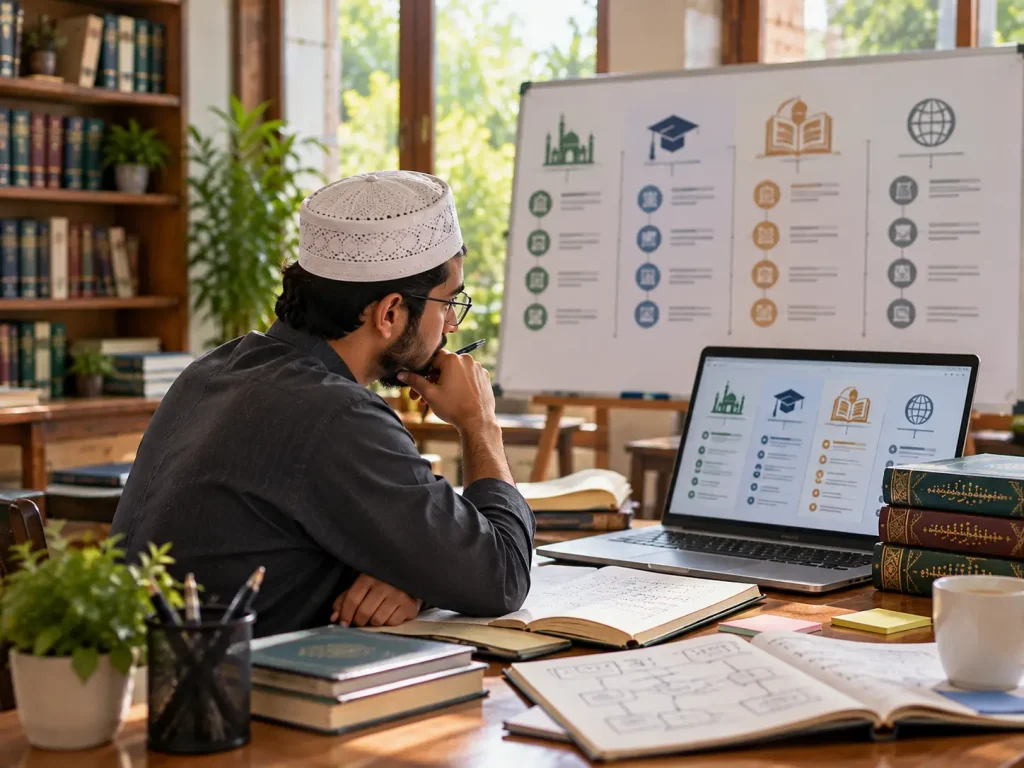
Different pathways create different balances between traditional scholarship, academic learning, time commitment, and qualifications.
| Educational Model | Islamic Learning Depth | Academic Development | Completion Timeline | Main Qualifications |
| Sequential Model | Moderate to high depending on the pathway | Strong university-level skills | 10–14 years | University degree + Traditional Sanad |
| Parallel Model | High through full-time madrasa study | Depends on independent academic study | 6–8 years or longer | Sanad + academic qualifications |
| Modular Model | Introductory to moderate | Strong professional focus | Flexible / ongoing | Islamic course certificates |
| Integrated Dual-Track Model | Complete Dars-e-Nizami pathway | Accredited university education | Around 8 years | Traditional Sanad + BS Degree |
The right choice depends on your goals, available time, and the level of Islamic scholarship you want to pursue.
How Integrated Islamic Education Works in Practice
An integrated approach brings classical Islamic studies and modern academic learning together through one coordinated system.
The goal is not simply to add more subjects. A successful model carefully plans the timetable, workload, and progression of both areas.
Example of an Integrated Curriculum
| Classical Islamic Studies | Modern Academic Studies |
| Classical Arabic grammar | Academic research methods |
| Advanced legal theory (Usul al-Fiqh) | Social sciences and contemporary subjects |
| Hadith analysis | Professional English writing |
| Traditional Sanad pathway | Recognized BS degree requirements |
At the School of Islamic Scholars & Leaders (SISL) in Karachi, the Islamic Scholar & Leaders Program (ISLP) follows this integrated approach by combining the classical Dars-e-Nizami curriculum with a BS in Islamic Studies recognized by the Higher Education Commission (HEC).
The program is designed for students who want to pursue traditional and modern Islamic education together within one academic framework.
1. Completing Both Qualifications Together
Instead of managing two separate institutions, students in an integrated model follow one coordinated academic system. They study classical Islamic sciences while completing university requirements through the same educational structure. This approach helps students work toward:
- Traditional Islamic qualification (Sanad)
- University degree requirements
- Research and communication skills
- Broader academic preparation
2. Combining Classical Scholarship With Modern Research Skills
Modern tools and research methods can support students studying classical Islamic texts. Students learn how to:
- Use digital research resources
- Organize academic references
- Evaluate sources
- Present research findings clearly
Alongside Islamic scholarship, skills in leadership, communication, and academic writing help graduates engage with wider professional and academic environments.
This combination prepares students for advanced studies such as what is MS Islamic Studies.
Building a Balanced Future Through Integrated Learning
Combining Islamic and modern education gives students a pathway to develop both religious understanding and contemporary skills. The right approach depends on your goals.
Some students may choose university education alongside part-time Islamic studies. Others may dedicate themselves to traditional scholarship. Some may prefer an integrated model that brings both systems together.
A strong educational pathway allows students to preserve the depth of classical Islamic learning while developing the research, communication, and academic skills needed in modern society.
By understanding the available options and planning carefully, students can pursue Islamic education with modern education in a way that supports both personal growth and future opportunities.
Frequently Asked Questions
Can a medical or engineering student learn classical Arabic?
Yes. Students from professional backgrounds can develop Arabic skills through structured courses, evening programs, and focused learning plans.
Does combining Islamic and modern education reduce the depth of Dars-e-Nizami?
A well-designed integrated program does not have to reduce the depth of Islamic studies. The outcome depends on curriculum planning, teaching quality, available study time, and how effectively both educational goals are coordinated.
Can graduates of integrated programs apply for professional opportunities?
If the university qualification meets required recognition standards, graduates can use it for opportunities that require an accredited degree. Career options depend on the specific qualification, skills, and professional requirements of each field.
What careers are available with combined Islamic and modern education?
Students with both religious and academic training can explore diverse career paths, including Islamic education, academic research, Shariah advisory roles, Islamic finance, policy and community leadership, teaching, and institutional development.