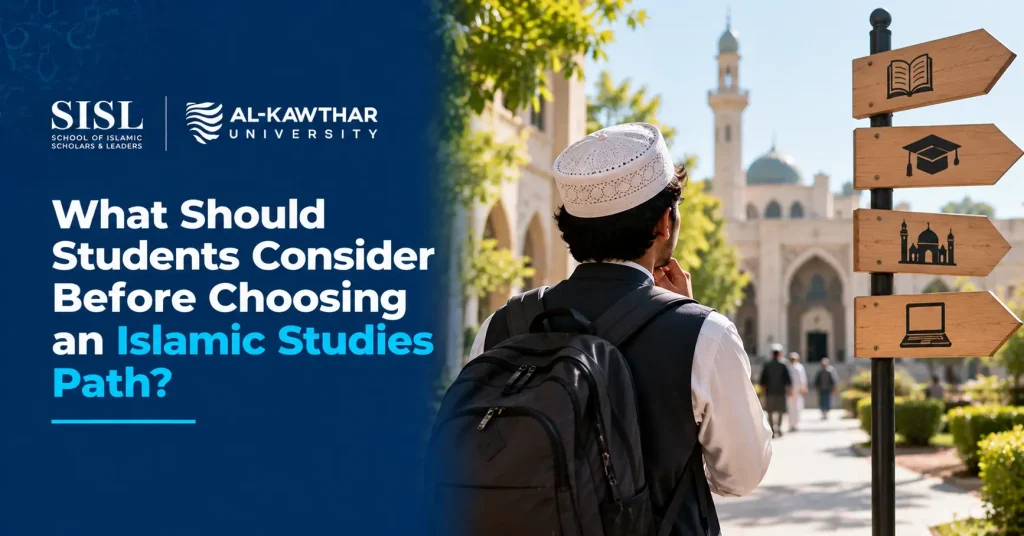
Choosing an Islamic studies path requires careful consideration of your goals, learning preferences, and future plans. Before enrolling, evaluate these key factors:
- Educational Goal: Decide whether you want devotional understanding, advanced scholarly text study, or academic research.
- Arabic Learning Depth: Consider how much Arabic immersion you need for your desired level of Islamic scholarship.
- Time Commitment: Evaluate whether you can manage full-time study or need a flexible learning option.
- Credentials: Understand the difference between a traditional Sanad and an accredited university degree.
- Learning Environment: Review the institution’s teaching approach, faculty, and academic culture.
- Entry Requirements: Check prerequisites such as Matric or O-Level qualifications before starting.
- Future Flexibility: Consider how the pathway supports your long-term goals in community leadership, civil administration, research, or professional fields.
Choosing an Islamic studies path can feel overwhelming when you are comparing traditional seminaries, university programs, and combined learning options. Many students want deeper Islamic knowledge but are unsure how to choose Islamic education matching their goals, available time, and future plans.
Some students want to understand the Quran and Islamic teachings for personal growth. Others want to pursue classical scholarship, complete an aalim course, conduct academic research, or combine Islamic learning with a professional career.
The right Islamic studies pathway depends on what you want to achieve. Before enrolling in any program, consider key questions:
- What level of Islamic knowledge do I want to develop?
- Do I want to study classical Arabic texts directly?
- Do I need a traditional Sanad, a university degree, or both?
- How much time can I dedicate every week?
- How will this pathway support my future academic or career goals?
Islam places importance on making decisions with clear intention:
“Actions are judged by intentions, and every person will have only what they intended.” – (Sahih al-Bukhari 6689)
Today, students have more options than before. You can pursue traditional scholarship, university-based Islamic Studies, or models that combine Islamic and modern education through carefully designed pathways.
This Islamic studies student guide explains the main factors you should evaluate before making an Islamic education decision, from your learning goals and Arabic requirements to credentials, study environment, and long-term opportunities.
Choosing an Islamic Studies Path Starts With Defining Your Goal
The first step in deciding how to choose Islamic education is understanding why you want to study Islam.
Islamic education is not one single pathway. Different programs are designed for different outcomes, and choosing the right option depends on whether you are seeking personal understanding, classical scholarship, academic research, or a combination of skills.
Understanding Different Learning Goals
| Learning Goal | What You Want to Develop | Possible Study Approach |
| Personal Islamic Understanding | Quranic understanding, daily religious knowledge, and stronger connection with Islamic teachings | Short courses, weekend programs, and modular Islamic studies |
| Classical Scholarship | Arabic mastery, Fiqh, Hadith, and direct engagement with traditional texts | Full-time Dars-e-Nizami or advanced Islamic scholarship programs |
| Academic Research | Research skills, Islamic thought analysis, and scholarly writing | University Islamic Studies programs and research pathways |
| Dual-Track Learning | Islamic scholarship alongside professional and academic skills | Integrated Islamic education models |
If Your Goal Is Personal Islamic Understanding
Some students want to strengthen their relationship with Islam, understand Quranic teachings, and improve their knowledge of daily religious responsibilities.
For this goal, a full-time multi-year program may not always be necessary. Evening classes, weekend courses, and modular programs allow students to continue their education or careers while building Islamic knowledge gradually.
This approach suits students who want consistent learning without committing to a full-time scholarly pathway.
If Your Goal Is Classical Scholarship
Students interested in becoming scholars need to consider the depth of study required. A traditional scholarly pathway involves:
- Classical Arabic grammar (Nahw and Sarf)
- Fiqh and legal methodology
- Hadith sciences
- Tafsir
- Detailed study of classical texts
Students researching to choose aalim course options should look beyond the course title and examine the curriculum, Arabic training, teachers, and level of text engagement. Comparing Dars-e-Nizami vs BS Islamic Studies explains the difference between traditional text-based scholarship and university-based Islamic Studies.
If Your Goal Is Academic Research
Some students are interested in studying Islamic history, philosophy, law, and contemporary issues through academic research. For this pathway, you need skills beyond religious knowledge, including:
- Research methodology
- Academic writing
- Source evaluation
- Critical analysis
University programs often provide stronger exposure to these research methods and prepare students for postgraduate studies such as MS or PhD-level research.
If Your Goal Is Combining Islamic Learning With a Professional Career
Many students want to maintain religious scholarship while working in fields such as medicine, technology, finance, law, or public service.
For these students, an Islamic studies pathway that combines traditional learning with modern education may provide a balanced approach.
Understanding how to combine Islamic and modern education allows for combining models adjoining religious knowledge and professional skills.
Evaluate the Depth of Arabic Learning Before Choosing a Program
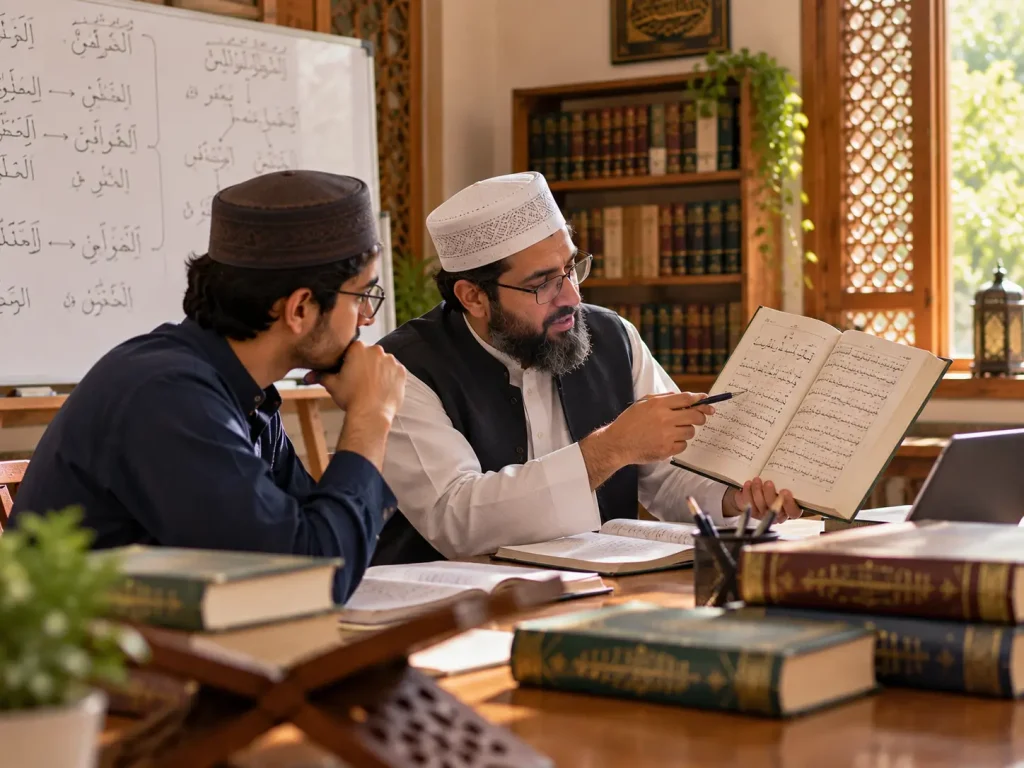
Arabic plays a central role in traditional Islamic scholarship. Before selecting a program, understand whether it focuses on general Islamic understanding or develops the ability to engage directly with classical sources.
Some programs rely mainly on translations and explanations, while others train students to read and analyse original Arabic texts.
Comparing Arabic Learning Approaches
| General Arabic Learning | Classical Arabic Learning |
| Modern Standard Arabic (MSA) | Classical grammar and text analysis |
| Conversational communication | Sarf and Nahw |
| Translation-based understanding | Direct reading of Arabic sources |
| Modern Arabic content | Classical Islamic manuscripts |
| Basic vocabulary | Detailed grammatical analysis (I’rab) |
Understanding the Difference Between General Arabic and Classical Arabic
Modern Arabic helps students communicate and understand contemporary Arabic content, but classical Islamic texts require additional skills.
Students studying traditional scholarship need to develop:
- Word pattern recognition through Sarf
- Sentence analysis through Nahw
- Correct grammatical interpretation through I’rab
These skills help students understand classical works without depending entirely on translations.
Questions to Ask About Arabic Training
Before enrolling, review the curriculum and ask:
| Question | Why It Matters |
| Will I study original Arabic texts? | Shows whether the program develops direct textual skills |
| How much time is dedicated to Arabic grammar? | Indicates the depth of language training |
| Will I gradually move toward classical texts? | Helps measure progression toward scholarship |
A strong Islamic studies pathway should match your desired level of Arabic ability and the type of scholarship you want to pursue.
Understand Credentials, Recognition, and Future Use
One of the most important parts of choosing an Islamic studies path is understanding what qualification you will receive at the end of your journey.
Students often focus on the curriculum and teaching style but overlook an equally important question:
Will this qualification support my future academic and professional goals?
Different Islamic education pathways offer different types of recognition. A traditional Sanad and a university degree both represent meaningful achievements, but they serve different purposes.
Understanding these differences before enrolling helps you make an informed Islamic education decision.
Comparing Traditional and Academic Credentials
| Traditional Sanad | University Degree |
| Represents scholarly learning and transmission (Isnad) | Represents completion of an accredited academic program |
| Granted through qualified scholars and traditional institutions | Awarded through recognized universities |
| Supports religious teaching and scholarship roles | Supports higher education and professional pathways |
| Connected with traditional scholarly communities | Used for academic, government, and corporate requirements |
| Recognition depends on traditional frameworks and relevant regulations | Recognition follows higher education accreditation systems |
Understanding Sanad and University Degrees
A traditional Sanad represents a connection between a student and the scholars through whom Islamic knowledge has been transmitted.
Through years of study, students develop expertise in areas such as Arabic, Fiqh, Hadith, and classical Islamic texts. Within traditional learning environments, a Sanad recognizes a student’s preparation to teach and contribute to religious scholarship.
A university degree follows a different structure. It is based on a defined curriculum, academic credits, examinations, research work, and institutional recognition.
Understanding the difference between sanad and university degree helps students understand why some pathways focus on traditional scholarship, while others focus on academic and professional recognition.
Understanding Seminary Boards and Certifications
If you are considering traditional Islamic education, it is important to understand how examination and certification systems work.
In Pakistan, many seminaries follow recognized examination boards that manage assessments and certification processes.
Learning about Wifaq certification helps students understand how traditional madrasa examinations are organized and how scholars progress through different levels of study.
Checking Higher Education Recognition
Students planning to continue into postgraduate studies, academic careers, or professional fields should understand how their qualification fits within higher education requirements.
Before enrolling, consider:
- Is the degree awarded by a recognized institution?
- Does the program meet relevant higher education standards?
- Will the qualification support future academic progression?
Understanding what does HEC recognition mean helps students evaluate degree recognition and attestation requirements.
Students exploring university-based Islamic studies can also learn more about BS Islamic Studies and how it combines Islamic subjects with academic coursework.
Choose a Learning Environment That Matches Your Style

The environment where you study plays an important role in your educational experience.
A traditional madrasa and a modern university approach learning differently. Neither environment is automatically suitable for every student. The right choice depends on your personality, learning preferences, and goals.
Comparing Learning Environments
| Traditional Madrasa Environment | University Environment |
| Teacher-led mentorship | Independent academic learning |
| Close relationship between teacher and student | Classroom discussions and research activities |
| Focus on classical texts and repetition | Focus on analysis, assignments, and academic writing |
| Communal learning and peer study circles | Semester-based learning structure |
| Character development (Tarbiyyah) alongside knowledge | Research skills and professional preparation |
The Traditional Seminary Learning Style
Traditional Islamic education places strong emphasis on mentorship, discipline, and direct engagement with classical texts. Students often learn through:
- Teacher-guided lessons
- Text explanation and analysis
- Peer review sessions (Takrar)
- Long-term study relationships
This approach suits students who value close guidance, structured learning, and deep engagement with Islamic scholarship.
The Quran highlights the importance of seeking knowledge with humility:
Moses said to him, “May I follow you on [the condition] that you teach me from what you have been taught of sound judgement?” – (Surah Al-Kahf 18:66)
The University Learning Style
University education usually focuses on independent learning, research, and academic discussion. Students develop skills through:
- Research assignments
- Academic writing
- Presentations
- Literature reviews
- Independent study
Students comparing traditional madrasa vs university education can better understand how each environment develops different skills.
Review Entry Requirements Before Starting
Your previous education affects which Islamic studies pathway you can enter and how smoothly you can continue into future qualifications.
Before enrolling, check whether your academic background meets the program requirements.
Common Entry Pathways
| Educational Background | Important Considerations |
| Local Matric (BISE) | Ensure required subjects and future academic requirements remain complete |
| Cambridge O Levels | Complete required subjects and obtain IBCC equivalence before moving into higher studies |
Students Coming From Matric
Students with a local Secondary School Certificate usually already follow Pakistan’s national education structure.
If you plan to combine Islamic studies with further academic education, keeping your general education requirements complete helps maintain future options. Students exploring options after local schooling can review Islamic education options after matric to understand possible pathways.
Students Coming From Cambridge O Levels
Cambridge students need to pay attention to equivalence requirements before entering many higher education pathways in Pakistan. Students should understand:
- Required O-Level subjects
- IBCC equivalence process
- Future degree admission requirements
Planning your pathway early makes the transition smoother. Students considering Islamic education after O Levels should review these requirements before selecting a program.
Think About Long-Term Career and Academic Goals
A major part of Islamic studies career planning is understanding where your chosen qualification can lead. Different pathways support different future directions. Before enrolling, consider where you want to be after five or ten years.
Career Possibilities Across Different Pathways
| Traditional Scholarship Path | University Degree Path | Combined Pathway |
| Imam and community teaching roles | Academic and research positions | Shariah advisory roles |
| Madrasa teaching | Civil service opportunities where requirements are met | Islamic finance and compliance roles |
| Religious education leadership | Education and policy-related fields | Applied ethics and contemporary research |
Traditional Scholarship Opportunities
Students following a classical Islamic education pathway may pursue roles such as:
- Teaching Islamic sciences
- Community education
- Religious leadership
- Advanced specialization in areas such as Ifta
This pathway is designed for students seeking deeper involvement in traditional scholarship.
Academic and Professional Opportunities
Students completing recognized university qualifications may pursue opportunities connected with:
- Higher education
- Research
- Public sector roles where eligibility requirements are met
- Educational administration
Students interested in postgraduate study can explore pathways such as an MS in Islamic Studies.
Combining Islamic Knowledge With Modern Expertise
Students who pursue both Islamic scholarship and modern academic skills may explore fields where both areas connect.
Examples include:
- Islamic finance
- Shariah compliance
- Education
- Research
- Policy discussions
The right pathway depends on your interests, qualifications, and the type of contribution you want to make.
Your Checklist for Choosing the Right Islamic Studies Path

Choosing an Islamic studies path requires more than comparing course names or relying on recommendations from others. Before paying admission fees or committing years to a program, take time to evaluate whether the pathway matches your goals, learning style, and future plans.
This checklist can help you make a more informed Islamic education decision.
Student Decision Checklist
| No. | Factor to Evaluate | Key Question to Ask |
| 01 | Learning Goal and Purpose | Am I seeking personal Islamic understanding, classical scholarship, academic research, or a combination of skills? |
| 02 | Arabic Learning Depth | Does the program teach direct engagement with classical Arabic texts or mainly rely on translations? |
| 03 | Time Commitment | Can I realistically manage the weekly workload alongside my other responsibilities? |
| 04 | Recognition and Credentials | Does the qualification match my future academic or professional requirements? |
| 05 | Entry Requirements | Do I meet the required academic prerequisites, such as Matric or O-Level equivalence? |
| 06 | Learning Environment | Does the teaching style match how I learn best? |
| 07 | Academic Schedule | Can I manage examinations, assignments, and different study commitments together? |
| 08 | Future Opportunities | Does this pathway support my long-term academic and career goals? |
1. Define Your Main Learning Goal
Before choosing an Islamic studies program, understand what you want to achieve. Ask yourself:
- Do I want stronger personal understanding of Islam?
- Do I want to study classical texts in depth?
- Do I want academic research skills?
- Do I want to combine Islamic knowledge with a professional career?
A program designed for personal learning may look very different from one designed for someone pursuing scholarly training.
2. Evaluate Arabic and Textual Depth
Arabic is one of the biggest differences between general Islamic learning and classical scholarship. Before enrolling, review the curriculum carefully.
Ask:
- Will I study original Arabic texts?
- How much time is dedicated to grammar (Nahw and Sarf)?
- Will I learn how to analyse unvoweled texts?
- Does the program develop independent reading ability?
A strong Islamic studies pathway should match the level of Arabic proficiency you want to achieve.
3. Check the Weekly Time Commitment
Different programs require different levels of dedication. Choose a format that fits your schedule:
| Study Format | Approximate Weekly Commitment | Suitable For |
| Modular / Part-Time Learning | 4–8 hours | Students, professionals, and those building Islamic knowledge alongside other commitments |
| Full-Time Seminary Study | 35–45 hours | Students seeking intensive classical scholarship |
| Self-Managed Parallel Study | 40–50 hours | Students balancing madrasa with separate academic requirements |
| Integrated Dual-Track Study | 35–42 hours | Students combining Islamic studies with university education |
A realistic understanding of your available time helps prevent burnout and allows you to choose a sustainable pathway.
4. Verify Credentials and Recognition
A major part of choosing an Islamic studies path is understanding what qualification you will receive. Different credentials serve different purposes.
| Qualification Type | What It Represents |
| Traditional Sanad | Recognition of Islamic scholarly study through traditional learning systems |
| University Degree | Academic qualification awarded through an accredited higher education institution |
| Combined Pathway | A model that brings together traditional Islamic learning and academic qualifications |
Before enrolling, understand the difference between sanad and university degree so you know how each qualification fits your future plans.
5. Review Academic Requirements Before Starting
Your previous education affects which pathways you can enter. Before beginning a program, confirm that you meet the required prerequisites.
| Background | Important Check |
| Matric Background | Confirm required subjects and future academic requirements |
| Cambridge O Levels | Complete required subjects and obtain relevant IBCC equivalence where needed |
6. Consider the Learning Environment
The environment where you study influences your overall experience. Some students prefer close teacher mentorship and traditional study circles, while others prefer independent research, discussions, and academic assignments.
| Traditional Learning Environment | University Learning Environment |
| Teacher-guided study | Independent academic learning |
| Classical text reading | Research-based learning |
| Peer review circles (Takrar) | Assignments and presentations |
| Character development (Tarbiyyah) | Academic writing and analysis |
The best environment depends on your learning style and the skills you want to develop.
7. Check Schedule and Examination Compatibility
Students combining multiple educational commitments should carefully review academic calendars.
Consider:
- Do examination dates overlap?
- Can I manage assignments from both systems?
- Does the program provide enough study time?
Students considering whether they can study Dars-e-Nizami and university together should evaluate the practical workload, not just the possibility of combining both.
8. Think About Long-Term Career Planning
A major part of Islamic studies career planning is understanding where your qualification can take you. Different pathways support different goals.
| Pathway | Possible Directions |
| Traditional Islamic Scholarship | Teaching, community education, religious leadership, advanced specialization |
| University Islamic Studies | Research, education, academic roles, further studies |
| Combined Education Model | Areas connecting Islamic knowledge with professional fields |
Students should consider their future interests before selecting a program. For those interested in postgraduate study, understanding pathways such as an MS in Islamic Studies can help with long-term planning.
Making a Thoughtful Islamic Education Decision
Choosing an Islamic studies path is a personal decision that requires honest reflection. The right program depends on your goals, whether you want personal religious understanding, classical scholarship, academic research, or a combination of these areas.
Some students benefit from flexible Islamic learning alongside their careers. Others prefer full-time scholarship. Some choose integrated pathways that combine traditional studies with modern education.
A thoughtful decision comes from understanding your own priorities, researching available options, and selecting a pathway that supports both your learning journey and future aspirations.
By evaluating your goals, time commitment, credentials, and long-term plans, you can choose an Islamic education pathway that helps you grow in knowledge while remaining aligned with your future direction.
Frequently Asked Questions
How do I choose the right Islamic education program?
Start by identifying your goal, then evaluate the curriculum, Arabic training, time requirements, credentials, and future opportunities. The best option depends on what you want to achieve through Islamic learning.
Should I choose a Dars-e-Nizami program or a university Islamic Studies degree?
Both pathways serve different purposes. Dars-e-Nizami focuses on classical Islamic scholarship, Arabic texts, and traditional learning methods. University Islamic Studies programs focus more on academic research, contemporary analysis, and formal degree structures.
What should I check before choosing an aalim course?
Before choosing an aalim course, review the Arabic curriculum, the classical texts included in the syllabus, the qualifications of the teachers, the overall study duration, the examination system, and how the final qualification is recognized. Understanding these factors helps you evaluate both the depth of Islamic learning and the practical opportunities available after completing the program.
How can I know if an Islamic studies program is suitable for me?
Review whether the program matches your goals, available time, preferred learning environment, and future plans. A suitable program should support both your current needs and your long-term direction.