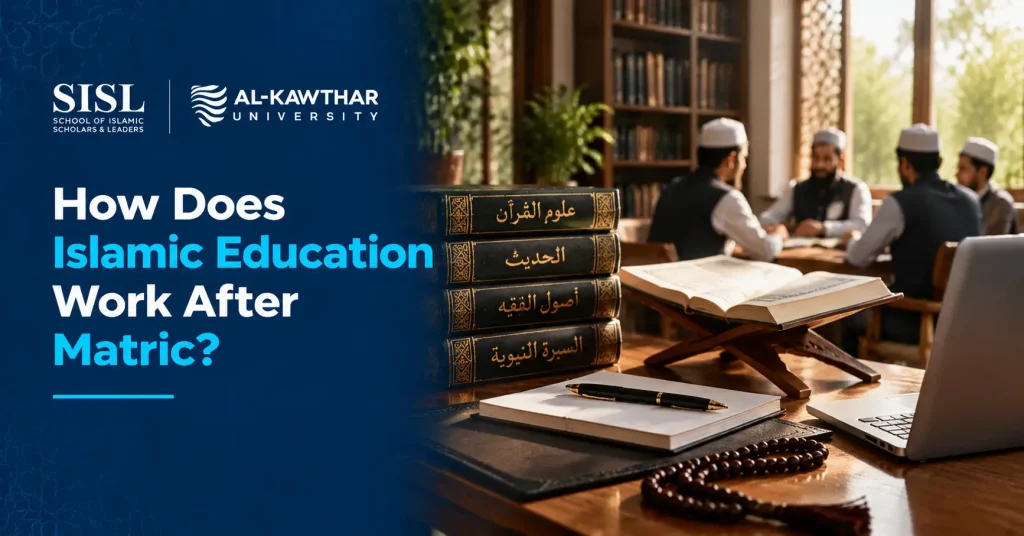
Islamic education after Matric can follow different pathways depending on your goals, time commitment, and plans for future studies:
- Enrol in a full-time Dars-e-Nizami programme at a traditional seminary to pursue long-term Islamic scholarship.
- Continue regular college education (FSc/FA/ICS) while studying Islamic subjects through part-time courses.
- Study Dars-e-Nizami after Matric while completing required Intermediate subjects privately for future academic options.
- Choose an integrated programme that combines traditional Sanad studies with an accredited university degree.
Completing your Matric examinations marks the beginning of an important stage in your education. If you are interested in Islamic learning, you may find yourself asking what comes next: should you continue with college studies, enrol in a traditional Islamic programme, or look for a path that allows you to pursue both?
Choosing Islamic studies after matric requires understanding the options available to you and how each pathway connects with your future goals. Students today can explore traditional Dars-e-Nizami studies, continue formal education alongside Islamic learning, or consider programmes that combine both areas of study.
The pursuit of knowledge holds a significant place in Islamic tradition. Allah says:
“Allah will raise those who have believed among you and those who were given knowledge, by degrees.” – (Surah Al-Mujadila 58:11)
Your decision after Matric shapes the direction of your academic journey, whether you plan to continue towards higher education, traditional scholarship, or a combination of both.
This guide explains the different Islamic education options after Matric, including Aalim courses, Dars e Nizami after Matric, and pathways that connect Islamic studies with modern education.
The Four Main Pathways After Matric
After completing your Matric examinations, you have several options for continuing your education. The right choice depends on your interests, your future goals, and the type of learning experience you want to pursue.
Each pathway offers a different balance between traditional Islamic studies, formal academic qualifications, and the amount of time you can dedicate to each area.
| Pathway | Description |
| Pathway 1: Full-Time Dars-e-Nizami | Complete traditional Islamic scholarship studies through a full-time seminary programme. |
| Pathway 2: College + Part-Time Islamic Studies | Continue FSc/FA/ICS while studying Islamic subjects alongside your regular education. |
| Pathway 3: Dars-e-Nizami + Private Board Exams | Study full-time at a madrasa while completing required Intermediate subjects privately. |
| Pathway 4: Integrated Islamic & Modern Education | Combine traditional Sanad studies with an accredited university degree. |
The exact requirements for each route depend on the institution you choose. Admission age, entry requirements, attendance policies, and available programmes vary between seminaries, colleges, and universities.
Before selecting a route, comparing traditional madrasa vs. university education can help you understand how these educational systems differ after secondary school.
Pathway 1: Full-Time Dars-e-Nizami After Matric
If your goal is to pursue traditional Islamic scholarship, enrolling in a full-time Dars-e-Nizami after matric programme allows you to dedicate your daily schedule to Islamic sciences. Students following this route usually aim towards roles such as:
- Islamic scholars (Alim)
- Imams
- Community educators
- Teachers in religious institutions.
| Study Period | Main Areas of Study |
| Years 1–2 | Arabic morphology (Sarf), syntax (Nahw), and foundational Fiqh. |
| Years 3–4 | Intermediate jurisprudence (Usul al-Fiqh) and classical rhetoric (Balaghah). |
| Years 5–6 | Advanced legal texts, logic (Mantiq), and Quranic interpretation (Tafsir). |
| Final Year | Dawrah-e-Hadith and study of major Hadith collections (Sihah Sittah). |
Building Classical Arabic Skills From the Beginning
Starting Dars e Nizami after Matric places you into an intensive study environment focused on Arabic language development and classical texts. You begin learning how to read and analyse unvowelled Arabic texts, study foundational grammar books such as Hidayat-un-Nahw, and engage with classical legal texts under teacher guidance.
The importance of seeking religious understanding is highlighted in the saying of the Prophet Muhammad ﷺ:
“When Allah wishes good for someone, He gives him deep understanding (Fiqh) of the religion.” – (Sahih al-Bukhari 71)
Examinations and Certification Through Wifaq Boards
Your progress is assessed through annual examinations conducted by recognised seminary federations.
Understanding dars e nizami vs BS Islamic Studies shows how traditional Islamic studies and university programmes differ in their teaching methods, assessment styles, and qualification systems.
Learning what Wifaq certification is also gives you insight into how seminary examinations and certificates are managed through recognised boards.
Pathway 2: College Education Alongside Islamic Studies
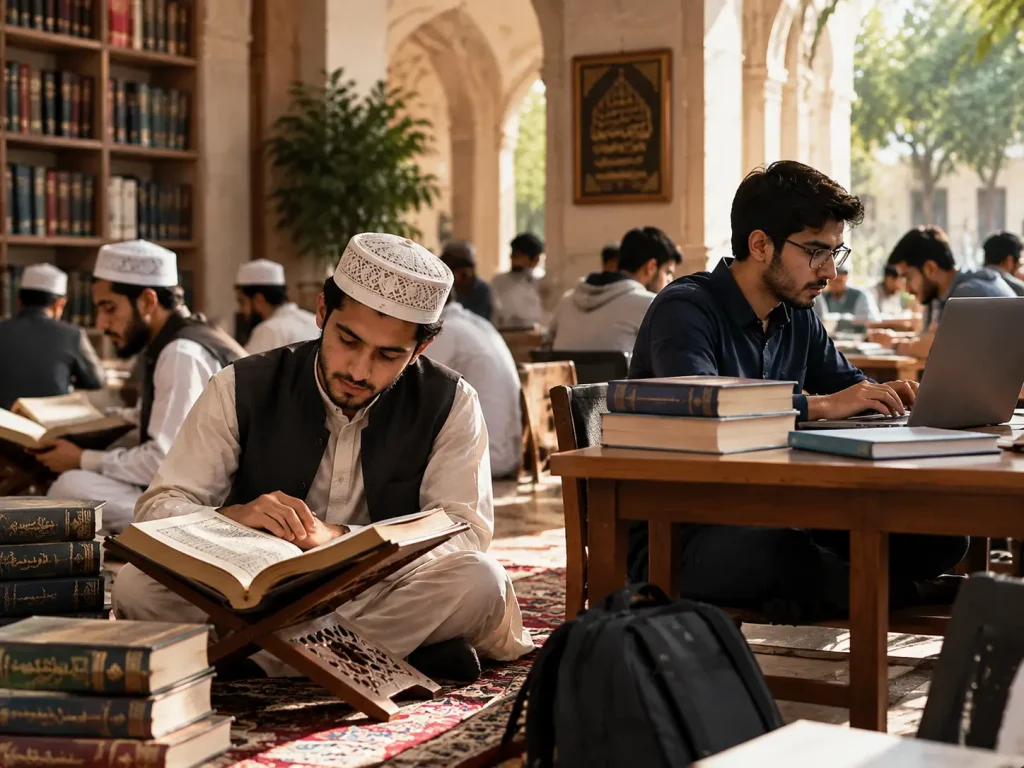
If you plan to enter fields such as medicine, engineering, technology, or business, you may choose to continue mainstream education while studying Islam alongside it.
Under this route, you complete your Intermediate education through FSc, FA, ICS, or I.Com while attending Islamic classes through evening courses, weekend programmes, or part-time study options.
| Regular Education | Islamic Learning |
| Intermediate college classes | Quranic Arabic studies |
| Physics, Chemistry, Mathematics, or Biology | Tajweed and Quran recitation |
| Practical laboratory work | Foundations of Fiqh and Aqeedah |
| Board examination preparation | Hadith study circles |
How This Path Works
You complete your Higher Secondary School Certificate (HSSC) through your chosen college stream while continuing Islamic learning outside regular college hours.
Your options may include Islamic diploma courses, evening madrasa classes (Halqahs), or weekend Aalim programmes depending on the institution available to you.
Benefits and Considerations
Benefits:
- Keeps professional university options open.
- Allows you to prepare for pathways such as MDCAT, ECAT, and other university admissions.
- Lets you continue Islamic learning alongside formal education.
Considerations:
- Limited weekly study hours make it harder to develop the same depth of Arabic reading ability achieved through full-time classical study.
- Part-time programmes usually follow a different learning model from traditional scholar training.
Students following this route may later explore academic Islamic studies through programmes discussed in what is BS Islamic Studies.
Pathway 3: Full-Time Madrasa Study With Private Intermediate Exams
Some students choose full-time madrasa education while completing their required Intermediate subjects separately.
This route allows you to focus deeply on Islamic studies after matric while keeping future academic options available through additional board qualifications.
| Area | Approach |
| Main Studies | Full-time Dars-e-Nizami at an affiliated seminary. |
| Board Requirements | Private Intermediate examinations through BISE. |
| Required Subjects | English, Urdu, and Pakistan Studies where applicable. |
Completing Required Subjects Privately
While studying at a madrasa, you can register as a private candidate with your local BISE board to complete required Intermediate subjects.
Planning these requirements through Islamic education after matric allows you to manage traditional studies alongside the academic requirements needed for future equivalence pathways.
Understanding the difference between sanad and university degree explains why completing additional academic requirements matters when you want to connect traditional qualifications with modern education systems.
Reviewing what HEC recognition means also helps you understand the requirements involved when planning further academic recognition.
Managing Multiple Examination Schedules
Balancing madrasa examinations with private board papers requires careful planning. Wifaq examinations and BISE examinations follow separate schedules, which means students need to organise their preparation well in advance.
The Prophet ﷺ reminded believers about maintaining balance:
“Indeed, your Lord has a right upon you, your self has a right upon you, and your family has a right upon you, so give everyone possessing a right their due.” – (Sahih al-Bukhari 1968)
Pathway 4: Combining Islamic Studies With Modern Education
Students who want to pursue both traditional scholarship and formal higher education may explore integrated programmes that combine both areas of study.
| Traditional Islamic Studies | Modern Education |
| Dars-e-Nizami curriculum | Accredited academic courses |
| Classical Arabic and Hadith studies | Research writing and modern skills |
| Traditional Sanad / Ijazah | University degree pathway |
| Teacher-led learning | Academic assessment methods |
If you are considering both options, can you study dars e nizami and university together explores how students manage both educational routes.
Integrated programmes bring both learning paths into one timetable, allowing students to pursue traditional Islamic studies alongside formal qualifications without managing separate institutions independently.
How Does Matric Compare to Cambridge O-Levels?
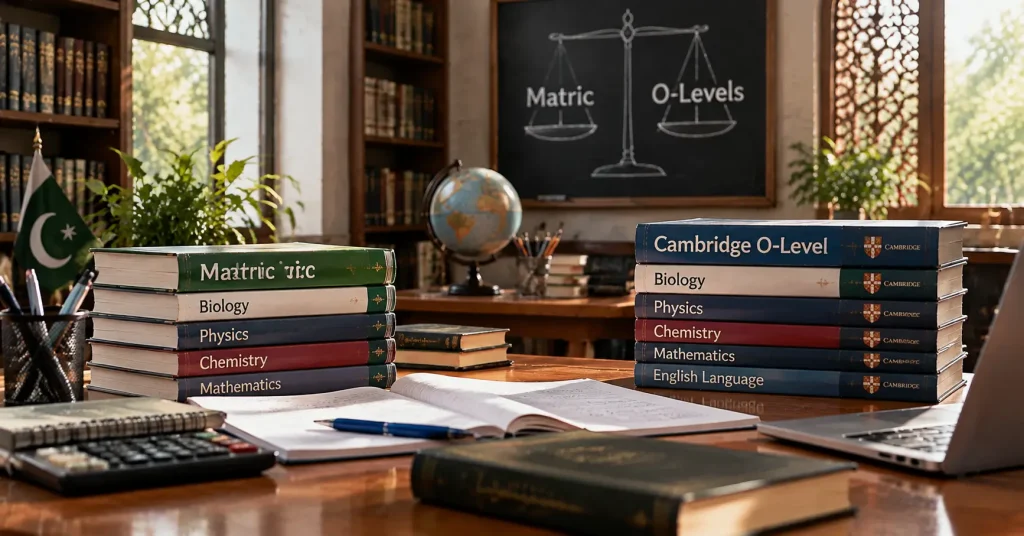
After completing secondary education, your next steps may differ depending on whether you studied through Matric or Cambridge O-Levels. Both qualifications represent the completion of 10 years of schooling, but the admission process for further education follows different requirements.
| Education Route | Next Requirement |
| Matriculation (BISE) | Usually allows direct admission into Intermediate colleges or seminary programmes. |
| Cambridge O-Levels | Requires an IBCC equivalence certificate before admission into many local institutions. |
1. Document Requirements After Matric and O-Levels
If you complete Matric through a local BISE board, your Secondary School Certificate (SSC) is generally accepted by Intermediate colleges and traditional seminaries across Pakistan.
If you complete Cambridge O-Levels, you need to obtain an official equivalence certificate from the Inter Board Coordination Commission (IBCC) before continuing into many local education pathways.
Planning your route through Islamic education after O Levels allows you to understand the additional documentation requirements, including subject combinations such as Pakistan Studies, Islamiyat, and Urdu where applicable.
2. Language Preparation for Islamic Studies
Your previous schooling background can influence how easily you adjust to traditional Islamic texts.
Matric students often have earlier exposure to Urdu literature and may encounter introductory Arabic concepts through Islamiyat or Arabic electives. This background can support the early stages of classical Arabic learning.
Students from O-Level backgrounds often develop strong English writing and analytical skills, while they may need additional preparation for classical Urdu and Arabic reading.
Planning Your Long-Term Islamic Studies Pathway
The choices you make after Matric influence the academic options available to you later. Whether you want to become a scholar, continue into university education, or combine both areas, planning early allows you to avoid unnecessary delays.
| Stage | Educational Goal |
| Ages 15–17 | Complete Matric and Intermediate requirements. |
| Ages 17–21 | Complete a 16-year qualification through a BS degree or recognised Alimiyyah route. |
| Ages 21–23 | Explore MS, MPhil, and further research opportunities. |
If you follow the traditional route, completing the required academic subjects alongside your religious studies becomes important for future higher education options. Students interested in postgraduate study can explore requirements through what is MS in Islamic Studies.
Comparing Your Islamic Education Options After Matric
Choosing between different routes becomes easier when you compare the time commitment, outcomes, and learning goals.
| Pathway | Main Focus | Weekly Commitment | Qualification Outcome | Suitable For |
| Full-Time Dars-e-Nizami | Arabic texts, Hadith, Fiqh, and traditional sciences | 30–35 hours | Traditional Sanad / Wifaq qualification | Students pursuing classical scholarship. |
| College + Part-Time Islamic Studies | Intermediate education alongside Islamic learning | College hours + evening/weekend study | HSSC qualification with Islamic studies experience | Students planning professional careers. |
| Madrasa + Private Intermediate | Full-time Islamic studies with private board preparation | Higher combined workload | Traditional qualification with possible HEC equivalence route | Students managing both pathways independently. |
| Integrated Islamic & Modern Education | Dars-e-Nizami combined with university education | Combined academic schedule | Traditional Sanad and university degree | Students seeking both forms of education. |
Combining Islamic Studies With Modern Education at SISL Karachi
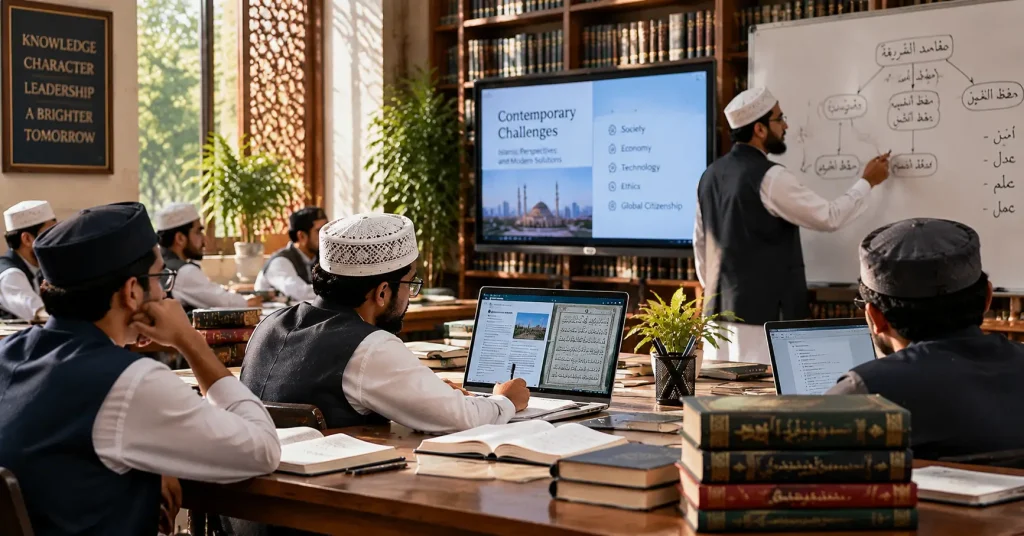
Managing separate institutions, examination schedules, and documentation requirements can become challenging for students who want both traditional scholarship and modern qualifications. Integrated programmes bring these areas together through one academic plan.
| Classical Islamic Studies | Modern Education |
| Classical Arabic texts | University-level coursework |
| Fiqh and Hadith studies | Academic research and communication skills |
| Traditional Sanad pathway | HEC-recognised BS degree |
| Teacher-guided learning | Modern research tools and digital literacy |
At the School of Islamic Scholars & Leaders (SISL) in Karachi, the 8-year Islamic Scholar & Leaders Program (ISLP) allows students to pursue traditional Islamic scholarship alongside an HEC-recognised Bachelor of Science (BS) in Islamic Studies.
Students complete the Dars-e-Nizami curriculum while developing modern academic skills, including professional communication, leadership, and digital research abilities.
The programme is designed for students who want to combine Islamic and modern education while keeping both traditional scholarship and academic opportunities available.
Choosing the Right Path After Matric
Your decision after Matric should match your interests, available time, and long-term goals.
If you want to pursue a professional career, continuing college education while you study Islam after school through part-time courses allows you to maintain both directions.
If your goal is traditional scholarship, a full-time Dars-e-Nizami route provides deeper engagement with classical Islamic sciences while requiring careful planning for future academic requirements.
If you want to pursue both traditional scholarship and modern qualifications together, exploring programmes that combine Islamic and modern education can provide a pathway that brings both goals together.
Making this decision with a clear understanding of each option allows you to choose an Islamic studies pathway that matches your aspirations and prepares you for the next stage of your education.
Frequently Asked Questions
Can I start an Aalim course after Matric if I do not know Arabic?
Yes. Many institutions design their aalim course after matric for students who are beginning their Islamic studies journey. Students usually start with foundational Arabic vocabulary, reading skills, grammar basics, and introductory Islamic sciences before moving towards advanced classical texts.
Will studying in a madrasa prevent me from attending university later?
Your future options depend on completing the required academic qualifications alongside your religious studies. Students who complete the necessary Matric and Intermediate subjects through recognised boards and fulfil HEC requirements can continue towards higher education after completing their traditional studies.
Which Intermediate group works best with Islamic studies after Matric?
The right choice depends on your career goals and available study time. Students planning intensive Islamic studies often consider FA or similar programmes because they may provide more flexibility for parallel learning. Students interested in medicine, engineering, or technology may choose science streams while managing additional Islamic studies commitments carefully.
What is the usual age for starting Dars-e-Nizami after Matric?
Many students begin Dars-e-Nizami after Matric between the ages of 15 and 18. However, admission requirements vary between institutions, so you should check the age criteria and entry requirements of your chosen seminary or programme.