Key Takeaways
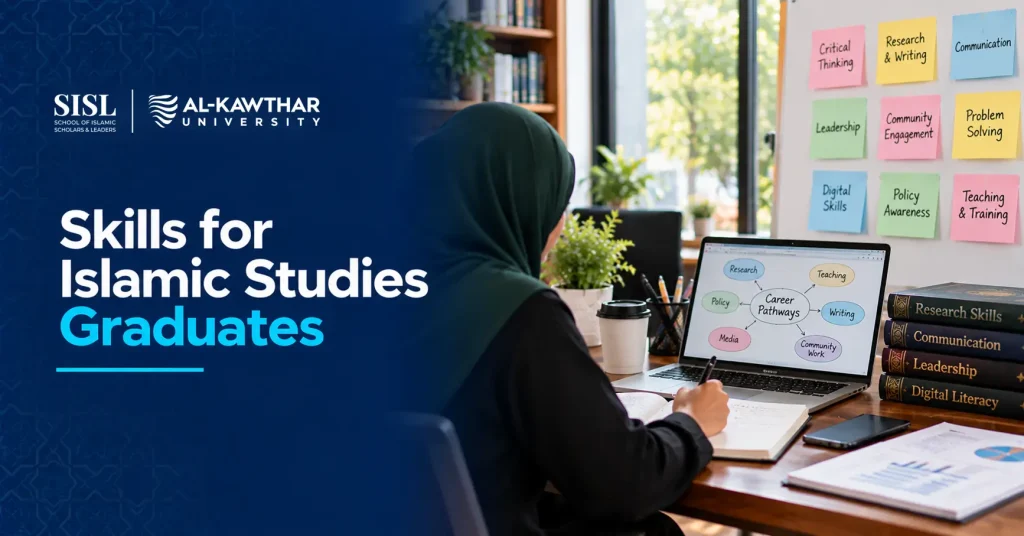
The most important skills for Islamic studies graduates include professional writing, academic research, English and Arabic communication, public speaking, digital literacy, teamwork, and project management. Combining these abilities with Islamic scholarship prepares graduates for career opportunities in education, finance, research, media, and technology.
- Professional Writing: Strong writing skills prepare Islamic studies graduates to produce research reports, educational materials, articles, and professional documents.
- Academic Research: Knowledge of research methods, source verification, and citation standards such as APA and Chicago supports careers in academic research, publishing, and policy analysis.
- English and Arabic Communication: Arabic proficiency supports the study of classical Islamic texts, while professional English communication is valuable for international research, teaching, and workplace collaboration.
- Public Speaking: Clear explanations and confident presentations prepare graduates for teaching, community education, public lectures, and professional discussions.
- Digital and Data Literacy: Skills in spreadsheets, digital research databases, and online productivity tools support research, administration, and analytical responsibilities.
- Teamwork and Project Management: Collaboration, planning, and time management prepare graduates to coordinate educational programmes, research projects, and community initiatives.
- Subject Specialisation: Developing expertise in fields such as Islamic finance, education, policy, or technology strengthens career opportunities when supported by relevant professional training and qualifications.
You’ve spent years studying Islamic texts, examining scholarly opinions, and learning how to support your arguments with evidence. But imagine sitting in a job interview where the employer asks, “How would you apply your education to the work we do here?”
Would you know how to explain the value of your training beyond your qualifications?
Whether you’re interested in teaching, research, Islamic finance, or administration, employers want to see how your knowledge translates into practical work.
Developing the right skills for Islamic studies graduates, including professional writing, communication, digital literacy, and project management, prepares you to take on responsibilities beyond traditional religious education.
Prophet Muhammad (PBUH) emphasised excellence in all matters, as recorded in Sahih Muslim 1955. Bringing that principle into your career starts with recognising the abilities you’ve already developed and strengthening the professional skills your chosen field requires.
How Your Islamic Studies Training Translates into Workplace Skills
Imagine an editor asks you to verify two conflicting accounts of an event in Islamic history. You’d examine the original sources, compare the evidence, and determine which account is better supported.
You’ve already practised similar methods while studying Hadith and Islamic history, but a professional assignment also requires you to present your findings clearly, meet deadlines, and provide references the editor can verify.
The same connection applies to other careers. Your experience analysing Arabic texts is relevant to translation and document review, while comparing scholarly opinions develops analytical abilities useful in research and policy discussions.
Here’s how the skills you’ve developed through Islamic studies relate to practical workplace responsibilities:
| Skills Developed Through Islamic Studies | Practical Workplace Applications |
| Classical Arabic text analysis | Translation, proofreading, and document review |
| Comparing scholarly opinions | Research analysis and policy discussions |
| Hadith source verification | Reference checking and editorial research |
| Fiqh and legal reasoning | Identifying issues for qualified Shariah advisers |
| Academic discussions and Takrar | Presentations, explaining arguments, and collaborative research |
Your Islamic Studies qualification and scholarly training provide a foundation for developing these abilities. Applying them professionally also requires learning the:
- Writing conventions
- Digital tools
- Technical requirements of your chosen industry
Skill 1: Writing Professional Reports and Documents
Imagine you’ve been asked to review a financial agreement and explain your findings to a manager. You’ve studied Islamic commercial law and understand the relevant principles, but how would you communicate your assessment to someone who hasn’t studied Fiqh?
A lengthy explanation filled with Arabic terminology probably won’t answer their immediate questions. Your manager needs to understand what you’ve examined, which concerns you’ve identified, and what further action is required.
Professional writing involves presenting information clearly, supporting your findings with evidence, and making your recommendations easy to understand.
If you’re developing your Islamic studies career skills, practise writing:
- Research Reports:
Explain your findings, supporting evidence, and conclusions using clear headings and accurate references.
- Professional Emails:
Communicate requests, findings, and project updates without unnecessary explanations.
- Policy Briefs:
Summarise complex religious or ethical questions for decision-makers who need practical information.
- Editorial Documents:
Prepare articles, educational materials, and research summaries for publication.
How Professional Writing Works in Islamic Banking
Suppose you’re working as a junior researcher supporting an Islamic bank’s Shariah compliance team. You’ve been asked to examine a proposed financing agreement. Your task involves:
- Reviewing the relevant contractual clauses
- Identifying questions concerning Islamic commercial principles
- Preparing a written summary for qualified Shariah advisers
A useful report would explain the transaction, identify the clauses requiring review, cite the relevant Islamic sources and applicable standards, and outline the questions the advisers need to resolve.
The authorised Shariah specialists remain responsible for determining compliance, while your research and documentation support their assessment.
Developing these abilities is one practical example of combining Islamic knowledge with professional skills.
Skill 2: Academic Research and Source Verification
If you’ve studied Hadith or Islamic jurisprudence, you’re already familiar with comparing texts and examining their supporting evidence. Professional research builds on those habits by requiring a clear research question, reliable sources, documented methods, and carefully supported conclusions.
For example, reading several books about an Islamic topic gives you background knowledge. Preparing an academic research paper requires you to evaluate those sources, compare their arguments, identify gaps in the available evidence, and explain how you reached your findings.
The Quran reinforces the importance of responsible investigation. In Surah Al-Isra (17:36), Allah warns against following claims without knowledge. Research skills Islamic Studies graduates should develop include:
- Literature Review:
Finding and evaluating existing research before developing an argument.
- Source Verification:
Checking Quranic references, Hadith authenticity, historical accounts, and scholarly attributions.
- Academic Referencing:
Using citation systems such as APA or Chicago to document sources accurately.
- Comparative Analysis:
Examining different scholarly interpretations and explaining their supporting evidence.
- Research Writing:
Presenting findings through academic papers, policy reports, and research summaries.
How Research Skills Apply to Healthcare Ethics
Imagine you’re supporting a research project examining Islamic perspectives on end-of-life medical care.
Your responsibility is to investigate:
- Relevant Quranic principles
- Hadith, classical juristic discussions, and contemporary Islamic bioethics scholarship. You’ll also need to understand the medical questions involved through reliable clinical literature and consultation with qualified healthcare professionals.
Your research might compare scholarly discussions about life-sustaining treatment, identify areas of agreement and disagreement, and prepare a referenced report for further expert consideration.
Clinical decisions remain the responsibility of qualified healthcare professionals working with patients and their authorised decision-makers. Your contribution focuses on accurate religious research and an explanation of relevant ethical perspectives.
Developing academic research methods alongside Islamic scholarship prepares you for research assistantships, educational publishing, postgraduate studies, and specialised interdisciplinary research opportunities.
Skill 3: Communicating Professionally in English and Arabic
Understanding classical Arabic is valuable, but what happens when someone asks you to explain a complicated Islamic concept in English?
Suppose you’re translating an Arabic text about commercial contracts for a financial institution. Your readers understand banking terminology but have little knowledge of classical Fiqh. Simply translating every Arabic word won’t explain the legal principles they need to understand.
Strong English and Arabic communication skills allow you to preserve the original meaning while presenting it in language appropriate for your audience.
For Islamic studies graduates interested in translation, publishing, research, or Islamic finance, professional bilingual communication involves:
- Arabic Comprehension:
Reading classical texts accurately and identifying the meaning of technical terms within their original context.
- Professional English Writing:
Explaining religious concepts through clear reports, articles, translations, and business documents.
- Accurate Terminology:
Distinguishing between terms such as Fard, Wajib, and Qabd, particularly when their meanings depend on specific Islamic legal traditions.
- Audience Awareness:
Adapting explanations for scholars, students, business professionals, and general readers without misrepresenting the original sources.
How Bilingual Skills Apply to Contract Review
Suppose you’re assisting a Shariah research team reviewing an Islamic financing agreement.
The contract contains Arabic terminology that needs to be explained to English-speaking legal and financial professionals. Your responsibility is to prepare accurate translations, identify relevant references, and explain the terminology used in the agreement.
For example, Qabd Hukmi refers to constructive possession in Islamic commercial jurisprudence. Your explanation should clarify the relevant conditions rather than assume that the English expression automatically carries the same legal implications.
Qualified Shariah advisers and legal professionals then evaluate the agreement within their respective areas of expertise.
Developing these communication abilities also supports the wider career opportunities available after becoming an Aalim, particularly in research, academic translation, and Islamic publishing.
Skill 4: Public Speaking and Audience Engagement
Picture yourself presenting a proposal for a new Islamic Studies curriculum to a school management committee. You’ve researched the subject thoroughly and prepared your recommendations, but the committee wants to know three things: what needs improvement, how your proposal addresses the problem, and what implementing it will cost.
Your knowledge matters, but so does your ability to explain it in a way that answers their concerns.
Public speaking is among the most useful professional skills for Islamic graduates pursuing teaching, leadership, community education, and institutional roles.
Allah explains in Surah Ibrahim (14:4) that messengers were sent speaking the language of their people so they could communicate the message clearly. The verse concerns prophetic communication, and its emphasis on clarity also offers a valuable lesson for anyone explaining knowledge to others.
How Public Speaking Skills Apply to Professional Presentations
Whether you’re addressing students, presenting research, or speaking to an organisation’s management, effective communication requires preparation and an understanding of your audience.
Focus on developing these abilities:
- Clear Explanations:
Introduce the main issue early and explain unfamiliar terminology before discussing technical details.
- Presentation Skills:
Use relevant examples, visuals, and supporting evidence to communicate your findings.
- Responding to Questions:
Listen carefully, address concerns respectfully, and acknowledge questions requiring further investigation.
- Confident Delivery:
Maintain an appropriate speaking pace, make eye contact, and present your ideas without relying entirely on written notes.
For example, when proposing an Islamic education programme, prepare a short presentation explaining the learning objectives, expected benefits, estimated costs, and implementation plan.
Practising with classmates, participating in academic discussions, and delivering short presentations will strengthen your confidence.
The communication skills Islamic scholars develop through teaching and public speaking also support careers in educational publishing, media, and academic leadership.
Skill 5: Digital Literacy and Data Research
You receive a spreadsheet containing hundreds of donation records and need to prepare a financial summary for a charitable organisation. Would you know how to organise the information, identify missing entries, and calculate the totals accurately?
Tasks like these are common in administration, research, finance, and nonprofit organisations.
For Islamic studies graduates, digital literacy involves using technology to manage information, conduct research, prepare documents, and complete everyday professional responsibilities.
Digital Skills Worth Developing
You don’t need advanced programming knowledge for most entry-level research or administrative positions. Start with the tools regularly used in your preferred field.
- Microsoft Excel and Google Sheets:
Learn formulas, sorting, filtering, and pivot tables to organise financial or administrative information.
- Digital Research Databases:
Practise locating Quranic references, Hadith, academic papers, and classical Islamic texts through searchable resources.
- Reference Management:
Learn tools such as Zotero to organise academic sources and prepare bibliographies.
- Document Collaboration:
Become familiar with shared documents, cloud storage, and collaborative editing.
- AI Research Evaluation:
Learn to identify unreliable AI-generated claims and verify references against original sources.
Digital research tools improve access to information, but accurate Islamic scholarship still requires evaluating sources and understanding their context.
How Spreadsheet Skills Apply to Islamic Finance
Suppose you’re supporting a Shariah compliance or finance team reviewing income records. Your supervisor asks you to organise transactions and prepare calculations based on categories already approved by the relevant specialists.
Using Excel, you’ll:
- Import the records
- Categorise entries
- Apply formulas
- Prepare a summary for review
Functions such as SUMIF, XLOOKUP, and pivot tables are useful for identifying discrepancies and checking totals.
In situations involving non-compliant income purification, authorised Shariah specialists determine the applicable requirements, while qualified financial personnel oversee the accounting and disbursement processes.
Your responsibility is to maintain accurate records and calculations within your assigned role. Developing digital research and professional communication skills also prepares you for administrative positions, research assistance, and educational technology projects.
Skill 6: Teamwork and Professional Collaboration
Your first professional assignment might involve working with people whose educational backgrounds are completely different from yours.
Perhaps you’re joining a project where an accountant manages the budget, a designer prepares educational materials, and a subject specialist reviews religious accuracy. Everyone contributes different expertise, and completing the project successfully depends on how well you work together.
Your knowledge of Islamic ethics and Adab provides a valuable foundation for respectful conduct. Workplace collaboration also requires practical habits such as communicating deadlines, accepting feedback, sharing updates, and recognising the responsibilities of other team members.
How Teamwork Applies to Professional Projects
Consider an educational organisation preparing a new Islamic Studies textbook.
The project involves researchers, writers, editors, designers, and administrators. As an Islamic content reviewer, your responsibility is to verify religious references and explain any corrections clearly.
To contribute effectively, you’ll need to:
- Communicate Responsibilities:
Understand your assigned tasks and explain what information you need from colleagues.
- Respect Different Expertise:
Consult editors about writing conventions, designers about presentation, and qualified scholars about specialised religious questions.
- Accept Constructive Feedback:
Review suggested changes professionally and explain concerns using evidence rather than personal preferences.
- Meet Deadlines:
Complete assigned work on time and inform colleagues early when an issue affects delivery.
- Document Progress:
Share concise updates so everyone understands completed tasks and outstanding work.
How to Prepare a Professional Project Update
If you’re coordinating a textbook project, a simple weekly progress report keeps everyone informed without requiring repeated discussions. Your report should cover:
1. Completed Work:
Identify chapters reviewed, references checked, and corrections submitted.
2. Outstanding Issues:
Explain which tasks require additional information or specialist approval.
3. Upcoming Deadlines:
List the next deliverables and the people responsible for them.
4. Required Actions:
Clarify what needs to happen before the project moves forward.
Learning these habits prepares you for responsibilities involving educational programmes, research teams, charitable organisations, and administrative projects. Strong teamwork grows through practical experiences like:
- Participating in group research
- Volunteering for community projects
- Completing supervised assignments
Skill 7: Project Management and Meeting Professional Deadlines
Imagine you’re responsible for launching a new Islamic Studies course at a school. The syllabus is ready, teachers have been selected, and students are interested in enrolling. But who will prepare the learning materials, coordinate teacher training, manage the budget, and make sure everything is completed before classes begin?
Project management brings these responsibilities together. Whether you’re coordinating an educational programme, organising a research project, or managing a community initiative, you’ll need to plan tasks, assign responsibilities, and monitor progress.
Allah emphasises the importance of fulfilling commitments in Surah Al-Isra (17:34). In your professional life, respecting deadlines and taking responsibility for assigned work are practical ways to honour your commitments.
How Project Management Skills Apply to Islamic Education
Suppose you’re coordinating the introduction of a new Islamic Studies curriculum across several schools. You’ll need to:
- Plan the Work:
Divide the project into manageable tasks, including syllabus development, content writing, review, and teacher preparation.
- Assign Responsibilities:
Identify who will develop lessons, review Islamic references, approve materials, and coordinate implementation.
- Manage Deadlines:
Set realistic completion dates and monitor whether each task is progressing as planned.
- Track Expenses:
Maintain a budget covering teaching materials, training, printing, and other operational requirements.
- Address Problems:
Identify delays early and communicate necessary adjustments to the team.
Tools such as Microsoft Excel, Trello, and Asana are useful for organising tasks, assigning deadlines, and monitoring progress.
Developing these abilities prepares you for coordination and administrative responsibilities in Islamic education careers, particularly when your work involves multiple teachers, departments, or institutions.
Skill 8: Developing Expertise in a Specific Professional Field
If you’re completing Islamic Studies, you’ve probably studied several subjects, including Hadith, Tafsir, Fiqh, Arabic, and Islamic history. But which subject would you like to work with professionally?
Your answer matters because different career paths require different qualifications and technical abilities.
For example, someone interested in Islamic banking needs knowledge of Fiqh al-Muamalat alongside financial and regulatory training. Someone pursuing educational publishing needs strong writing, editing, and research skills.
Choosing a specialisation allows you to concentrate on the abilities most relevant to your career goals.
How to Choose Your Professional Specialisation
Start by identifying which part of your Islamic education interests you most and where you want to apply that knowledge. Some possible directions include:
- Islamic Finance:
Develop knowledge of commercial Fiqh, accounting, banking regulations, and Shariah compliance.
- Education:
Study curriculum development, teaching methods, educational assessment, and academic administration.
- Media and Publishing:
Strengthen your writing, editing, translation, and religious fact-checking abilities.
- Technology:
Learn digital research methods, database management, and AI content evaluation.
- Community Services:
Explore Zakat administration, safeguarding, nonprofit management, and relevant social welfare qualifications.
Once you’ve chosen a field, review the qualifications employers expect and begin building relevant experience.
For example, AAOIFI’s Certified Shariah Advisor and Auditor (CSAA) is a recognised professional qualification pathway for Islamic finance specialists.
Professional certification, supervised experience, and relevant academic qualifications strengthen your preparation, although individual jobs have their own eligibility requirements.
How SISL Develops Islamic Scholarship and Professional Skills
If you’re planning a career after Islamic Studies, choosing an educational institution that develops academic knowledge alongside practical abilities deserves attention.
At the School of Islamic Scholars & Leaders (SISL) in Karachi, students pursue classical Islamic scholarship alongside university education, communication, research, and leadership development.
Combining Dars-e-Nizami with University Qualifications
The eight-year Islamic Scholar & Leaders Program combines traditional Dars-e-Nizami studies with a university pathway covering BS and MS qualifications in Islamic Studies.
The programme includes Arabic, Hadith, Fiqh, and Tafsir alongside English communication, academic research, computer literacy, and leadership.
Al-Kawthar University is recognised by Pakistan’s Higher Education Commission. Students should also verify the specific recognition, progression, and admission requirements applicable to their intended qualifications.
Developing Critical Thinking Through Fikrmand
SISL’s Fikrmand learning approach uses case studies, academic discussions, and problem-solving exercises to develop analytical reasoning.
Students examine different arguments, evaluate supporting evidence, and explore how classical Islamic knowledge relates to contemporary questions.
Such preparation supports careers involving research, teaching, educational writing, and professional communication.
Learning Communication and Entrepreneurship
SISL’s curriculum also includes leadership, entrepreneurship, and professional communication.
Its Aalim Tajir initiative introduces students to business and entrepreneurial thinking, while the English for Ulema course focuses on academic writing, professional correspondence, presentations, and public communication.
These learning opportunities provide a foundation for further professional development. Specialised positions still require the relevant qualifications, experience, and industry training.
You can review the SISL admissions process to understand the available academic pathways.
How Islamic Studies Skills Apply to Different Careers
Different employers look for different combinations of subject knowledge and professional abilities. Here’s how the skills discussed throughout the article relate to potential career paths.
| Professional Skill | Practical Application | Possible Career Field |
| Professional Writing | Research reports, policy briefs, educational materials | Publishing, administration |
| Academic Research | Source verification, literature reviews, academic papers | Universities, research institutes |
| English and Arabic Communication | Translation, bilingual documentation, academic communication | Translation, Islamic publishing |
| Public Speaking | Lectures, presentations, educational workshops | Teaching, community education |
| Digital Literacy | Spreadsheet analysis, digital research, data verification | Administration, educational technology |
| Teamwork | Editorial collaboration, group research, project coordination | Nonprofits, research organisations |
| Project Management | Planning educational programmes, budgets, and timelines | School administration, NGOs |
| Subject Specialisation | Applying Islamic knowledge alongside technical qualifications | Islamic finance, research, education |
The opportunities available to you depend on your qualifications, demonstrated abilities, and the specific requirements of each position.
How to Assess Your Professional Skills Before Applying for Jobs
Before applying for a position, consider how confidently you could complete the tasks an employer would assign.
Use these eight questions to assess your readiness:
1. Professional Writing:
Could you prepare a clear, two-page report explaining a complex Islamic topic to someone without specialist religious knowledge?
2. Academic Research:
Do you know how to verify sources and format references using APA or Chicago citation standards?
3. English and Arabic Communication:
Could you translate a classical Arabic passage into accurate, understandable English?
4. Public Speaking:
Are you comfortable presenting information, answering questions, and explaining your reasoning to different audiences?
5. Digital Literacy:
Can you use spreadsheets, research databases, and common workplace software to complete assigned tasks?
6. Teamwork:
Can you collaborate with colleagues, respond professionally to feedback, and meet shared deadlines?
7. Project Management:
Have you planned an activity or project involving a budget, assigned responsibilities, and completion dates?
8. Specialisation:
Have you identified the qualifications and practical experience required for your intended career?
If several questions reveal skills you haven’t developed yet, use those findings to plan your next learning goals.
You could begin by improving your English writing, learning Excel, completing a research assignment, or gaining experience through an internship.
Choose activities that produce work samples or practical experience you can discuss during job interviews.
Preparing for a Career Beyond Islamic Studies
Your Islamic Studies education provides knowledge and analytical abilities that deserve practical application. Whether you’re interested in teaching, research, finance, media, or administration, the next step is identifying the professional skills your chosen career requires.
Begin with abilities you already possess, strengthen the areas where you need further training, and build experience through real assignments. A well-written research report, successful group project, or carefully prepared presentation gives employers something concrete to evaluate.
Your qualifications establish your educational background, while your professional skills demonstrate what you’re prepared to contribute. Combining both gives you a stronger foundation for pursuing meaningful career opportunities.
Frequently Asked Questions
Which professional skill should an Islamic Studies graduate learn first?
Start with professional communication, particularly clear English writing and speaking. Then develop digital literacy, research methods, and the technical skills required for your preferred career.
Do technology companies hire Islamic Studies graduates?
Islamic Studies graduates with relevant digital skills are suitable candidates for religious content review, Islamic educational technology, and AI research evaluation roles. Hiring depends on technical abilities, experience, and employer requirements.
Can I develop professional skills without a university degree?
Yes. Short courses, certifications, internships, and independent practice develop valuable workplace abilities. Positions with formal academic or regulatory requirements still require recognised qualifications.
How can I improve my public speaking skills?
Practise giving short presentations, join discussion groups, and request feedback from teachers or colleagues. Debate societies, educational workshops, and public speaking clubs also provide opportunities to improve.
Was this article helpful?