Key Takeaways
Careers in Islamic education extend beyond traditional classroom teaching, offering opportunities in academic institutions, research, publishing, and educational technology. The right career path depends on your qualifications, interests, and professional skills.
- Teaching: Islamic Studies graduates may pursue careers as school teachers, Arabic instructors, or university lecturers, depending on their academic qualifications and teaching experience.
- Curriculum and Educational Leadership: Opportunities include curriculum development, teacher training, academic administration, and educational programme management.
- Research, Publishing, and Technology: Graduates may work in Islamic research, academic writing, translation, publishing, and digital learning platforms.
- Skills and Qualifications: Strong Islamic knowledge, Arabic proficiency, academic English, research abilities, communication, and digital skills can help graduates pursue a wider range of professional opportunities.
You’re considering an Aalim programme or an Islamic Studies degree, but before committing years to your education, you probably want to know:
What can you actually do with an Islamic Studies degree?
Teaching in a madrasa or becoming an imam might be the first options that come to mind. But careers in Islamic education extend into university lecturing, curriculum development, academic research, publishing, teacher training, and educational technology.
Some jobs in Islamic studies involve working directly with students, while others involve translating classical Arabic texts, developing digital learning resources, or helping schools improve how Islamic Studies is taught. The qualifications and skills you’ll need depend on which direction interests you.
Islam places great importance on teaching beneficial knowledge. The Prophet Muhammad (PBUH) said:
“Indeed, Allah, His angels, the inhabitants of the heavens and the earth, even the ant in its hole and the fish, send blessings upon the one who teaches people good.” – (Jami’ at-Tirmidhi 2685)
The role of an Islamic scholar in modern society includes opportunities to share knowledge through education, research, and communication.
So, which career path suits you, and what would you need to pursue it?
Let’s find out.
Teaching and Academic Lecturing
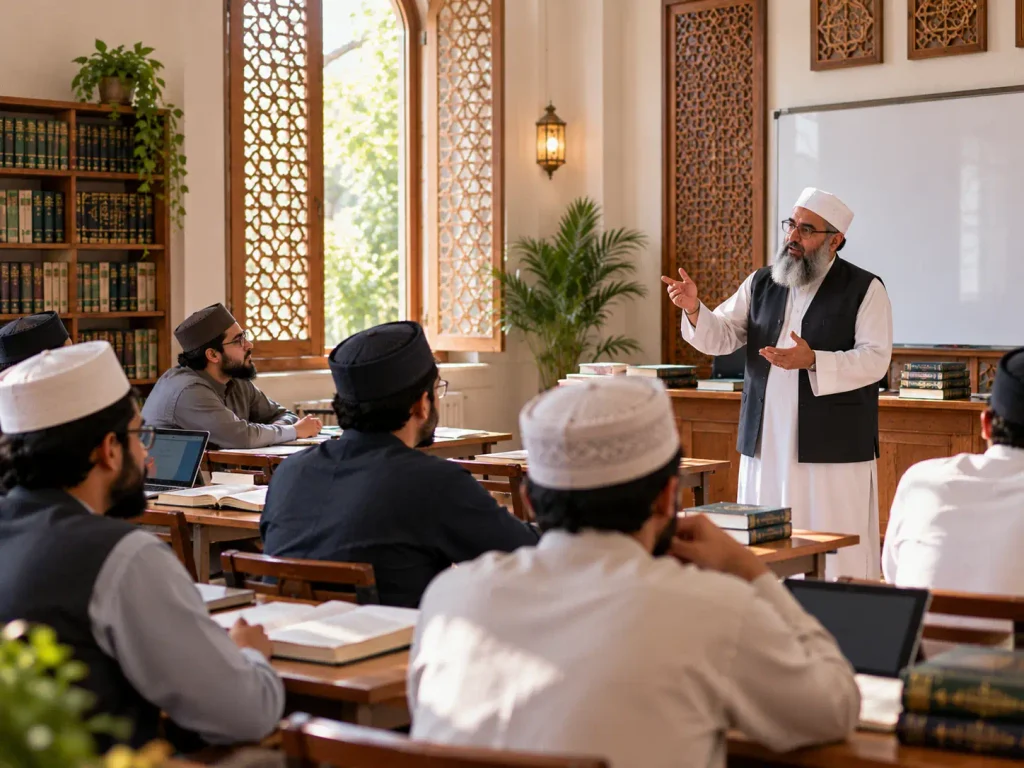
If you enjoy explaining Islamic concepts and helping others understand them, teaching could be a natural career choice. But Islamic teaching careers aren’t limited to madrasas. You could:
- Teach children in a school
- Prepare teenagers for board examinations
- Eventually lecture at a university.
The qualifications and teaching skills you’ll need depend on where you want to work.
Teaching in Traditional Madrasas
If you’ve completed an Aalim programme or studied Dars-e-Nizami, you may consider teaching the subjects you’ve spent years learning. Traditional madrasas offer several teaching responsibilities:
- Junior Instructor (Mudarris):
Introduces students to Arabic grammar, including Sarf (morphology) and Nahw (syntax), alongside foundational Islamic texts.
- Senior Instructor:
Teaches advanced subjects such as Usul al-Fiqh (principles of Islamic jurisprudence), Balaghah (Arabic rhetoric), and classical legal texts.
- Hadith Instructor (Shaykh al-Hadith):
An experienced scholar who teaches advanced Hadith collections, explaining narrations, their interpretations, and relevant scholarly discussions.
- Study Circle Supervisor:
Guides students through Takrar, where they revise lessons, discuss interpretations, and strengthen their understanding through peer learning.
These responsibilities vary between institutions. Strong subject knowledge matters, but so does your ability to explain difficult Arabic passages and recognise when students need additional guidance.
Teaching in Schools and International Institutions
Perhaps you’d prefer working with children and teenagers rather than teaching advanced classical texts. Mainstream schools offer several jobs in Islamic studies, including:
- Primary Islamic Studies Teacher:
Introduces younger students to Islamic beliefs, Seerah, character development (Akhlaq), and basic Quranic understanding.
- Secondary Islamiyat Teacher:
Prepares students for Matric examinations or international qualifications such as Cambridge O Level Islamiyat.
- Quranic Arabic Instructor:
Teaches students to understand Arabic vocabulary, grammar, and Quranic passages rather than relying entirely on memorisation.
A strong understanding of Islamic subjects alone isn’t enough for every school position. You’ll also need classroom management, lesson planning, assessment skills, and the ability to communicate with students at different learning levels.
Becoming a College or University Lecturer
If academic teaching interests you, further education may open opportunities in colleges and universities. Possible roles include:
- College Lecturer:
Teaches Islamic Studies or related subjects in government or private colleges. Public-sector appointments may involve competitive recruitment examinations and specific academic requirements.
- University Lecturer:
Teaches undergraduate courses, prepares assessments, and may contribute to departmental research.
- Assistant Professor or Professor:
Takes on advanced teaching, academic research, publication, and, where qualified, postgraduate supervision.
So, can an Aalim become a lecturer?
In Pakistan, the Higher Education Commission recognises qualifying Shahadatul Almiya credentials from approved institutions as equivalent to an MA in Arabic or Islamic Studies for specified teaching and further-study purposes.
However, equivalence doesn’t automatically qualify you for a university position. Each institution has its own recruitment standards, and advanced appointments generally require additional postgraduate qualifications.
Your academic background influences the career opportunities available with an Islamic Studies degree, but practical teaching experience and further study can be equally important.
Curriculum Development and Instructional Design
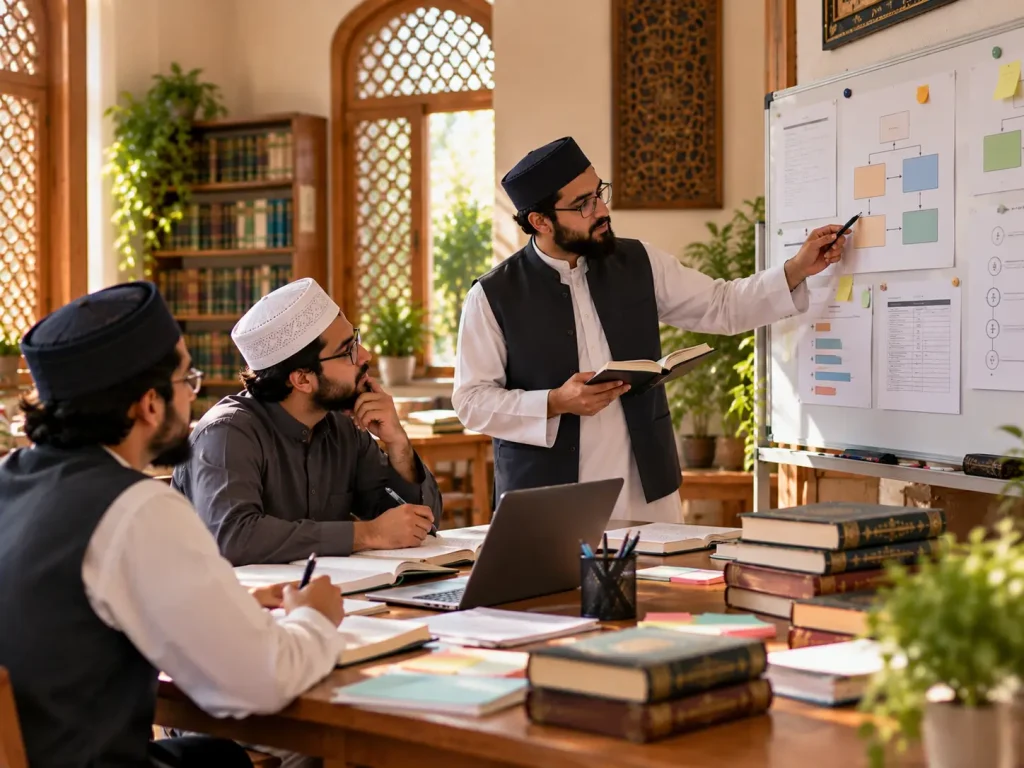
Not every educator spends their day teaching in front of students. Some work behind the scenes, deciding what students should learn, how lessons should progress, and how understanding should be assessed.
If you enjoy organising information, writing educational material, or improving how subjects are taught, curriculum development could be worth exploring.
What Does a Curriculum Designer Do?
Imagine a school wants to introduce Islamic Studies from Grade 1 through Grade 12. Students can’t reasonably begin with advanced discussions of jurisprudence. They need lessons that match their age, previous knowledge, and ability to understand new concepts.
A curriculum designer plans that progression, deciding which topics belong at each level, what students should achieve, and how teachers can assess their learning. The Quran emphasises developing religious understanding and sharing that knowledge with others:
“To obtain understanding in the religion and warn their people when they return to them that they might be cautious.” – (Surah At-Tawbah 9:122)
While the verse doesn’t prescribe modern curriculum design, it highlights the importance of gaining religious knowledge and communicating it responsibly.
Career Opportunities in Curriculum Development
Several Islamic education professions involve developing learning materials rather than delivering daily classroom lessons.
- Curriculum Developer:
Plans the sequence of Islamic Studies topics across grades, establishes learning objectives, and selects suitable teaching materials.
- Instructional Designer:
Converts educational material into online courses, interactive lessons, videos, and digital assessments.
- Assessment Specialist:
Creates examination questions, marking guides, and evaluation methods that measure students’ understanding rather than memorisation alone.
For example, an instructional designer developing a Seerah course might combine historical sources with timelines, interactive activities, and questions that encourage students to explain what they’ve learned.
The work combines Islamic knowledge and professional skills, particularly research, educational writing, digital literacy, and lesson planning.
If you want to pursue this career, familiarity with curriculum standards, learning objectives, assessment methods, and educational technology will strengthen your preparation.
Teacher Training and Professional Development
Have you ever attended a class where the teacher clearly understood the subject but struggled to explain it in a way students could follow?
Knowing Islamic texts and knowing how to teach them effectively require different skills. That’s why teacher training offers another career path for people with a background in Islamic education.
Instead of teaching students directly, you work with educators to improve their lessons, classroom management, and teaching methods.
Career Opportunities in Teacher Training
- Madrasa Teacher Trainer:
Helps instructors explain complex Islamic subjects through discussions, practical examples, and activities that encourage students to think critically.
- Islamic Studies Coordinator:
Observes lessons, supports teachers, reviews assessments, and maintains teaching standards across different grades.
- Professional Development Trainer:
Conducts workshops on lesson planning, student engagement, positive classroom discipline, and teaching students with different learning needs.
For example, you might help a Quran teacher develop activities that improve students’ understanding alongside memorisation, or guide a new Islamic Studies teacher in managing a classroom.
Pakistan’s Higher Education Commission also recognises professional development as an important part of improving:
- Teaching quality
- Research
- Educational leadership.
To pursue this career, you’ll generally need:
- Teaching experience
- Strong communication
- A sound understanding of educational methods.
Emotional intelligence, active listening, and constructive feedback are among the skills for Islamic Studies graduates that become especially valuable when mentoring other educators.
Academic Administration and Educational Leadership
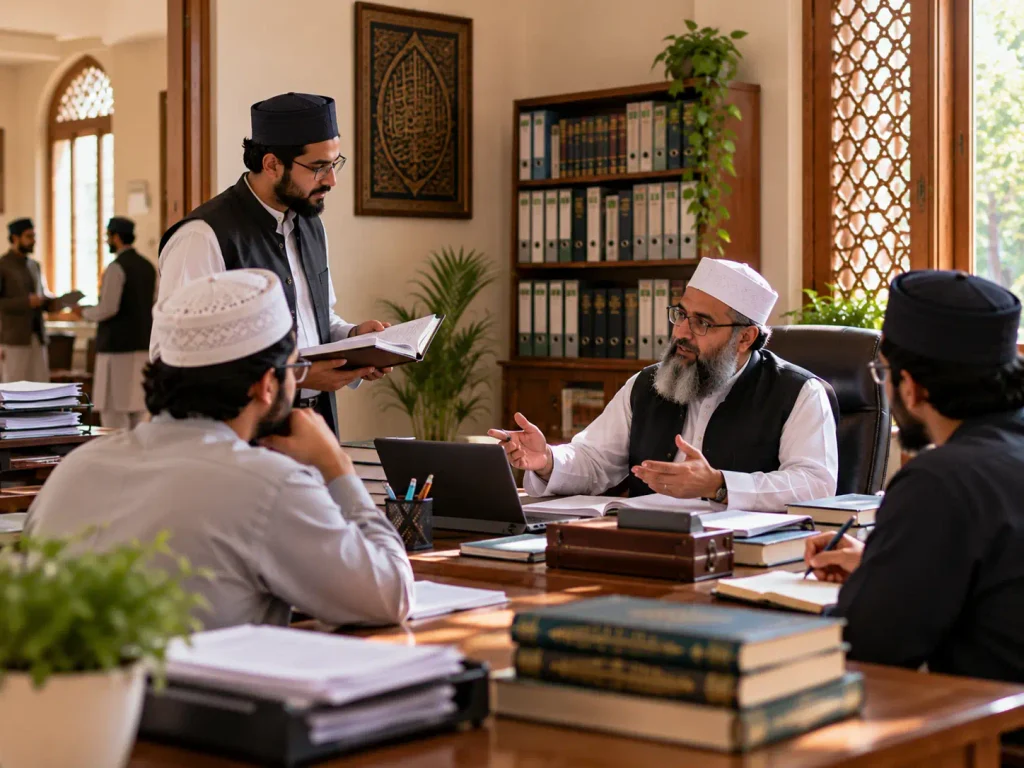
Perhaps you enjoy organising academic activities, solving problems, or managing teams more than delivering classroom lessons. If so, academic administration may suit your interests.
Schools, universities, and madrasas need professionals who manage admissions, coordinate teachers, maintain academic records, and ensure that institutional policies are followed.
Your understanding of Islamic education can be particularly useful in organisations where academic decisions must also reflect religious values.
Career Opportunities in Academic Administration
- School Principal or Academic Head:
Oversees teaching quality, staff development, student welfare, and institutional planning. Senior appointments usually require substantial educational and leadership experience.
- Madrasa Registrar or Academic Coordinator:
Manages student admissions, examination records, academic calendars, and communication with relevant examination bodies.
- Academic Quality or Compliance Officer:
Supports institutional documentation, programme reviews, and compliance with applicable education standards.
For example, an academic coordinator at a madrasa might manage Wifaq examination registrations while ensuring students and teachers follow the academic calendar.
In universities, quality assurance professionals work with institutional policies and requirements established by bodies such as the Higher Education Commission. Madrasa registration and administration involve different authorities and requirements, including those of the Directorate General of Religious Education.
Professional responsibility also has a place in Islamic teachings. A narration attributed to Prophet Muhammad (PBUH) states:
“Verily, Allah loves that when any one of you does a job, he should perfect it.” – (Shu’ab al-Iman, Al-Bayhaqi 4929)
The ability to manage educational institutions also demonstrates how Islamic scholars can work outside madrasas, particularly when religious knowledge is combined with administrative experience, communication, and leadership skills.
Islamic Research and Policy Analysis
If you enjoy examining classical texts, investigating religious questions, or comparing scholarly interpretations, research may be worth considering.
Islamic Studies research careers allow you to examine issues affecting Muslim communities, from education and family life to Islamic finance, technology, and contemporary ethics. You might work with a university department, research institute, academic journal, or organisation conducting policy research.
Career Opportunities in Islamic Research
- Academic Researcher:
Studies Quranic sciences, Hadith, jurisprudence, Islamic history, or contemporary issues and prepares research papers for publication.
- Manuscript Researcher:
Examines historical Arabic manuscripts, compares different copies, and contributes to annotated scholarly editions through Tahqiq.
- Research or Policy Associate:
Investigates social, educational, or legal questions and prepares evidence-based reports for academic or policy organisations.
- Islamic Ethics Researcher:
Studies questions involving medical ethics, artificial intelligence, or financial practices. Specialist advisory positions generally require additional training in the relevant field.
For example, you might research how Islamic educational institutions can improve student learning or examine scholarly approaches to ethical questions raised by artificial intelligence.
Pakistan already has established outlets for this work. The Islamic Research Institute publishes the peer-reviewed journal Islamic Studies, covering classical Islamic disciplines alongside contemporary academic subjects.
What Skills Do Islamic Researchers Need?
Strong Arabic comprehension provides a foundation, but academic research requires much more. You’ll need to develop critical reading, research methodology, evidence evaluation, academic English, and accurate referencing skills.
Familiarity with citation systems such as Chicago or APA and reference-management tools such as Zotero can also be valuable.
Research positions often require postgraduate qualifications, particularly when the work involves independent academic publication or specialist advisory responsibilities.
The range of Islamic Studies research careers depends on your academic specialisation, research experience, and ability to communicate findings clearly.
Publishing, Translation, and Islamic Media
You don’t necessarily need to teach or conduct university research to make use of your Islamic education. If you enjoy writing, translation, editing, or storytelling, you may find opportunities in Islamic publishing and media.
Religious books, educational websites, documentaries, online courses, and podcasts all require people who understand Islamic sources and can communicate them accurately.
Career Opportunities in Publishing and Media
- Islamic Text Translator:
Translates Arabic, Urdu, or Persian religious literature into another language while preserving the meaning and context of the original.
- Academic Editor:
Reviews manuscripts for clarity, consistency, terminology, and source accuracy. Advanced critical editing requires specialist knowledge of manuscripts and textual scholarship.
- Educational Content Writer:
Develops Islamic Studies textbooks, learning materials, articles, and educational resources for different age groups.
- Scriptwriter or Research Producer:
Researches Islamic history, Seerah, or contemporary religious topics and develops scripts for documentaries, podcasts, or educational videos.
Imagine working on a documentary about a historical Muslim scholar. Your responsibilities might include:
- Verifying historical accounts
- Selecting reliable references
- Writing the narration
- Ensuring the final script presents the subject accurately.
Or you might translate a classical Arabic text into accessible English, helping readers understand concepts that would otherwise require advanced language training.
Skills That Matter in Islamic Publishing
Religious knowledge gives you the foundation, but employers may also look for strong writing, editing, translation, fact-checking, and digital production skills.
A translator needs command of both languages, while a media researcher must distinguish reliable sources from unsupported historical claims. These abilities are particularly relevant to Islamic scholars pursuing media careers, where accuracy matters as much as clear communication.
You can begin developing these skills by writing researched articles, translating shorter passages under qualified supervision, or contributing to educational publications. Such projects also help you build a portfolio that demonstrates your abilities to prospective employers.
Educational Technology and Digital Learning
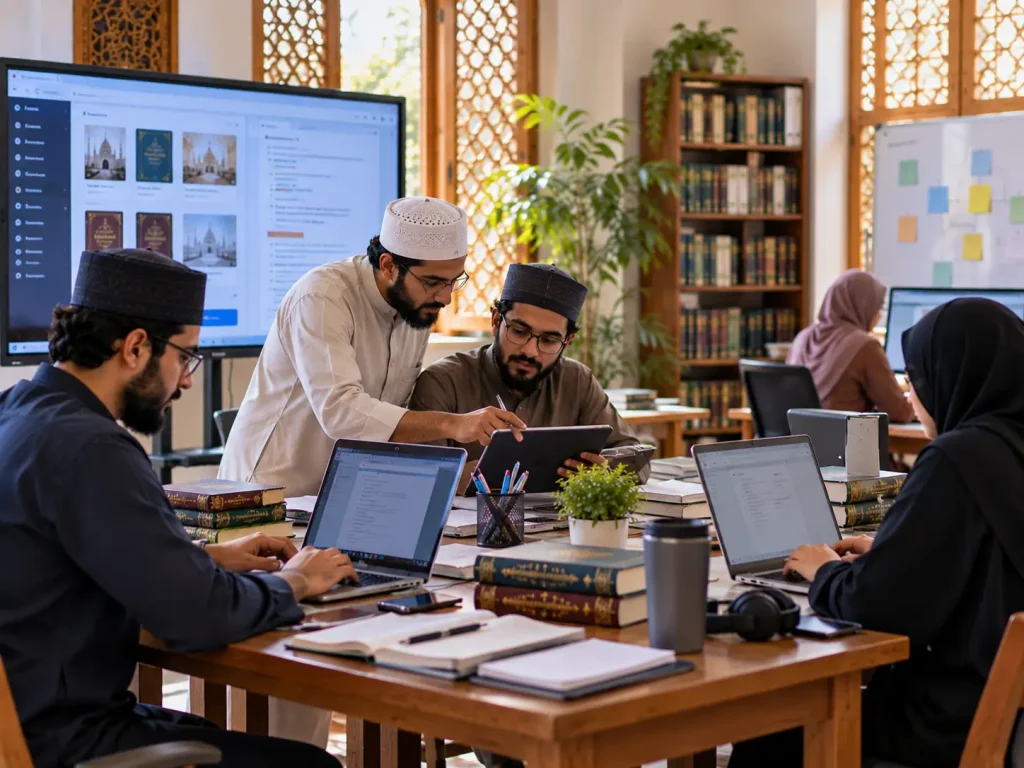
If you enjoy experimenting with digital tools, careers in Islamic education also extend into educational technology, commonly known as EdTech.
Think about a Quran learning app or an online Arabic course. Software developers build the technology, but someone also needs to check whether the lessons are accurate, the references are reliable, and the explanations make sense to students.
Your background in Islamic Studies could be valuable in that process, especially if you develop digital research and content-development skills.
Career Opportunities in Islamic EdTech
- Subject Matter Expert (SME):
Works with developers and course designers to review Islamic learning materials, check references, and create suitable learning activities.
- AI Knowledge Auditor:
Evaluates AI-generated Islamic content, identifies inaccurate quotations or fabricated citations, and checks answers against reliable scholarly sources.
- Digital Content Architect:
Organises Quranic, Hadith, and Arabic educational content into searchable databases and learning resources.
- Digital Manuscript Archivist:
Assists with digitising, cataloguing, and indexing historical Islamic texts using metadata and specialised software.
Imagine an educational app incorrectly attributing a Hadith to Prophet Muhammad (PBUH). A qualified researcher could identify the problem, check the original source, and help the development team correct the content.
You don’t necessarily need to become a software engineer. However, understanding spreadsheets, research databases, digital publishing, AI evaluation, and basic technical workflows will strengthen your preparation.
The growing use of technology for Islamic scholars creates opportunities to combine textual knowledge with digital skills, although specialist positions often require practical experience or additional technical training.
Career Opportunities Beyond Educational Institutions
Your career doesn’t have to remain within schools, universities, or educational platforms.
Some Islamic Studies graduates pursue additional qualifications that allow them to work in specialised professional fields.
1. Islamic Banking and Shariah Compliance
Can an Aalim work in Islamic finance?
Yes, although classical Islamic education alone may not meet the requirements for specialist financial positions.
If you study Fiqh al-Mu’amalat (Islamic commercial jurisprudence), you already have a foundation for understanding Islamic financial contracts. Developing knowledge of accounting, banking, financial regulation, and commercial law may open additional opportunities. Potential roles include:
- Shariah compliance researcher
- Islamic banking compliance officer
- Shariah audit professional
- Islamic finance research associate
Pakistan’s State Bank Shariah Governance Framework establishes responsibilities for Shariah boards, compliance functions, and auditing within Islamic banking institutions. Professional qualifications offered by AAOIFI may support further specialisation.
These positions have different eligibility requirements. Senior advisory appointments generally demand substantial scholarly expertise, specialist qualifications, and professional experience.
2. Advanced Academic Research
If you want to pursue university research or postgraduate teaching, your qualifications will play an important role.
A recognised bachelor’s degree or an eligible traditional qualification with the required equivalence may provide a route into further education.
You might progress through an MS or MPhil before applying for doctoral research.
If you’re considering further study in Islamic Studies, compare university admission requirements, research opportunities, and possible areas of specialisation before choosing a programme.
An MS or PhD may strengthen your preparation for research and academic positions, but each institution determines its own hiring requirements.
Comparing Careers in Islamic Education
Not sure which direction suits you? The following comparison may help you connect your interests with possible career paths.
| Career Field | Possible Roles | Skills to Develop | Further Preparation |
| Teaching | Islamic Studies teacher, madrasa instructor, lecturer | Subject knowledge, communication, classroom management | Teaching experience and relevant academic credentials |
| Curriculum Development | Curriculum writer, instructional designer | Lesson planning, assessment, educational writing | Curriculum training or educational qualifications |
| Teacher Training | Teacher coach, subject coordinator | Mentoring, observation, constructive feedback | Classroom experience and professional training |
| Administration | Academic coordinator, registrar, principal | Leadership, planning, education governance | Administrative experience and relevant qualifications |
| Research | Research assistant, academic researcher | Arabic, research methods, academic writing | Postgraduate study for advanced roles |
| Publishing and Media | Translator, editor, scriptwriter | Translation, source verification, storytelling | Language proficiency and a professional portfolio |
| Educational Technology | Content specialist, AI auditor, digital archivist | Digital literacy, source analysis, content management | Technical training and practical projects |
The qualifications listed are general preparation routes, not universal hiring requirements. Individual employers may ask for specific degrees, certifications, or experience.
Preparing for Different Career Paths: The SISL Approach
When you’re considering an Aalim programme, it’s worth examining both the Islamic subjects you’ll study and the professional skills you’ll develop alongside them.
For example, strong Arabic comprehension may prepare you for classical research, but curriculum design also requires knowledge of teaching methods. Similarly, academic publishing calls for accurate referencing and clear writing.
The School of Islamic Scholars & Leaders (SISL) at Al-Kawthar University, Karachi, offers an eight-year Islamic Scholar & Leaders Program that combines Dars-e-Nizami with university education.
According to its published academic roadmap, students progress towards a BS in Islamic Studies by Year 6 and an MS in Islamic Studies by Year 8, alongside traditional Wifaq qualifications.
The programme also includes areas such as:
- Arabic language and classical Islamic sciences
- Academic English, research, and communication
- Leadership and critical thinking
- Computer literacy and digital research
The intention is to develop students’ classical scholarship alongside skills relevant to teaching, research, communication, and other professional fields.
If you’re comparing Islamic education programmes, examine their curricula, qualification requirements, teaching methods, and opportunities for practical experience. The right choice should reflect the kind of work you hope to pursue.
Choosing a Career That Fits Your Strengths
You don’t need to have your entire career planned before beginning Islamic education. But understanding the available opportunities can make your academic decisions more meaningful.
If you enjoy explaining ideas, teaching or teacher training might suit you. If you prefer research and writing, consider publishing or academic work. If technology interests you, digital education offers another direction worth exploring.
The important question isn’t simply which jobs are available. It’s which skills and qualifications you’ll need to pursue the work that interests you.
As you consider your next step, look for opportunities to develop sound Islamic knowledge, practical experience, and the professional abilities your chosen field requires.
Frequently Asked Questions
Can someone with an Islamic education background work in EdTech?
Yes. Islamic Studies graduates may contribute as content researchers, subject experts, or source-verification specialists. You’ll also need digital literacy and relevant practical skills, particularly when working with software developers or AI-based learning platforms.
Do you need a university degree to become a curriculum designer?
Not every curriculum position requires the same qualification. Some employers value traditional scholarship and experience, while others require a recognised degree. Knowledge of instructional design, assessment, and educational writing can strengthen your applications.
How can an Aalim move into teacher training or administration?
Start by gaining classroom experience and developing skills in lesson planning, staff mentoring, and educational management. A B.Ed, relevant professional certification, or recognised university qualification may strengthen your opportunities, depending on the employer.
What professional skills are useful for Islamic Studies graduates?
Academic English, Arabic proficiency, research, communication, teaching methods, and digital literacy are valuable across many roles. Project management, leadership, and familiarity with research software may also support careers outside traditional classroom teaching.
Was this article helpful?