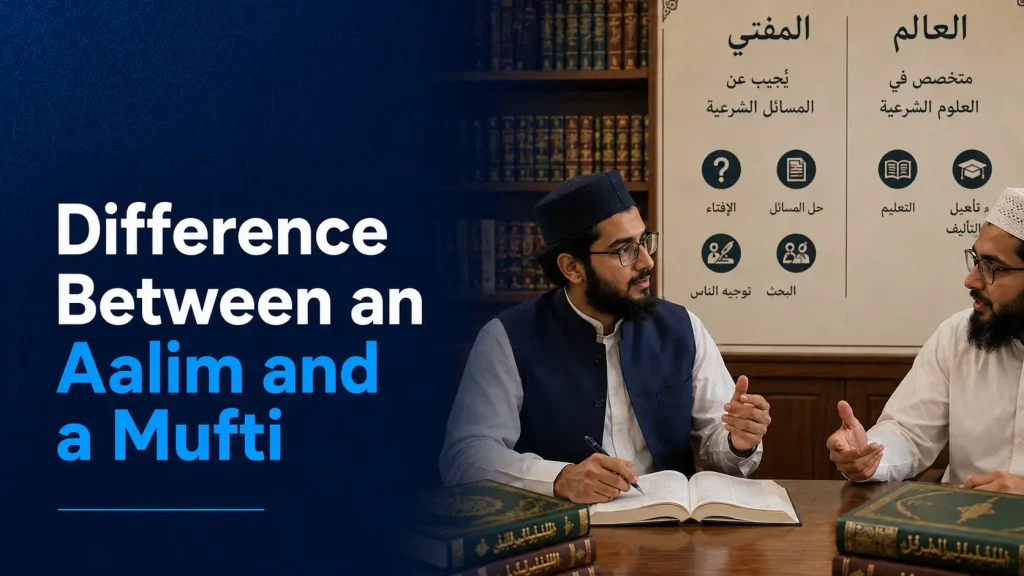
The main difference between an Aalim and a Mufti lies in the depth of legal specialization. An Aalim completes broad training in Islamic sciences such as Arabic, Tafsir, Hadith, Fiqh, and Usul al-Fiqh, preparing them to teach and explain religious texts. A Mufti usually builds on that foundation through advanced study in Fiqh and Ifta, with specific training in researching complex cases and issuing formal fatwas.
You need an Islamic opinion on something. When you start looking for someone to ask, two titles often come up: Aalim and Mufti.
As someone seeking guidance, the question naturally follows:
What’s the difference between an Aalim and a Mufti, and who should you approach?
An Aalim receives broad training across the Islamic sciences and may teach, explain religious matters, and guide people on established rulings. A Mufti builds on that foundation through further specialization in Fiqh and Ifta, preparing them to research complex legal questions and issue formal fatwas.
The Qur’an reminds believers to seek knowledge from those qualified to provide it:
“So ask the people of the message if you do not know.” – (Surah An-Nahl 16:43)
This guide explores the core difference between an Aalim and a Mufti, how their training differs, what each role involves, and who you should approach when you need Islamic guidance.
What Is an Aalim?
The title Aalim comes from the Arabic word ‘Ilm, meaning knowledge. An Aalim is an Islamic scholar who has completed several years of formal study across the main Islamic sciences under qualified teachers. In South Asia, this education commonly follows the Dars-e-Nizami curriculum or a similar scholar-training program.
Rather than specializing immediately in one area, you study several disciplines that help you understand the Qur’an, Hadith, Islamic law, and classical scholarship in greater depth.
What Does an Aalim Study?
Aalim training usually covers subjects such as:
- Arabic Language
Sarf, Nahw, and Balaghah help you understand the grammar, sentence construction, and expression found in classical Arabic texts.
- Quranic Sciences
Tafsir and its principles help you understand how scholars interpret the Qur’an and approach its verses within their linguistic and scholarly context.
- Hadith Sciences
You study major Hadith collections alongside the principles scholars use to understand narrations, their transmission, and their application.
- Fiqh and Usul al-Fiqh
Fiqh introduces Islamic rulings across areas such as worship, family matters, and financial dealings, while Usul al-Fiqh examines the principles behind legal reasoning.
- Aqeedah and Mantiq:
These subjects introduce Islamic creed and methods of reasoning that appear throughout classical scholarly works.
As you move through an Aalim course syllabus, these subjects build on one another, giving you the broader grounding needed before pursuing a particular area of Islamic scholarship in greater depth.
What Does an Aalim Do?
After completing scholar training, an Aalim may teach Islamic sciences, deliver sermons, lead prayers, mentor community members, conduct research, and explain established religious teachings within the scholar’s area of knowledge.
The responsibility attached to Islamic knowledge is reflected in a well-known saying of Prophet Muhammad (PBUH):
“Indeed, the scholars are the inheritors of the Prophets. The Prophets did not leave behind dinars or dirhams, but they left behind knowledge, and whoever takes it has taken a bountiful share.” – (Jami` at-Tirmidhi 2682)
The breadth of an Aalim’s education is important to the distinction at the heart of this discussion. You receive training across several Islamic sciences as an Aalim, while becoming a Mufti requires deeper specialization in Islamic jurisprudence and Ifta.
What Is a Mufti?
A Mufti is a scholar who has advanced training in Islamic jurisprudence and the process of issuing fatwas. In the South Asian scholarly tradition, a Mufti usually completes Aalim training first and then continues into a specialization known as Takhassus fi al-Ifta.
The difference lies in focus. As an Aalim, you study broadly across Arabic, Tafsir, Hadith, Fiqh, Usul al-Fiqh, and other Islamic sciences. Ifta training takes you deeper into Islamic law, where you learn how to research specific cases, examine relevant legal principles, and formulate formal religious opinions.
What Does a Mufti Study?
Before reaching Ifta, you need the grounding covered in what an Aalim studies. The specialization then builds on that knowledge through more focused work in areas such as:
- Advanced Fiqh
Studying detailed legal discussions and understanding how earlier jurists approached different circumstances.
- Usul al-Fiqh
Applying the principles of Islamic legal reasoning when examining questions and evidence.
- Fatwa Research
Learning how to locate relevant rulings, compare scholarly positions, and identify the details that affect a particular case.
- Contemporary Issues
Examining questions involving finance, family matters, medicine, technology, inheritance, and other areas where new circumstances require careful legal study.
- Fatwa Writing:
Learning how to present a ruling clearly, support it through recognized scholarly sources, and address the facts of the question being asked.
What Does a Mufti Do?
A Mufti deals with questions that require deeper legal analysis than a general explanation of an established ruling.
Someone may approach a Mufti about the terms of a business contract, a complicated inheritance dispute, a divorce case, or a new financial arrangement where the relevant ruling depends heavily on the details.
The Mufti examines those details before consulting the relevant Qur’anic guidance, Hadith, Fiqh literature, legal principles, and scholarly precedent. A fatwa is then issued as a formal religious opinion based on that research.
Islamic scholars have long treated Ifta as a serious responsibility. A report recorded in Sunan ad-Darimi warns:
“The most daring of you in issuing fatwas is the most daring toward the Fire.” – (Sunan ad-Darimi 157)
The warning reflects why becoming a Mufti involves further study after general scholar training.
Issuing a fatwa requires more than knowing an Islamic ruling. You need to understand the case in front of you, the legal principles involved, and how earlier scholarship applies to the circumstances being examined.
Aalim vs. Mufti: Side-by-Side Comparison
The clearest way to understand the difference between an Aalim and a Mufti is to compare what each one studies and what that training prepares them to do.
| Criteria | Aalim | Mufti |
| Training | Completes broad scholar training across the Islamic sciences | Completes Aalim training before pursuing further specialization in Fiqh and Ifta |
| Main Areas of Study | Arabic, Tafsir, Hadith, Fiqh, Usul al-Fiqh, Aqeedah, and related disciplines | Advanced Fiqh, legal research, Ifta, fatwa writing, and the study of complex cases |
| Main Responsibilities | Teaching, explaining established religious guidance, mentoring, and community work | Researching detailed legal questions and issuing formal fatwas |
| Approach to Legal Questions | Explains established rulings within the scholar’s area of knowledge | Examines specific circumstances and applies Islamic legal principles to the case |
| Further Study | May continue into teaching, research, or another area of specialization | Pursues dedicated training in Ifta after general scholar education |
The distinction also helps when comparing traditional scholar training with academic Islamic Studies degree tracks.
An Aalim or Mufti spends significant time working with Arabic and classical Islamic texts, while a university Islamic Studies degree usually places greater emphasis on academic research, history, and the study of Islam within a university setting.
How Does an Aalim Become a Mufti?
Completing your Aalim studies doesn’t automatically make you a Mufti. If you want to specialize in Islamic jurisprudence and issue formal fatwas, you need further training in Ifta after completing your broader scholarly education.
The exact duration and curriculum differ between institutions, but the path usually begins after Dars-e-Nizami or equivalent Aalim training. Your earlier study of Arabic, Fiqh, Hadith, and Usul al-Fiqh gives you the foundation needed to move into more detailed legal research.
| From Aalim to Mufti | |
| Stage | What It Involves |
| 1. Complete Aalim Training | Finish Dars-e-Nizami and advanced Hadith study |
| 2. Study Ifta Principles | Study legal methodology, Fiqh, and Islamic legal maxims |
| 3. Practise Fatwa Research | Research cases and draft responses under qualified supervision |
| 4. Complete Ifta Specialization | Meet the academic and practical requirements set by the institution |
1. Learn the Principles of Ifta
Your first task is learning how a Mufti approaches a legal question. A question rarely arrives in the same wording as a classical Fiqh text, so you need to understand the circumstances properly before searching for the relevant ruling.
Study in Rasm al-Mufti and related areas teaches you how to navigate classical legal works, understand differences between jurists, recognise which opinions carry authority within a legal school, and determine which discussions apply to the case you’re examining.
The broader Dars-e-Nizami curriculum matters at this stage because Ifta builds directly on the Arabic, Fiqh, Usul, and textual study you’ve already completed.
2. Apply Legal Maxims
You also study Qawa’id Fiqhiyyah, or Islamic legal maxims, which help you understand how broader legal principles relate to individual cases.
Principles such as “certainty isn’t removed by doubt” and “harm must be removed” appear across many areas of Fiqh.
Learning how jurists use these principles helps you examine unfamiliar situations without treating every new question as completely disconnected from earlier scholarship.
3. Practise Fatwa Research Under Supervision
A major part of Ifta training involves working through questions yourself. You research the issue, identify the relevant Fiqh discussions, examine the circumstances, and prepare a written response.
Your work is then reviewed by experienced scholars who identify problems in your reasoning, use of sources, understanding of the case, or wording of the answer. Repeating that process develops the judgement required to move from knowing Islamic law academically to applying it carefully to real questions.
4. Complete Your Ifta Specialization
Finishing the required study and supervised practice leads to qualification according to the standards of the institution and scholars overseeing your training. At that point, the title Mufti reflects an added area of specialization beyond your broader education as an Aalim.
The distinction matters because Ifta carries a specific responsibility. You’re no longer only explaining a ruling you’ve studied. You’re examining the facts of a particular case, researching the relevant legal tradition, and determining how that scholarship applies before giving a formal religious opinion.
Can an Aalim Give a Fatwa?
Aalim training alone doesn’t automatically qualify someone to issue formal fatwas. An Aalim has broad knowledge across the Islamic sciences and may answer many everyday religious questions within the scope of their training.
Ifta requires further expertise in Fiqh, legal research, and applying Islamic rulings to the details of a particular case. The difference becomes easier to understand when you look at the kinds of questions you might ask each scholar.
| General Religious Guidance | Questions Requiring Ifta |
| Explaining prayer and fasting rules | Examining a complicated divorce case |
| Teaching the principles of Zakat | Reviewing the terms of a financial contract |
| Explaining Qur’anic verses and Hadith | Resolving a complex inheritance question |
| Providing religious advice and mentorship | Examining new medical or financial issues |
What Can You Ask an Aalim?
For many everyday questions, an Aalim may provide the guidance you need. Their broad education prepares them to explain established teachings and help you understand how they relate to your religious practice.
You might approach an Aalim for:
- Guidance on Wudu, Ghusl, Salah, and fasting.
- An explanation of common Zakat principles.
- Help understanding a Qur’anic verse or Hadith.
- Questions about Islamic manners, worship, and personal conduct.
- Religious teaching, mentorship, or general spiritual guidance.
Working confidently with classical Arabic also helps an Aalim engage with the Qur’an, Hadith, and scholarly texts in their original language rather than relying entirely on translations.
When Should You Approach a Mufti?
A Mufti becomes especially important when your question depends on specific circumstances, competing legal considerations, or an issue that requires detailed research before a ruling is given.
You may need a Mufti for matters such as:
- Marriage and Divorce:
Questions involving conditional divorce statements, Khula, or circumstances where the exact wording and sequence of events affect the ruling.
- Business and Finance:
Partnership agreements, investments, financing arrangements, digital transactions, or contracts that require detailed review.
- Inheritance:
Estates involving several heirs, previous transfers, debts, wills, or disagreements over ownership.
- Medical Questions:
Organ donation, fertility treatment, end-of-life care, and other matters where Islamic law needs to be considered alongside medical facts.
In cases like these, the details matter. A Mufti examines what happened, researches the relevant Fiqh, and considers how established legal principles apply before giving a formal fatwa.
What Do Aalims and Muftis Do in Practice?
The difference between the two roles becomes clearer when you look at the work each scholar may take on after completing their studies.
Where an Aalim May Serve
An Aalim’s broad education opens several ways to teach and serve a community:
- Teaching:
Teaching Arabic, Tafsir, Hadith, Fiqh, or other Islamic sciences.
- Mosque Leadership:
Leading prayers, delivering Khutbahs, and teaching regular study circles.
- Community Mentorship:
Helping people understand everyday religious matters and providing Islamic guidance.
- Educational Work:
Writing, researching, creating educational content, or teaching through schools and Islamic institutions.
Those possibilities form part of the wider career options after becoming an Aalim, especially as Islamic education now reaches people through universities, research, community organisations, and digital platforms.
Where a Mufti May Serve
A Mufti’s deeper training in Ifta may lead to work that involves more detailed legal research, including:
- Fatwa Research:
Receiving questions, researching the relevant Fiqh, and preparing formal religious opinions.
- Family and Inheritance Matters:
Examining cases where the ruling depends heavily on personal circumstances and legal details.
- Islamic Finance:
Some Muftis specialize further in commercial Fiqh and advise financial institutions on Shariah-related matters.
- Contemporary Questions:
Researching new issues involving medicine, technology, business, and other areas that require detailed juristic study.
Your career after scholar training therefore depends partly on how far you want to specialize. General Aalim training gives you breadth across the Islamic sciences, while Ifta develops deeper expertise in Islamic jurisprudence.
Choosing Your Path in Islamic Scholarship
You don’t need to begin scholar training with every future specialization already decided. Your first priority is developing a strong foundation across Arabic, Tafsir, Hadith, Fiqh, Usul al-Fiqh, and the other disciplines that support deeper Islamic study.
Build Your Foundation Before Specializing
If becoming a Mufti interests you, Aalim training gives you the knowledge required before entering Ifta. Years spent studying Arabic and classical texts matter because advanced legal research assumes that foundation is already in place.
As you progress, you may discover that your interests lie in Fiqh and Ifta, Hadith, Tafsir, Islamic education, research, or another area of scholarship. Specialization then gives you the opportunity to pursue that field in greater depth.
Studying Islamic Scholarship at SISL
At the School of Islamic Scholars & Leaders (SISL), you pursue Dars-e-Nizami alongside university education through the eight-year Islamic Scholar & Leaders Program. The program brings classical Islamic study together with academic research, communication, critical thinking, leadership, and technology.
| Islamic Scholar Training | University and Professional Development |
| Dars-e-Nizami studies | University education in Islamic Studies |
| Arabic, Tafsir, Hadith, Fiqh, and Usul | Academic research and writing |
| Study of classical Islamic texts | Communication and critical thinking |
| Traditional Sanad pathway | Leadership and technology skills |
The combined path gives you broad scholar training while keeping further academic and professional options open. Understanding how long it takes to become an Aalim also helps you consider the commitment involved before choosing your program.
Once you’ve completed your general scholar education, the study options after an Aalim course may include further academic study or specialization in an area such as Ifta, depending on the path you want to pursue.
Understanding Who to Approach for Islamic Guidance
The difference between an Aalim and a Mufti ultimately comes down to breadth and specialization. An Aalim studies across the Islamic sciences and helps people understand established religious teachings, while a Mufti goes deeper into Fiqh and Ifta to research questions that require formal legal analysis.
Knowing the difference helps you approach the right scholar when you need guidance. A question about everyday worship may require an explanation from a knowledgeable Aalim, while a complicated divorce, inheritance, financial, or medical matter may need the deeper legal expertise of a Mufti.
For those considering the scholarly path themselves, the journey begins with a strong foundation. SISL’s Islamic Scholar & Leaders Program brings Dars-e-Nizami and university education into the same eight-year pathway, giving you the broad Islamic education from which teaching, research, community service, and further specialization may follow.
Frequently Asked Questions
Can a female Islamic scholar become a Mufti?
Yes. A female scholar with the required Islamic education may pursue advanced Ifta training and qualify to issue fatwas. The exact pathway and title vary between institutions.
Is a fatwa legally binding in a civil court?
Generally, no. A fatwa is a religious legal opinion rather than a court judgment. Its legal effect depends on the judicial system of the country involved.
Does every Mufti follow a particular Madhhab?
Many Muftis train within a recognized Madhhab and follow its legal methodology when researching rulings. Approaches may differ across scholarly institutions and traditions.
How do you know whether someone is qualified to issue fatwas?
Look at their scholarly training, Ifta specialization, teachers, supervising institution, and experience in formal fatwa research rather than relying on the title alone.