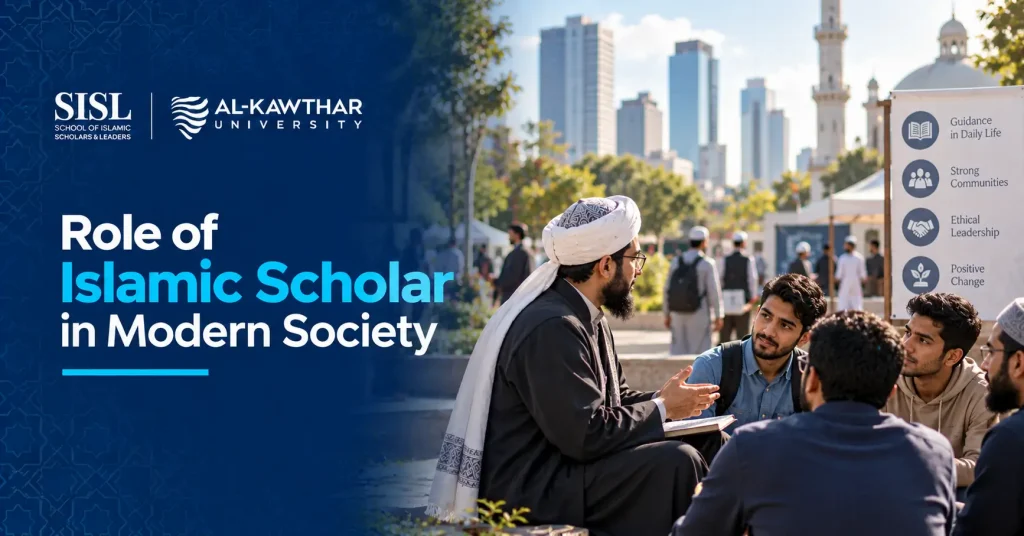
The role of an Islamic scholar in modern society extends beyond religious teaching to include guidance, research, community service, and public communication.
- Education: Teaching Islamic knowledge in madrasas, schools, universities, and online.
- Religious Guidance: Helping people understand Islamic principles and make informed ethical decisions.
- Research: Examining contemporary issues through Quran, Hadith, and Islamic scholarship.
- Community Welfare: Supporting charitable work, education, and community development.
- Institutional Consultation: Advising organisations on relevant Islamic principles and ethical matters.
- Digital Communication: Sharing reliable Islamic knowledge through media and online platforms.
- Collaboration: Working with medical, legal, financial, and technology specialists when issues require their expertise.
Over the past two centuries, changes in religious and secular education have gradually narrowed how Islamic scholars (Ulema) are perceived in some communities. Their responsibilities are often associated mainly with leading daily prayers, officiating Nikah, conducting Janazah, and delivering Friday sermons.
While these duties remain essential, limiting scholars to religious ceremonies overlooks their wider contribution to society. Today, communities face complex questions involving Islamic finance, medical ethics, artificial intelligence, family relationships, and the challenges young Muslims encounter with faith and identity.
Historically, Islamic scholars also served as jurists, educators, advisers, and administrators of charitable endowments (Waqf). Their responsibility to preserve and share knowledge is reflected in the words of Prophet Muhammad (peace be upon him):
“The learned are the heirs of the Prophets, and the Prophets leave neither dinar nor dirham, leaving only knowledge” – (Sunan Abi Dawud 3641)
Understanding the role of an Islamic scholar in modern society means recognising these responsibilities while knowing when to collaborate with specialists in medicine, law, economics, and technology.
Whether you’re a seminary student, an Aalim, or exploring career opportunities with an Islamic Studies degree, this guide examines six responsibilities that define the role of Ulema today.
Six Responsibilities of Islamic Scholars in Modern Society
The role of Ulema today involves several responsibilities extending beyond religious instruction. Scholars contribute to:
| Responsibility | Contribution to Society |
| 1. Teaching and Mentorship | Educating students and developing their understanding of Islam |
| 2. Spiritual and Family Guidance | Providing religious counsel and supporting families |
| 3. Research and Policy | Examining contemporary issues through Islamic scholarship |
| 4. Institutional Consultation | Advising organisations on relevant Islamic principles |
| 5. Public Communication | Explaining Islamic teachings through writing, speaking, and digital media |
| 6. Community Welfare | Supporting Zakat, Waqf, and charitable initiatives |
Across these responsibilities, scholars need both a sound understanding of Islamic sources and an accurate picture of the circumstances in which their guidance will be applied.
Understanding Islamic Texts and Contemporary Realities
How should a scholar approach a question about an unfamiliar financial product, an emerging medical treatment, or the use of artificial intelligence?
Classical Islamic scholarship provides the principles needed to examine such matters. However, reaching a well-informed conclusion also requires understanding how the product, treatment, or technology actually works.
A scholar examining a banking contract, for example, needs to know its terms, how payments are calculated, and which risks the parties assume before applying relevant Islamic legal principles.
This relationship between textual understanding and practical circumstances has long been recognised in Islamic jurisprudence. In I’lam al-Muwaqqi’in, Ibn al-Qayyim wrote:
“The mufti or judge is not able to issue a fatwa or verdict without understanding two things:” – Ibn al-Qayyim, I’lam al-Muwaqqi
Ibn al-Qayyim goes on to explain those two requirements: understanding the actual circumstances of a matter and understanding the relevant Islamic ruling. For contemporary Ulema, this involves two complementary areas of knowledge:
- Understanding Islamic Sources:
Studying the Quran, Sunnah, Usul al-Fiqh, legal maxims (Qawa’id Fiqhiyyah), and the objectives of Islamic law (Maqasid al-Shariah).
- Understanding Contemporary Circumstances:
Examining the social, economic, legal, and technical details of a question before offering guidance.
No individual scholar needs to become an expert in every professional discipline. When an issue involves medicine, finance, law, or technology, consulting qualified specialists is an important part of understanding it accurately.
For Aalims interested in applying their knowledge professionally, exploring whether Islamic scholars can work outside madrasas provides examples of fields where religious scholarship and specialised expertise intersect.
Teaching and Intellectual Mentorship
Education remains one of the central responsibilities of Islamic scholars. However, students now encounter religious information through many different sources, including:
- Websites
- Videos
- Social media
- AI-powered tools.
Access to information doesn’t necessarily mean students know how to evaluate it. Someone may find several conflicting opinions about an Islamic question online without understanding the evidence, scholarly methods, or circumstances behind each view.
A knowledgeable teacher can explain those differences, introduce reliable sources, and guide students towards a more informed understanding.
Where Islamic Scholars Teach Today
The opportunities for teaching extend across several educational settings.
| Educational Setting | Main Contribution |
| Traditional Madrasas | Teaching classical Islamic sciences and preparing future scholars |
| Mainstream Schools | Teaching Islamiyat, Islamic Studies, Arabic, and character education |
| Universities | Teaching advanced Islamic subjects and conducting academic research |
1. Teaching in Traditional Seminaries
Madrasas and Islamic universities remain important institutions for preserving and teaching classical scholarship. An Aalim may teach:
- Arabic grammar
- Fiqh
- Hadith
- Tafsir
- Other Islamic sciences according to their qualifications and experience.
Beyond explaining textbooks, experienced educators guide students in interpreting evidence, examining scholarly differences, and developing sound study habits. Advanced instruction also supports the preservation of scholarly transmission traditions, including Isnad.
2. Guiding Students in Mainstream Schools
Children and teenagers may approach Islamic Studies with questions about faith, science, identity, and contemporary social issues.
Your responsibility as a teacher involves listening to those questions, responding with appropriate evidence, and helping students distinguish between established teachings and matters of scholarly interpretation.
For example, during a lesson on Islamic ethics, you might ask students to discuss honesty in online communication or responsible behaviour on social media.
Connecting familiar situations to Islamic principles makes the lesson more relevant without reducing religious education to personal opinions.
Schools also expect teachers to understand age-appropriate instruction, assessment, and student safeguarding. Aalims interested in this pathway can explore whether an Aalim can become a lecturer or teacher to understand the qualifications different institutions require.
3. Teaching and Research at Universities
University teaching offers opportunities to examine Islamic thought alongside history, law, economics, literature, and other academic disciplines.
A qualified scholar might teach a course on Islamic jurisprudence, supervise research on classical manuscripts, or contribute to discussions about contemporary ethics.
These positions generally require recognised postgraduate qualifications and relevant academic experience.
For graduates interested in developing curricula or managing educational programmes, careers in Islamic education provide further possibilities.
Spiritual Guidance and Family Support
Religious scholars often become trusted advisers when individuals face difficult personal circumstances.
Someone experiencing grief may seek reassurance through Islamic teachings. A young adult struggling with questions about faith may want to speak with a knowledgeable Aalim. A couple preparing for marriage may ask about their religious responsibilities.
These situations require patience, discretion, and an understanding of the limits of religious counselling.
1. Providing Spiritual Guidance
Spiritual guidance may involve explaining Islamic teachings about repentance, patience, gratitude, and personal responsibility.
An Aalim can listen to someone’s concerns, discuss relevant Quranic teachings and Hadith, and offer encouragement suited to their circumstances.
For example, a person experiencing bereavement may find comfort in learning about Islamic perspectives on loss and the importance of community support.
However, spiritual guidance should respond to the individual’s actual concerns rather than assuming every difficulty has a purely religious cause.
2. Supporting Families Through Guidance and Reconciliation
Family guidance is another important area of community service.
Scholars may assist with premarital education, explain Islamic responsibilities within marriage, or help family members understand the principles of reconciliation (Sulh). Their involvement may include:
- Premarital Guidance:
Explaining mutual rights, responsibilities, and the importance of respectful communication.
- Family Disagreements:
Helping willing participants discuss misunderstandings and seek appropriate resolutions when mediation is safe.
- Inheritance Questions:
Explaining Islamic inheritance principles and referring families to qualified legal professionals for estate administration and applicable legal procedures.
Impartiality is particularly important when disputes involve financial interests or unequal power within a family.
3. Recognising When Professional Support Is Needed
One of the most important qualities of a responsible religious adviser is recognising when someone needs assistance beyond religious guidance.
A person experiencing persistent anxiety, severe depression, trauma, or another mental health condition may benefit from spiritual support alongside assessment and treatment from an appropriately qualified professional.
A practical approach is to develop trusted referral relationships with:
- Qualified mental health professionals and medical practitioners.
- Family lawyers and legal aid organisations.
- Child protection and safeguarding services.
- Community organisations providing specialised support.
You can continue offering appropriate spiritual support while respecting the professional’s role and the individual’s privacy.
The modern Islamic scholar role therefore requires religious knowledge, sensitivity towards people’s circumstances, and the judgment to involve other professionals when necessary.
Applied Research and Public Policy
Religious guidance often begins with an individual’s concerns, but many challenges affecting Muslim communities involve laws, institutions, and public policies.
Consider issues such as access to education, inheritance rights, Zakat distribution, and the management of charitable endowments. Addressing them requires more than individual advice. Scholars may also contribute through research, policy recommendations, and collaboration with public institutions.
Islamic scholarship has a long tradition of examining governance through principles such as Siyasah Shar’iyyah and Maslahah (public welfare). Today, Muslim scholar leadership in this field involves combining Islamic legal knowledge with credible research and an understanding of existing laws.
| Area of Contribution | Practical Application |
| Public Policy Research | Studying social challenges and recommending improvements |
| Legislative Consultation | Examining proposed laws through relevant Islamic principles |
| Welfare Policy | Researching Zakat distribution, Waqf management, and poverty relief |
| Institutional Advice | Contributing Islamic ethical expertise to financial, healthcare, and charitable organisations |
1. Legislative and Policy Consultation
In Pakistan, the Council of Islamic Ideology is a constitutional advisory body that examines questions concerning the relationship between legislation and Islamic teachings.
Qualified Islamic scholars may also contribute to research institutes, advisory committees, and academic discussions about proposed laws.
For example, a scholar researching women’s inheritance rights might examine classical Fiqh alongside Pakistani inheritance laws and evidence about difficulties families encounter when claiming their legal shares.
Their research could inform recommendations, although legislative decisions remain the responsibility of the appropriate public authorities.
2. Researching Community Challenges
Research institutions and think tanks offer opportunities to investigate questions affecting public welfare. A scholar might study whether a community’s Zakat programme reaches eligible households effectively or examine how a Waqf-funded educational institution manages its resources.
Such research requires reliable data, sound methods, and collaboration with specialists who understand the relevant social and economic conditions.
For graduates interested in this work, Islamic Studies research careers offer opportunities to develop the necessary academic and professional expertise.
Institutional Consultation and Corporate Governance
Businesses, hospitals, and charitable organisations regularly make decisions involving financial responsibilities, ethical questions, and public trust.
Islamic scholars with relevant specialisation may contribute to these decisions. However, institutional advisory work requires familiarity with the organisation’s operations as well as Islamic principles.
1. Islamic Finance and Shariah Governance
Islamic banks and other financial institutions need qualified professionals who can evaluate products and operations against applicable Shariah requirements.
In Pakistan, the State Bank’s Shariah Governance Framework establishes responsibilities for Islamic banking institutions, including Shariah boards, compliance departments, and internal Shariah audits.
A scholar working in this field might review financing contracts, examine a product’s underlying transactions, or advise on questions involving Riba and Gharar.
For example, evaluating an Islamic home-financing product requires understanding how ownership, payments, and contractual obligations operate in practice.
Scholars therefore work alongside bankers, accountants, auditors, and legal professionals rather than assessing financial documents in isolation.
Our guide on how an Aalim can work in Islamic finance explores the qualifications and professional skills involved.
2. Medical Ethics and Healthcare Consultation
Medical institutions face questions concerning organ transplantation, reproductive treatment, end-of-life care, and new medical technologies.
A qualified Islamic scholar may contribute religious and ethical perspectives when invited to participate in appropriate advisory discussions. However, two institutional roles should be distinguished:
- Clinical ethics committees
Support discussions about ethical difficulties arising during patient care.
- Research ethics committees or Institutional Review Boards (IRBs)
Examine research involving human participants, including consent, safety, and participant rights.
Membership requirements vary between institutions. A religious scholar’s participation isn’t automatically required in either setting.
Clinical decisions remain the responsibility of appropriately qualified healthcare professionals working with patients and their authorised decision-makers under applicable laws and policies.
3. Charitable and Nonprofit Governance
Charitable organisations depend on public confidence and responsible financial management. Scholars with relevant expertise may advise on Zakat eligibility, Waqf conditions, ethical fundraising, and the responsibilities involved in managing donated funds.
For instance, a charity planning to use Zakat contributions for educational assistance should verify that its beneficiaries and distribution method satisfy the applicable Islamic requirements.
Accountants, auditors, and legal professionals remain essential for financial reporting, regulatory compliance, and organisational oversight.
Public Communication and Digital Media
Religious knowledge is now shared through websites, podcasts, video platforms, and social media. A student searching for an Islamic ruling may encounter dozens of explanations without knowing which are reliable.
For contemporary Ulema, public communication provides an opportunity to make dependable scholarship more accessible and explain why informed interpretations sometimes differ.
| Communication Channel | Contribution |
| Articles and Opinion Pieces | Explaining Islamic perspectives on educational, social, and ethical questions |
| Podcasts and Educational Videos | Discussing complex subjects through accessible explanations |
| Digital Knowledge Platforms | Providing referenced Islamic resources and correcting misinformation |
1. Explain Complex Ideas Clearly
Islamic scholarship contains concepts that require careful explanation. When discussing Maqasid al-Shariah, for example, a scholar should explain what the term means, how it relates to established Islamic legal methods, and why it matters to the question being discussed.
The goal is to make sound knowledge understandable without presenting a complicated scholarly issue as if it had one universally accepted answer.
Graduates interested in writing, broadcasting, and educational content can explore media careers for Islamic scholars.
2. Verify Information Before Sharing It
Social media encourages quick responses, but religious communication requires care.
Before commenting on a widely shared Hadith, a disputed quotation, or a breaking news story, scholars should examine the original source and determine whether important context is missing.
Principles such as Tabayyun (verification) and Hikmah (wisdom) are especially relevant when public discussions become contentious.
Scholars should also recognise the limitations of AI-generated summaries and religious answers, which may contain inaccurate references or misleading explanations.
Developing technology skills for Islamic scholars can support responsible research, digital publishing, and source verification.
Community Welfare Through Zakat and Waqf
Throughout Islamic history, charitable endowments (Awqaf) have supported educational institutions, hospitals, and other public services.
Islamic scholars have contributed to these initiatives as teachers, advisers, administrators, and trustees, although their responsibilities have varied across institutions and historical periods.
Today, the role of Islamic scholars in society also includes helping communities understand how religious charitable obligations can be fulfilled responsibly.
1. Improving Zakat Distribution
Zakat provides important support for eligible recipients, particularly people facing financial hardship.
A scholar advising a Zakat committee might examine who qualifies to receive assistance, how donations are distributed, and whether the programme follows relevant Islamic principles.
For example, a community organisation may want to support eligible individuals through educational expenses or tools needed for employment.
Such initiatives require careful attention to recipient eligibility and the applicable requirements concerning ownership (Tamlik). Zakat funds shouldn’t be treated as unrestricted money for any charitable project.
2. Supporting Waqf Development
A Waqf can provide longer-term support for education, healthcare, or other permissible charitable purposes through dedicated assets.
Scholars may work with lawyers, accountants, and administrators to understand the endowment’s conditions and oversee its use.
For example, a Waqf established to support education might fund scholarships or institutional expenses according to its founding terms and applicable law.
Transparency, proper documentation, and responsible management are essential to maintaining public trust.
3. Contributing During Community Emergencies
During floods, displacement, or other emergencies, scholars may support relief efforts by mobilising volunteers, communicating community needs, and connecting affected families with credible organisations.
Their contribution is particularly useful when religious guidance is accompanied by accurate information from relief agencies and relevant public authorities.
Why Islamic Scholars Need to Collaborate With Other Specialists
One of the most important responsibilities of scholars is recognising where their expertise ends and another professional’s begins.
An Aalim may understand the Islamic principles relevant to a medical procedure without knowing its clinical risks. Similarly, a software engineer may understand how an AI system operates without having the training needed to interpret Islamic legal sources.
Responsible guidance requires both perspectives. A recognised principle in Islamic scholarship states:
الْحُكْمُ عَلَى الشَّيْءِ فَرْعٌ عَنْ تَصَوُّرِهِ
“Judging something depends on properly understanding it.”
The principle highlights why an accurate understanding of the matter must come before a conclusion. The Quran also says:
“So ask the people of the message if you do not know.” – (Surah An-Nahl 16:43)
The verse originally addresses questions about earlier messengers and directs the audience to people familiar with previous scriptures. Its emphasis on seeking knowledge from those who possess it also offers a useful reminder about recognising the limits of one’s understanding.
How Interdisciplinary Consultation Works
| Stage | Main Responsibility |
| 1. Understand the Issue | A relevant specialist explains the technical facts, risks, and circumstances |
| 2. Examine Islamic Principles | A suitably qualified scholar assesses the religious and ethical questions |
| 3. Discuss Possible Approaches | Participants clarify uncertainties and consider relevant consequences |
| 4. Reach an Appropriate Decision | The responsible professionals or institutions act within their legal and professional authority |
This approach can involve Ahl al-Khibrah (people with specialist expertise) and, where appropriate, Ijtihad Jama’i (collective scholarly deliberation).
1. Medicine and Bioethics
When considering organ transplantation or assisted reproductive treatment, doctors explain the procedure, available evidence, and medical risks. Islamic scholars examine the relevant religious principles and recognised juristic opinions.
Together, they can clarify the ethical questions while respecting patient consent, clinical responsibilities, and applicable law.
2. Law and Public Policy
When examining inheritance rights or family law, legal professionals explain the existing statutes and court procedures.
Scholars contribute relevant Islamic jurisprudential analysis, allowing policy recommendations to consider both religious reasoning and legal realities.
3. Economics and Islamic Finance
Economists, accountants, and bankers explain financial products, risk, and market practices. Qualified Shariah specialists examine contractual arrangements and relevant Islamic finance standards.
Their combined expertise supports more informed product assessment and institutional compliance.
4. Technology and Artificial Intelligence
Software engineers and data specialists explain how digital systems process information, use personal data, and produce outputs. Scholars can then examine ethical concerns such as privacy, accountability, fairness, and the reliability of religious information.
For instance, evaluating an AI tool that answers Islamic questions requires technical testing alongside verification of Quranic references, Hadith citations, and the scholarly methods used.
Collaboration also demands clear communication and research literacy. Developing professional skills alongside Islamic knowledge and understanding the skills Islamic Studies graduates need can prepare Aalims to contribute more effectively to these discussions.
Ultimately, the modern Islamic scholar role involves providing informed religious guidance while respecting the knowledge, responsibilities, and professional judgment of others.
How SISL Prepares Islamic Scholars for Modern Leadership
When Islamic scholars and professionals from other fields work together, communication can become a challenge. A scholar may understand the Islamic principles relevant to a medical procedure but lack the technical knowledge to assess it. A physician may understand the treatment but be unfamiliar with Islamic legal reasoning.
Similar difficulties arise in finance, law, public policy, and technology. Addressing them requires scholars who can explain Islamic principles clearly, understand professional perspectives, and recognise when specialist knowledge is needed.
The School of Islamic Scholars & Leaders (SISL) in Karachi aims to develop these abilities by combining classical Islamic education with university studies and practical skills.
| Classical Islamic Scholarship | Contemporary Academic Development |
| Eight-year Dars-e-Nizami curriculum | BS and MS pathway in Islamic Studies |
| Quran, Hadith, Fiqh, and Usul al-Fiqh | Academic research and critical thinking |
| Arabic language and classical texts | English communication and writing |
| Scholarly discussion and Islamic ethics | Leadership, problem-solving, and entrepreneurship |
| Traditional methods of studying religious sources | Digital literacy and technology-assisted research |
1. Combining Classical Scholarship With University Education
SISL’s eight-year Islamic Scholar & Leaders Program brings Dars-e-Nizami together with university education.
According to the published programme roadmap, students progress towards a BS in Islamic Studies by Year 6 and an MS in Islamic Studies by Year 8, alongside their traditional Wifaq studies.
For students interested in university teaching, research, or institutional consultation, the integrated pathway offers an opportunity to develop academic qualifications while continuing their Islamic education.
Graduates must still meet the admission, recruitment, and professional requirements of any institution they wish to join. Prospective students should also confirm the current degree-awarding and recognition arrangements before enrolling.
2. Developing Critical Thinking Through Fikrmand
SISL’s Fikrmand approach encourages students to examine evidence, discuss different perspectives, and connect Islamic principles with practical questions.
For example, when studying an Islamic commercial contract, you need to understand both the relevant Fiqh principles and how the transaction operates.
Case studies and academic discussion encourage students to explain their reasoning, evaluate arguments, and recognise questions that require further investigation.
These abilities provide useful preparation for research and professional collaboration, although specialist fields such as clinical bioethics or financial auditing require additional training and experience.
3. Building Digital and Business Skills
SISL also includes digital literacy, leadership, and entrepreneurship in its educational programme. Its Aalim Tajir initiative introduces students to business ideas, commercial opportunities, and practical market experience.
Such exposure is relevant for scholars interested in developing educational services, publishing initiatives, or other ethical businesses. However, financial independence depends on practical experience, business decisions, and individual circumstances.
For aspiring scholars, familiarity with online teaching, digital research tools, and educational technology provides additional ways to communicate and share knowledge.
4. Professional Development for Existing Aalims
If you’ve already completed Dars-e-Nizami, your next step may involve strengthening particular skills rather than beginning another full academic programme.
SISL’s Short Courses and Certifications include English for Ulema, a four-month course designed for Islamic scholars and madrasa graduates.
Improved English communication can support academic reading, professional discussions, and teaching audiences from different educational backgrounds.
You can explore the available courses and entry requirements through SISL Admissions. For graduates considering advanced specialisations or university qualifications, our guide to further studies after Aalim explains the relevant educational pathways.
Comparing the Six Responsibilities of Modern Islamic Scholars
The following table brings together the main responsibilities discussed in this article, the specialists scholars may work with, and examples of their contributions.
| Scholarly Responsibility | Main Setting | Relevant Specialists | Practical Contribution |
| Teaching and Mentorship | Madrasas, schools, universities | Educators, curriculum specialists | Islamic education, academic teaching, learning materials |
| Spiritual and Family Guidance | Mosques, community organisations | Counsellors, psychologists, family lawyers | Religious guidance, appropriate referrals, safe family support |
| Research and Public Policy | Universities, think tanks, advisory bodies | Researchers, lawyers, policy analysts | Research papers, ethical analysis, policy recommendations |
| Institutional Consultation | Financial institutions, hospitals, charities | Bankers, doctors, accountants, auditors | Specialised Shariah advice, ethical consultation, compliance guidance |
| Public Communication | Publishing, broadcasting, digital platforms | Editors, journalists, technology professionals | Educational articles, podcasts, referenced resources |
| Community Welfare | Zakat organisations, Waqf trusts, NGOs | Social workers, accountants, development professionals | Welfare programme guidance, responsible charitable administration |
Seven Questions Every Islamic Scholar Should Consider
Whether you’re preparing to graduate or already serving a community, the following questions offer a practical way to evaluate your readiness for wider responsibilities.
| Area | Readiness Question |
| 1. Islamic Knowledge and Context | Do I understand the relevant Islamic sources and the actual circumstances of the issue? |
| 2. Specialist Collaboration | Do I know which qualified professionals to consult when a question goes beyond my expertise? |
| 3. Counselling Boundaries | Can I recognise when someone needs medical, psychological, legal, or safeguarding support? |
| 4. Clear Communication | Can I explain complex Islamic concepts to people without specialist religious training? |
| 5. Practical Problem-Solving | Can I offer well-researched recommendations that consider institutional and legal realities? |
| 6. Digital Responsibility | Do I verify religious references and factual claims before sharing them publicly? |
| 7. Professional Integrity | Do I recognise potential conflicts of interest and maintain appropriate independence when advising others? |
Start by identifying the responsibilities most relevant to your current work. If you teach, improve your communication and educational methods. If you advise a charitable organisation, strengthen your understanding of financial governance and relevant legal obligations.
Regularly reviewing these questions will help you identify where additional study, experience, or professional support is needed.
Carrying Islamic Scholarship Into Wider Society
Islamic scholars have long contributed to education, law, public welfare, and community life. Their responsibilities continue to develop as society encounters new questions.
An Aalim teaching young students, advising a Zakat organisation, or participating in an ethical discussion about medical treatment may work in very different settings. Yet each responsibility calls for sound Islamic knowledge, careful judgment, and an understanding of the people affected.
The role of an Islamic scholar in modern society also requires knowing when to seek another professional’s expertise. A scholar doesn’t need to master medicine, economics, law, and technology to contribute meaningfully to discussions involving those fields.
If you’re preparing for a career in Islamic scholarship, consider where your strengths and interests lie. Develop the qualifications required for that field, improve your communication and research skills, and build relationships with professionals whose knowledge complements your own.
By combining classical scholarship with practical understanding and a willingness to collaborate, you can serve your community in ways that are both faithful to Islamic principles and responsive to its needs.
Frequently Asked Questions
Has the role of an Islamic scholar changed in modern society?
The responsibilities of preserving Islamic knowledge, teaching, and providing religious guidance remain important. Today, scholars also contribute to research, institutional consultation, community welfare, and digital education.
Why should Islamic scholars collaborate with doctors, economists, and lawyers?
Specialists explain the medical, financial, or legal facts that scholars need to understand before offering relevant Islamic guidance. Collaboration reduces the risk of conclusions based on incomplete or inaccurate information.
Can Islamic scholars work in mainstream institutions while maintaining their religious principles?
Yes. Qualified scholars may work in universities, hospitals, financial institutions, and research organisations while maintaining their religious commitments and respecting professional responsibilities.
What is collective Ijtihad, and why is it important?
Ijtihad Jama’i involves qualified scholars deliberating together on complex Islamic legal questions, often with input from relevant specialists. It allows different forms of expertise to inform their conclusions, although scholarly councils may still reach different opinions.
Was this article helpful?