Traditional madrasa vs university education differs in learning approach, methodology, and educational outcomes:
University Education: Emphasizes structured coursework, research methodologies, interdisciplinary learning, and accredited degrees designed for academic, professional, and administrative pathways.
Choosing an educational path after secondary school is a decision that shapes more than your academic journey. It influences the way you understand knowledge, develop your thinking, and prepare to serve your community.
Traditional Madrasa Education: Focuses on classical Arabic, Quran and Hadith sciences, jurisprudence, detailed study of traditional texts, and scholarly transmission through established chains of knowledge.
For students interested in Islamic learning, one important question often emerges:
Should you pursue traditional madrasa education, university studies, or seek a path that brings the strengths of both?
The pursuit of knowledge has always held a central place in Islam. The Prophet Muhammad (peace be upon him) said:
“Whoever treads a path seeking knowledge, Allah makes easy for him the path to Paradise.” – (Sahih Muslim 2699)
Traditional Islamic scholarship has preserved centuries of engagement with the Quran, Hadith, Arabic, and jurisprudence.
Universities have developed systems of research, specialised study, and engagement with contemporary disciplines. Understanding the strengths of each approach allows you to make a more informed decision about the type of education that best supports your aspirations.
In this guide, we examine traditional madrasa vs university education, exploring how each system approaches knowledge, scholarship, and intellectual development while highlighting the strengths that each educational path brings.
Purpose and Educational Philosophy: Different Approaches to Knowledge
To understand the difference between a traditional madrasa and a university degree program, you first need to understand what each institution was designed to accomplish.
While both systems engage with religious knowledge and intellectual development, their educational philosophies follow different paths.
| Educational System | Core Educational Focus |
| Traditional Madrasa | Preserving sacred transmission, developing legal competence, and nurturing Tarbiyyah |
| Modern University | Critical inquiry, contextual history, and sociological analysis |
The distinction between these systems is not simply about where learning takes place. It is about the purpose of that learning, the methods used to develop understanding, and the type of intellectual formation each environment seeks to cultivate.
The Traditional Madrasa: Classical Studies and Personal Development
A traditional seminary focuses on preserving the transmission of sacred knowledge across generations. As a student, you are not merely acquiring information; you are entering a living intellectual tradition built through centuries of scholarship.
The goal is to develop deep competence in foundational Islamic texts, master the tools required for legal derivation, and cultivate spiritual discipline (Tarbiyyah).
Students view this journey as both personal devotion and communal responsibility. The Prophet Muhammad (peace be upon him) highlighted the importance of deep understanding of religion:
“When Allah wishes good for someone, He gives him deep understanding (Fiqh) of the religion.” – (Sahih al-Bukhari 71)
Within this environment, learning revolves around textual precision, linguistic analysis, and understanding how established legal principles apply to human actions and changing circumstances.
The University Approach: Research, Analysis, and Broader Learning
A university approaches Islamic Studies through the framework of humanities and social sciences. Rather than primarily preparing students for traditional scholarly functions such as legal derivation or congregational leadership, academic programs examine religion as a historical, social, and philosophical field of study.
You explore how theological discussions developed, how religious ideas influenced societies and politics, and how Islamic civilization interacted with different cultures.
The emphasis is placed on critical analysis, comparative study, and engaging with multiple perspectives through contemporary academic literature.
Curriculum Structure: Classical Islamic Texts vs. University Courses
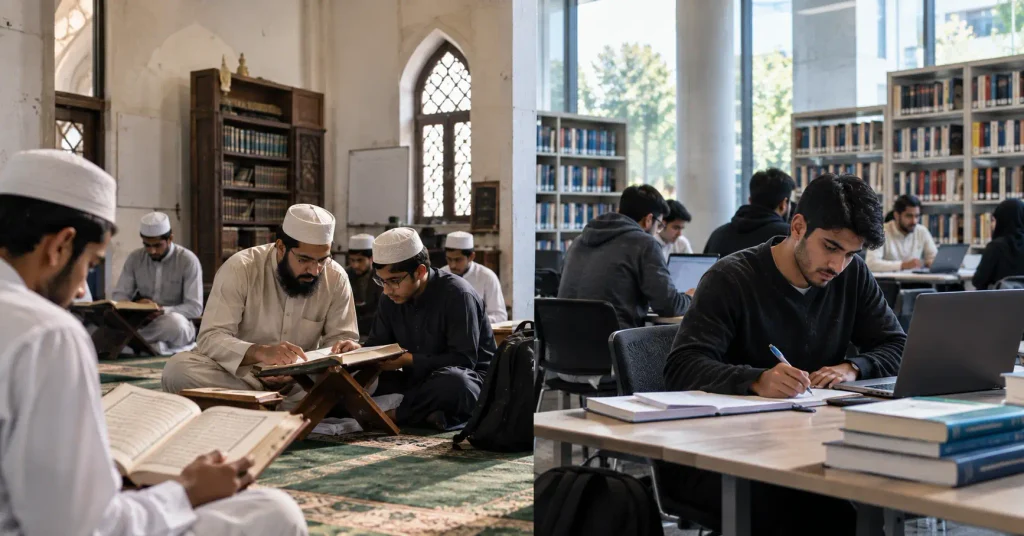
The difference in educational purpose shapes your daily coursework, the books you study, and the way knowledge is organised.
| Educational Track | Curriculum Structure |
| Madrasa Track (Dars-e-Nizami) | Progressive study of classical texts from cover to cover |
| University Track (Undergraduate) | Semester-based modules, general education requirements, and term papers |
The Madrasa Syllabus: The Dars-e-Nizami Tradition
Traditional madrasas in South Asia generally follow the Dars-e-Nizami curriculum, where students progress through classical texts systematically, studying them in depth under the guidance of qualified teachers.
The curriculum begins with foundational linguistic sciences, including Arabic morphology (Sarf) and syntax (Nahw). Students then progress through classical logic (Mantiq), legal theory (Usul al-Fiqh), substantive law, and Quranic interpretation(Tafsir).
The program culminates in the capstone year (Dawrah-e-Hadith), where students read and analyse the six canonical Hadith collections (Sihah Sittah).
Comparing Dars-e-Nizami vs BS Islamic Studies highlights how a traditional syllabus prioritises continuous textual immersion and specialised engagement with classical sources.
The University Curriculum: Semester-Based Learning and Academic Exploration
A university organises its curriculum through standardised semester credit hours, typically completed over eight semesters across four years.
Instead of dedicating several years to continuous study of classical manuals, the program combines Islamic Studies with broader academic requirements. Students complete foundational courses such as:
- English composition
- Mathematics
- Pakistan Studies
- Introductory computer skills
Islamic Studies courses are organised into individual modules covering areas such as Qur’anic interpretation, Islamic history, contemporary Muslim thought, and Islamic economics.
Language of Study: Classical Arabic Mastery and Contemporary Communication
The language you study in directly shapes your ability to access, interpret, and engage with Islamic sources.
| Learning Environment | Language Approach |
| Madrasa Environment | Immersion in unvoweled classical Arabic (Fusha al-Turath) |
| University Setting | Primary instruction in English/Urdu with functional Arabic |
Classical Arabic in the Madrasa
In a traditional madrasa, classical Arabic (Fusha al-Turath) serves as the primary gateway to Islamic scholarship. From the early stages of study, students develop a strong foundation in Arabic grammar, morphology, and sentence analysis.
You learn to recognise grammatical structures, analyse word formations, and understand how linguistic details influence the interpretation of classical texts.
By the advanced stages of study, students engage directly with unvoweled Arabic works across disciplines such as jurisprudence, theology, and Hadith commentary without depending entirely on translations. This develops the ability to independently examine classical writings and understand the language in which much of the Islamic scholarly tradition was preserved.
Language Usage in the University
University Islamic Studies programs in non-Arab countries generally conduct instruction in languages such as English, Urdu, or regional languages.
Students typically study Arabic as a dedicated subject to develop familiarity with:
- Quranic vocabulary
- Basic grammar
- Access to Islamic sources.
The curriculum usually does not require complete immersion in reading extensive unvoweled classical manuscripts. This approach allows students to engage with contemporary academic literature, research papers, and wider discussions surrounding Islamic thought while developing functional access to primary sources.
Teaching Style and Environment: The Halqah vs. The Lecture Hall
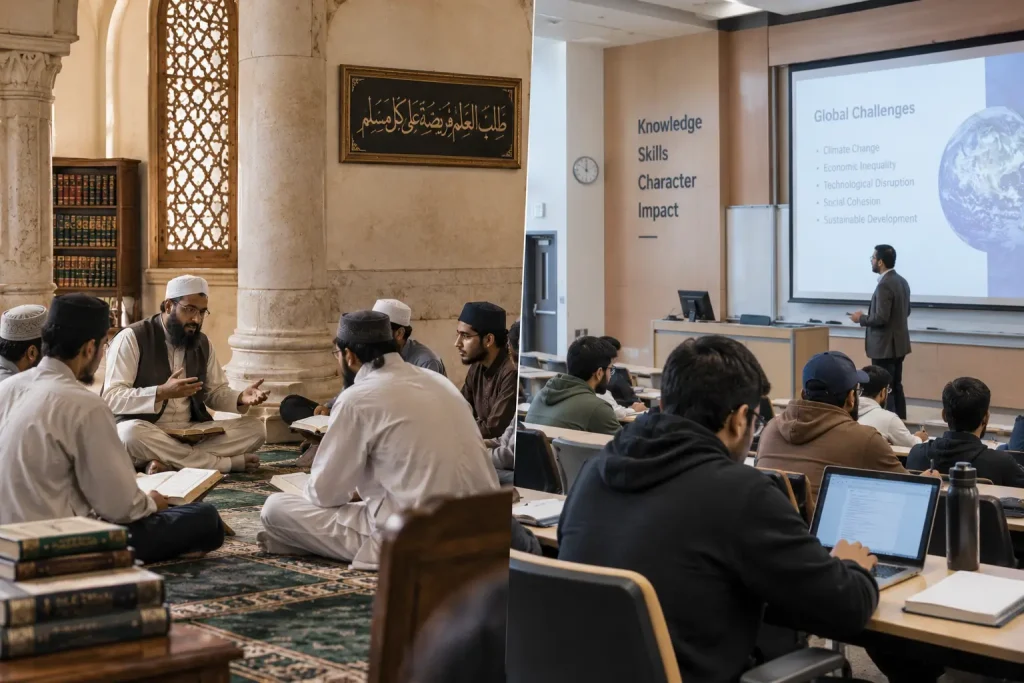
The physical environment and teaching approach shape how students interact with knowledge and with their teachers.
| Learning Environment | Teaching Style |
| Traditional Halqah | Floor circles, peer study (Takrar), and holistic Tarbiyyah |
| University Lecture | Tiered seating, digital presentations, and scheduled office hours |
The Madrasa: Traditional Learning and Teacher Guidance
Traditional madrasa education is built around the Halqah (study circle). Students sit together around their teacher, engaging directly with classical texts through explanation, discussion, and clarification.
Learning continues beyond classroom sessions through Takrar — a structured review process where students revisit lessons, discuss difficult passages with peers, and strengthen their understanding through repetition and discussion.
The environment also places strong emphasis on Tarbiyyah. Living and studying within close proximity to teachers allows students to observe scholarly character, discipline, etiquette, and spiritual practices alongside academic learning.
The Prophet Muhammad (peace be upon him) highlighted the responsibility involved in receiving and conveying knowledge:
“May Allah brighten the face of a person who hears what I say, retains it, and conveys it as he heard it.” – (Sunan Abi Dawud 3660)
The University: Academic Research and Independent Analysis
University education takes place within structured academic environments designed around lectures, discussions, assignments, and research activities.
Students learn through presentations, classroom discussions, digital resources, and independent study. Interaction with professors usually takes place during scheduled classes, office hours, and academic consultations.
This model encourages students to manage their own learning schedules, conduct independent research, collaborate with classmates, and develop academic skills required for broader educational and professional environments.
Qualifications, Assessment, and Recognition: Sanad vs. Degree
The qualifications awarded by each system reflect their different educational histories, assessment methods, and recognition frameworks.
| Accreditation Framework | Traditional Madrasa | Modern Chartered University |
| Governing Structure | Wifaq-ul-Madaris Boards | Statutory University Charter |
| Qualification Awarded | Shahadat-ul-Alimiyyah Sanad | Bachelor of Science (BS / BA) |
| Assessment Record | Traditional Teaching License | Transcript with GPA & Credits |
| Knowledge Authorization | Direct Isnad to Authors | Direct HEC Statutory Status |
The Traditional Credential: Sanad and Shahadah
Madrasa students complete examinations administered by recognised seminary boards such as Wifaq-ul-Madaris. Successful completion leads to the Shahadat-ul-Alimiyyah, a traditional scholar certification.
Alongside this qualification, graduates may receive a Sanad or Ijazah, a chain of authorised teachers connecting their learning back to earlier scholars and the authors of classical works.
Understanding the difference between sanad and university degree explains why traditional scholarly circles place importance on this chain of transmission.
The University Credential: The Chartered Degree
University students earn accredited Bachelor of Science (BS) or Bachelor of Arts (BA) degrees awarded through recognised academic institutions.
Assessment is recorded through semester grades, credit hours, and official transcripts. University qualifications provide structured recognition across employment sectors, civil service pathways, and postgraduate education.
Research Methodology: Classical Verification (Tahqiq) vs. Modern Academic Research
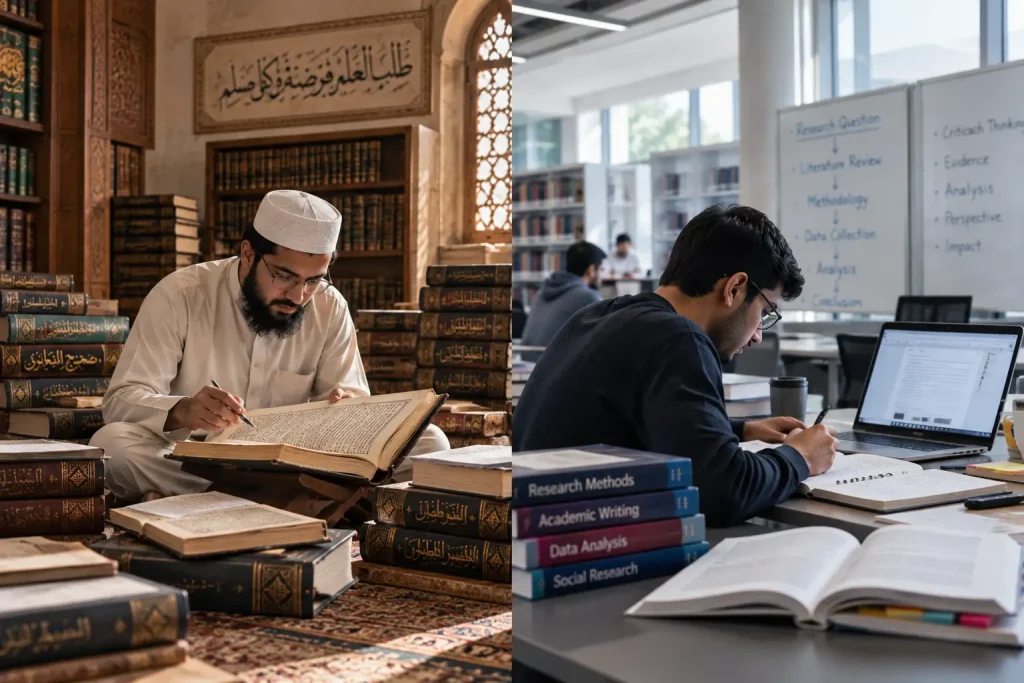
Both traditional madrasa and university systems value rigorous research, but they train students to investigate questions through different methodologies.
| Research Approach | Methodology |
| Madrasa Research | Manuscript verification (Tahqiq), Ilm al-Rijal, and marginal annotations (Hawashi) |
| University Research | Theses, literature reviews, and quantitative/qualitative analysis |
Understanding this difference helps you appreciate how each system approaches evidence, interpretation, and the development of knowledge.
Classical Scholarly Verification
In a traditional madrasa, research focuses on preserving textual accuracy and developing precise understanding of established scholarly works. Students engage with methods such as:
- Manuscript Verification:
Comparing different manuscript copies to identify variations, verify accurate wording, and establish reliable texts.
- Biographical Narrator Criticism:
Studying the biographies, reliability, and scholarly backgrounds of narrators to evaluate the authenticity of Hadith chains.
- Marginal Annotations:
Developing detailed explanations and analytical notes on classical texts to clarify difficult passages and reconcile apparent differences between scholarly positions.
This approach helps you understand Islamic knowledge through the original texts, scholarly methods, and traditions developed over generations.
Contemporary Academic Research
University research follows modern academic conventions designed around investigation, analysis, and the development of new perspectives. Students engage with methods such as:
- Structured Literature Reviews:
Examining existing academic publications, comparing scholarly arguments, and recognizing areas requiring further study.
- Methodological Frameworks:
Using approaches such as interviews, historical analysis, and quantitative research methods to study religious practices, communities, and social developments.
- Formal Academic Writing:
Following recognised citation systems and research standards to produce academic papers, conference presentations, and dissertations.
Exploring what is MS Islamic Studies provides further insight into how postgraduate programs evaluate research projects, thesis writing, and advanced academic inquiry.
Traditional Madrasa vs University Education: Key Differences and Benefits
The difference between traditional madrasa vs university education is ultimately a difference in educational purpose and method.
A traditional madrasa provides deep engagement with classical Islamic scholarship, helping you develop textual mastery, legal reasoning, and continuity with the scholarly tradition.
A university develops research skills, analytical thinking, and engagement with broader academic disciplines through structured programs and modern research frameworks.
For students deciding their educational path, the important question is not simply which system exists, but what kind of knowledge, skills, and contribution they hope to develop through their learning journey.
Entry Requirements and Educational Timing
One of the first practical differences you’ll notice between a traditional madrasa and a university program is when students typically begin their journey and what preparation is expected before admission.
| Educational Track | Standard Entry Point | Common Requirements |
| Madrasa | Ages 15–16 (Post-Matric / O-Levels) | Quranic literacy, Tajweed, and basic Urdu/Arabic reading |
| University Degree | Ages 18–19 (Post-Intermediate / A-Levels) | 12 years of formal education, academic records, and entry requirements |
Beginning the Madrasa Journey
Traditional seminaries generally accept students at an earlier stage of education. Many students begin after completing Qur’an memorization (Hifz), while others enter after completing Matriculation or O-Levels.
The admission process focuses primarily on religious foundations, including:
- Fluent Quran recitation with correct Tajweed.
- Basic ability to read and write Urdu or Arabic.
- An institutional evaluation assessing reading ability, commitment, and suitability.
Beginning seminary studies at this stage requires thoughtful planning. Exploring different options for Islamic education after secondary education helps you understand how classical studies can be pursued alongside broader academic development.
Beginning a University Degree
A university degree normally requires completion of twelve years of formal schooling before admission. Students typically enter after Intermediate education or A-Levels with the required equivalence documentation.
University admission follows academic criteria such as:
- Minimum academic scores according to institutional requirements.
- Entry tests or aptitude assessments where applicable.
- Departmental merit calculations based on previous academic performance.
Traditional Madrasa vs University Education: A Side-by-Side Comparison
The following table highlights the major structural differences between both educational systems:
| Educational Dimension | Traditional Madrasa Pathway | University Degree Pathway |
| Primary Institutional Focus | Classical text mastery, Sanad, and legal derivation | Academic research, critical history, and sociological inquiry |
| Instructional Medium | Classical Arabic (Fusha al-Turath) immersion | English, Urdu, or functional Modern Standard Arabic |
| Classroom Environment | Traditional Halqah circles and peer review (Takrar) | Lecture halls, multimedia presentations, and structured academic settings |
| Curricular Architecture | Multi-year Dars-e-Nizami studied progressively | Four-year modular semester credit-hour system |
| Assessment Model | Annual examinations through seminary boards | Semester assessments, assignments, examinations, and GPA grading |
| Awarded Credential | Shahadat-ul-Alimiyyah with traditional Sanad / Ijazah | Chartered BS or BA degree |
| Standard Entry Point | Post-Matric / O-Levels (often ages 15–16) | Post-Intermediate / A-Levels (often ages 18–19) |
| Research Methodology | Manuscript verification (Tahqiq) and narrator criticism (Rijal) | Literature reviews, qualitative and quantitative research, formal academic citations |
Career Pathways and Professional Outcomes
Both educational environments prepare students to serve society, but they generally open different professional pathways.
| Educational Path | Common Career Directions |
| Traditional Madrasa | Mosque leadership, seminary teaching, and specialised Ifta training |
| University Path | School teaching, civil service, policy research, and academic careers |
| Bridging Roles | Islamic banking compliance, Shariah auditing, and Halal certification |
Professional Pathways After Madrasa Education
A traditional seminary prepares students for roles connected with religious leadership, teaching, and scholarly service. Common pathways include:
- Mosque Leadership and Imamat:
Leading prayers, delivering sermons, and guiding community religious affairs.
- Seminary Teaching:
Teaching Islamic sciences such as Sarf, Nahw, and Fiqh to future students.
- Advanced Juristic Specialisation (Ifta):
Completing further specialised training (Takhassus) to develop expertise in issuing legal rulings.
- Pastoral Guidance:
Supporting individuals and families through religious counselling and guidance.
Professional Pathways After University Education
A university degree in Islamic Studies equips you with skills for academic, institutional, and professional environments. These pathways include:
- Mainstream Education:
Teaching Islamic Studies, ethics, and related subjects in schools.
- Public Administration and Civil Service:
Pursuing government examinations and administrative roles.
- Policy and Research:
Working with think tanks, welfare organisations, and research institutions.
- Postgraduate Academia:
Continuing into MS, MPhil, and PhD programs for academic careers.
Emerging Areas Requiring Both Skill Sets
Some modern sectors require professionals who understand both classical Islamic scholarship and contemporary systems:
- Islamic banking
- Corporate Shariah auditing
- Halal certification
These sectors increasingly require individuals who can understand classical commercial jurisprudence while also working with financial statements, corporate structures, and regulatory requirements.
Combining Tradition with Contemporary Learning
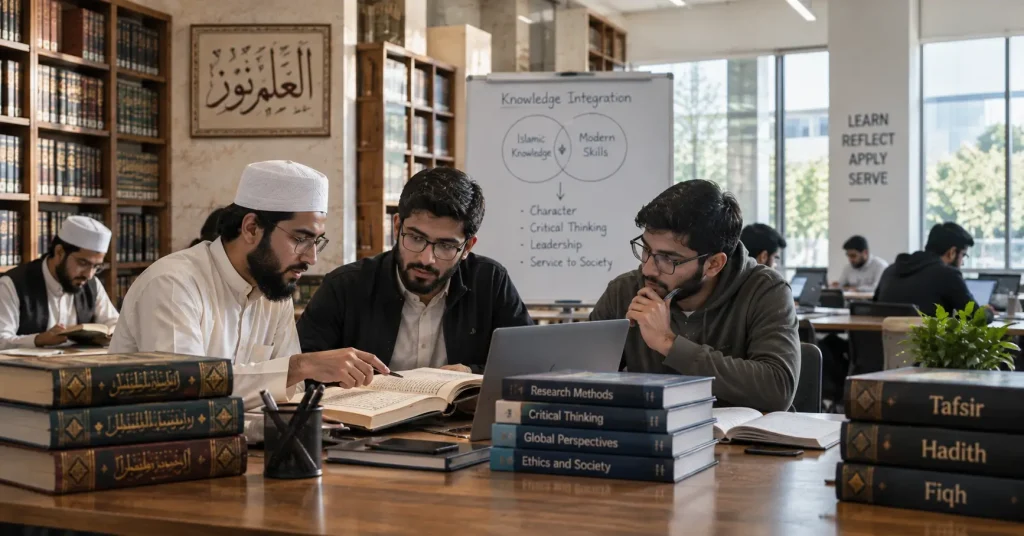
When you compare both systems, you find that each develops important strengths.
| Traditional Madrasa Strengths | Modern University Strengths |
| Deep classical Arabic understanding | Academic research and writing skills |
| Continuous scholarly transmission (Sanad) | Contemporary contextual understanding |
| Holistic moral development (Tarbiyyah) | Recognised academic credentials |
A traditional madrasa graduate may possess exceptional textual depth while needing additional exposure to academic writing, modern organisational structures, or contemporary research methods.
Similarly, a university graduate may understand historical context and research methodologies while requiring further training to independently engage with advanced classical Arabic manuscripts and traditional legal reasoning.
This growing need for scholars who can bridge both worlds has encouraged students and families to explore integrated pathways that combine classical Islamic scholarship with recognised higher education.
SISL’s Integrated Approach to Islamic Scholarship and Higher Education
Bridging traditional scholarship with modern higher education requires an approach that preserves the strengths of both systems.
The School of Islamic Scholars & Leaders (SISL) brings these two dimensions together through its Islamic Scholar & Leaders Program (ISLP), combining classical Islamic studies with accredited university education.
| Program Feature | How SISL Integrates Both Approaches |
| Dual Qualifications | Students complete the Dars-e-Nizami curriculum alongside an HEC-recognised BS in Islamic Studies |
| Classical Scholarship | Students study Arabic texts across Sarf, Nahw, Fiqh, Usul, Tafsir, and Hadith under qualified scholars |
| Leadership Development | Students develop communication, research writing, public speaking, and institutional management skills |
| Digital Research Skills | Students learn modern research tools while maintaining classical standards of verification |
This integrated model equips you with classical scholarship and modern skills. You develop the ability to serve through education, research, and leadership.
Choosing a Path That Brings Both Traditions Together
The discussion around traditional madrasa vs university education is often presented as a choice between two separate paths. One preserves deep engagement with classical Islamic scholarship, while the other develops research skills and contemporary academic understanding.
However, your pursuit of knowledge does not need to leave one tradition behind to gain from the other. The scholars of the future need both a strong foundation in Islamic scholarship and the ability to engage with the realities, questions, and challenges of the contemporary world.
SISL’s integrated approach brings these dimensions together by combining classical Islamic studies with academic, communication, and leadership development.
For a student seeking to grow in knowledge while preparing to serve communities, institutions, and future generations, this means building a foundation that is both deeply rooted and widely applicable.
“Indeed, the scholars are the inheritors of the Prophets. The Prophets did not leave behind dinars or dirhams, but they left behind knowledge, and whoever takes it has taken a bountiful share.” – (Jami` at-Tirmidhi 2682)
Frequently Asked Questions
Can a Madrasa Graduate Apply Directly for University Master’s Programs?
A madrasa graduate can pursue postgraduate studies if their final seminary qualification (Shahadat-ul-Alimiyyah) receives the required Higher Education Commission (HEC) equivalence.
The equivalence process may require completion of additional general education subjects, including areas such as English, Urdu, and Pakistan Studies, depending on the academic requirements.
Is a University Islamic Studies Degree Easier Than a Traditional Madrasa Program?
Neither pathway is inherently easier; they require different forms of academic commitment.
A traditional madrasa demands years of continuous study, daily engagement with classical texts, memorisation, Arabic analysis, and review sessions. A university degree requires consistent performance across semesters, academic writing, research assignments, examinations, and maintaining academic standards throughout the program.
Can a University Islamic Studies Graduate Issue Formal Fatwas?
A four-year university degree in Islamic Studies alone does not qualify a graduate to issue formal legal verdicts (Fatwas). Formal legal reasoning requires specialised training in Islamic jurisprudence, particularly advanced study in legal derivation (Takhassus fi al-Ifta) under the supervision of qualified scholars.
Do Traditional Madrasa Students Study Contemporary Subjects Like English or Science?
Curricula vary between institutions. Traditional seminaries primarily focus on classical Islamic sciences. However, many modern madrasas and integrated educational institutions increasingly include subjects such as English, mathematics, computer literacy, and broader academic preparation alongside religious studies.
What Is the Difference Between a Sanad and an HEC-Recognised Degree?
A Sanad represents a traditional scholarly authorisation connecting a student to their teachers and the wider chain of transmission. An HEC-recognised degree is a formal academic qualification awarded through a recognised university framework, providing institutional recognition for further education and professional pathways.