HEC recognition means that a higher education qualification or institution meets the academic and legal standards set by the Higher Education Commission of Pakistan. In Islamic Studies, recognition may apply to university degrees such as BS or MS Islamic Studies, or to the academic equivalence of traditional qualifications such as Shahadat-ul-Alimiyyah when required criteria are fulfilled.
- University degree recognition: BS and MS programmes awarded by chartered universities follow the recognised higher education framework.
- Academic equivalence: Traditional Islamic qualifications may receive equivalence after meeting required conditions.
- Recognition has a specific scope: Students should verify whether recognition applies to the institution, degree programme, or qualification type.
When you see the words HEC recognized on an Islamic Studies programme, you may assume it tells you everything you need to know about the qualification. However, recognition can refer to different aspects, including the institution offering the programme, the degree being awarded, or the equivalence of a traditional qualification.
For students and parents, understanding this difference matters. Choosing an Islamic education pathway involves understanding not only what you will study, but also how that qualification fits into future academic and professional opportunities.
Islam places strong emphasis on honesty and fulfilling commitments. Allah says:
“O you who have believed, fulfill [all] contracts.” – (Surah Al-Ma’idah 5:1)
This principle also applies to educational commitments and representations. Students deserve clarity about what a qualification represents, what recognition it carries, and what pathways it opens.
This guide explains what HEC recognition means for Islamic Studies, the difference between university degrees and traditional qualifications, and what you should verify before choosing an Islamic studies path.
The Three Layers of HEC Recognition
When you see the term HEC recognition attached to an Islamic Studies programme, it is important to understand what exactly has been recognised. Recognition works through different regulatory layers within Pakistan’s higher education system.
| Recognition Tier | What It Covers |
| Tier 1: Institutional Charter | Legal authorisation for an institution to operate as a university. |
| Tier 2: Programme-Level NOC | Approval for a specific degree programme to be offered and awarded. |
| Tier 3: Deeni Asnad Equivalence | Academic equivalence for eligible traditional seminary qualifications. |
Understanding these layers helps you evaluate whether recognition applies to the institution, the specific degree, or a traditional qualification.
Tier 1: Institutional Charter
An institutional charter is granted through an act of parliament or a provincial assembly. It establishes the university as a legally authorised institution that can provide higher education.
However, a charter does not automatically mean every campus, department, or programme carries the same recognition status. The HEC evaluates universities to ensure campuses meet required standards, including infrastructure, library facilities, and faculty requirements.
Before enrolling, it is important to verify that the specific campus or affiliated location you choose is approved. A programme offered through an unauthorised sub-campus or franchise may create issues with degree verification, even if the main university has official recognition.
Understanding traditional madrasa and university education helps explain why universities follow state recognition frameworks while seminaries operate through independent educational boards.
Tier 2: Programme-Level Approval (The Programme NOC)
Even when a university has a valid charter, individual degree programmes require specific approval before they can be offered.
The HEC issues programme-level approval for degrees such as BS Islamic Studies and MS Islamic Studies after reviewing factors including:
- The availability of required full-time, qualified faculty members.
- Alignment of the syllabus with National Curriculum Review Committee (NCRC) standards.
- Completion of required credit hours under undergraduate and postgraduate frameworks.
Tier 3: Deeni Asnad Equivalence
The third recognition pathway applies differently from university degrees. It provides a process for evaluating traditional seminary qualifications awarded through recognised madrasa examination federations.
Through this system, eligible qualifications can receive academic equivalence with conventional education levels after fulfilling required conditions.
What HEC Recognition Means for University Degrees (BS & MS)
For a university Bachelor of Science (BS) or Master of Science (MS) programme, HEC recognition confirms that the qualification meets required academic standards.
| Degree Level | Academic Requirements |
| BS Islamic Studies | 124–136 credit hours, eight academic semesters, general education requirements, and supervised academic work. |
| MS Islamic Studies | 30–36 credit hours, graduate-level coursework, research seminars, and a defended thesis. |
Standardised Undergraduate Requirements
A recognised BS Islamic Studies programme follows a structured academic framework that extends beyond specialised religious subjects. Alongside Islamic disciplines, students complete general education areas such as English composition, quantitative reasoning, and basic computing.
Understanding what BS Islamic Studies is helps students see how credit hours, semesters, and curriculum requirements contribute to formal degree recognition.
Civil and International Validity
A degree awarded through an approved programme provides several practical benefits:
- Degree Attestation:
Academic documents can be verified through the HEC Degree Attestation System (DAS).
- Further Academic Opportunities:
Recognised qualifications support applications where formal degree verification is required.
- International Evaluation:
Recognised degrees may be assessed by international credential evaluation bodies for further study and professional purposes.
The Madrasa Equivalence Framework: How HEC Recognises Dars-e-Nizami
The HEC does not recognise madrasas as universities. Instead, it manages an equivalence process that evaluates eligible traditional seminary qualifications against recognised academic levels.
| Step | Requirement |
| Step 1 | Complete Dawrah-e-Hadith through an approved Wifaq board. |
| Step 2 | Complete compulsory Matric subjects, including English, Urdu, and Pakistan Studies/Islamiyat. |
| Step 3 | Complete compulsory Intermediate subjects, including English, Urdu, and Pakistan Studies. |
| Outcome | Receive an equivalence certificate after fulfilling required conditions. |
The Shahadat-ul-Alimiyyah Equivalence
The Shahadat-ul-Alimiyyah is the qualification awarded after completing the final stage of Dars-e-Nizami, known as Dawrah-e-Hadith.
Under the equivalence framework, HEC evaluates this qualification for academic parity with relevant higher education levels when applicants fulfil the required conditions.
If you are exploring traditional Islamic qualifications, knowing what Wifaq certification is helps you understand how seminary examination boards document qualifications before they are submitted for the equivalence process.
The Compulsory Subject Requirement (The BISE Bridge)
A seminary qualification alone does not complete the equivalence process. Applicants must also fulfil compulsory academic requirements through a recognised Board of Intermediate and Secondary Education (BISE).
These requirements include:
- Secondary School Certificate (SSC / Matric):
Completion of compulsory examinations in English, Urdu, and Pakistan Studies (or Islamiyat).
- Higher Secondary School Certificate (HSSC / Intermediate):
Completion of compulsory examinations in English, Urdu, and Pakistan Studies.
Clear Boundaries of Equivalence
An equivalence certificate provides academic recognition for specific purposes, such as applying for certain academic programmes or professional opportunities.
However, equivalence does not convert a traditional madrasa into a chartered university, nor does it allow a seminary to independently issue statutory university degrees.
Curricular Benchmarks and Quality Standards

The HEC maintains academic quality standards for Islamic Studies programmes by evaluating areas such as faculty qualifications, curriculum design, and assessment practices.
| Quality Area | Focus |
| Faculty Credentials | Required qualifications and supervision standards. |
| Curriculum Balance | Combining classical Islamic studies with academic research skills. |
| Verification Standards | Transparent grading and examination processes. |
Academic oversight requires institutions to maintain fair and measurable evaluation standards. Islamic teachings also emphasise fairness and accuracy in measurement:
“And give full measure when you measure, and weigh with an even balance. That is the best [way] and best in result.” – (Surah Al-Isra 17:35)
In higher education, this balance is reflected through research methodology, citation practices, and academic evaluation alongside classical studies.
Comparing Dars e Nizami vs BS Islamic Studies shows how these two educational paths differ in their curriculum, learning methods, and recognition processes.
Early Educational Planning: Avoiding Equivalence Challenges
Many equivalence-related challenges arise when students begin their educational pathway without planning required academic qualifications in advance.
Completing these requirements early helps avoid delays when applying for university admission, degree verification, or equivalence.
| Education Pathway | Planning Route |
| Local Board Track | Matric (Compulsory Subjects) → Intermediate (Compulsory Subjects) |
| International Track | Cambridge O-Levels → IBCC Equivalence Certificate |
Managing Local Board Requirements
If you begin seminary studies after school, completing compulsory board examinations as a private candidate allows you to fulfil required academic conditions alongside Islamic studies.
If you are planning Islamic education after matric, completing required subjects such as English and Urdu through recognised education boards allows you to continue religious studies while meeting academic requirements.
Navigating International Schooling (O-Levels)
Students from Cambridge or other international education systems may need additional documentation before continuing into higher education pathways. Before applying for university admission or formal equivalence, students must obtain the required IBCC equivalence certificate.
Planning your Islamic education after O Levels early helps you complete these requirements and create a smoother transition into higher education.
Postgraduate Progression and Academic Opportunities
Holding an HEC-recognised 16-year qualification is the starting requirement for advanced academic research. Whether your qualification comes through a chartered university degree or an official equivalence certificate, this status determines your eligibility for postgraduate study.
| Stage | Requirement |
| 16-Year Qualification | Chartered BS degree or Shahadat-ul-Alimiyyah equivalence certificate. |
| Admission Requirements | Minimum 2.50 CGPA / 50% marks and required entry testing. |
| Advanced Study | Admission into 18-year MS or MPhil research programmes. |
Moving Into MS and MPhil Programmes
Graduates with a recognised BS degree and candidates holding verified Shahadat-ul-Alimiyyah equivalence may apply for 18-year postgraduate programmes, including MS and MPhil.
Before admission, universities usually require applicants to meet specific criteria:
- Academic Requirements:
A minimum CGPA of 2.50 out of 4.00 in semester-based systems, or at least 50% marks under annual examination systems.
- Entry Test Requirements:
Passing the HEC Graduate Assessment Test (GAT General) conducted by NTS, or an equivalent university admission test, with the required score.
- Departmental Assessment:
Presenting a research proposal and appearing before the relevant graduate committee.
Understanding the curriculum, thesis requirements, and research methodology covered in what is MS Islamic Studies gives you a clearer picture of how postgraduate study develops advanced research skills.
Recognition Comparison: Degree, Equivalence, and Unrecognised Qualifications
The type of qualification you hold determines how it is verified, where it can be used, and what academic opportunities it provides.
| Area | Chartered University BS Degree | Madrasa Equivalence (Shahadat-ul-Alimiyyah) | Unrecognised / Autonomous Institute |
| Awarding Body | Chartered public or private university | Recognised seminary (Wifaq) board | Unaffiliated madrasa or private academy |
| Academic Status | Recognised 16-year undergraduate qualification | 16-year equivalence after required conditions | Non-formal qualification |
| HEC Verification | Verified through Degree Attestation System (DAS) | Verified through official equivalence certificate | Not eligible for HEC attestation or equivalence |
| Civil Service Eligibility | Eligible through recognised degree pathway | Eligible after submitting equivalence documentation | Not eligible |
| Teaching Opportunities | Eligible for relevant subject specialist roles | Eligible for relevant Arabic/Islamiyat positions where requirements are met | Not eligible for government-funded positions |
| Required Background | Higher Secondary Certificate / A-Levels | Required Matric and Intermediate subjects | Varies |
Managing the Equivalence Process Alongside Traditional Studies
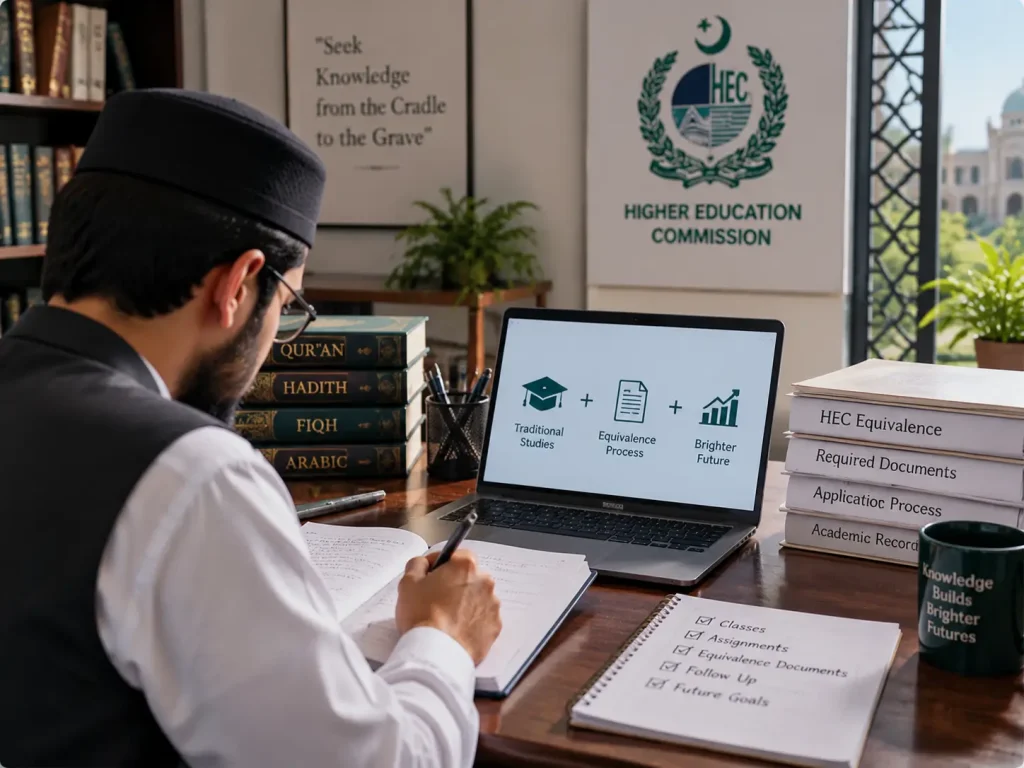
Completing the traditional equivalence pathway requires careful planning. Many madrasa students manage private board examinations alongside intensive classical Arabic studies, which can create additional administrative challenges.
| Common Requirement | Challenge |
| SSC and HSSC compulsory examinations | Managing independent board registrations. |
| English and Urdu subjects | Preparing alongside classical Islamic texts. |
| Seminary and BISE schedules | Avoiding examination clashes. |
| HEC documentation | Completing verification processes on time. |
Because of these requirements, many students explore whether they can pursue both pathways together through can you study dars e nizami and university together.
Some institutions combine Dars-e-Nizami studies with an HEC-recognised Bachelor of Science in Islamic Studies, allowing students to complete both qualifications alongside each other.
This approach allows graduates to receive a traditional Sanad alongside a university degree without managing a separate equivalence process after completing their studies.
How to Verify HEC Recognition Before Applying
Before submitting admission fees or original documents, verify the recognition status of the institution and programme directly.
| Step | What to Check |
| 1 | Search the HEC Recognised Universities and Degree Awarding Institutions directory. |
| 2 | Confirm that the specific campus location is approved. |
| 3 | Verify the programme-level approval status. |
| 4 | Review official affiliation notifications where applicable. |
1. Check the HEC Recognised Universities Directory
Visit the official HEC portal and confirm that the institution appears in the recognised universities and degree-awarding institutions directory.
2. Verify Campus Approval
A university’s recognition does not automatically apply to every location operating under its name. Check whether the specific campus you plan to attend appears among approved locations.
3. Confirm Programme Approval
Verify that the relevant department offers the specific programme you intend to study, such as BS, MS, or PhD Islamic Studies.
4. Review Affiliation Documents
If a private college claims affiliation with a public university, review the official affiliation notification issued by the university registrar and verify the details through official channels.
Taking time to verify educational information reflects the Quranic principle of careful investigation:
“O you who have believed, if there comes to you a disobedient one with information, investigate, lest you harm a people out of ignorance and become, over what you have done, regretful.” – (Surah Al-Hujurat 49:6)
Making an Informed Islamic Education Decision
Understanding what HEC recognition means helps you evaluate educational options with greater confidence. Recognition affects how a qualification is verified, where it can be used, and which academic pathways remain open after graduation.
Pursuing Islamic knowledge alongside formal education requires careful planning. By checking institutional recognition, completing required academic subjects, and exploring options that combine Islamic and modern education, you can pursue your studies with a clearer understanding of your qualification pathway.
Frequently Asked Questions
Can an autonomous seminary issue an HEC-recognised degree independently?
An autonomous seminary cannot issue a university degree unless it has legal authority as a degree-awarding institution. Traditional madrasas follow a separate pathway where eligible Shahadat-ul-Alimiyyah qualifications may receive equivalence through recognised seminary boards and HEC procedures.
Does HEC equivalence allow madrasa graduates to teach in mainstream colleges?
An HEC equivalence certificate allows eligible candidates to apply for relevant teaching positions, including certain public college lecturer roles, after fulfilling required recruitment requirements such as screening tests and interviews.
What is the difference between HEC attestation and HEC equivalence?
HEC attestation verifies that a degree and transcript issued by a recognised university are genuine. HEC equivalence evaluates whether a foreign or traditional qualification corresponds to a recognised academic level.
Can you receive HEC equivalence without completing compulsory English and Urdu requirements?
Applicants seeking Shahadat-ul-Alimiyyah equivalence must complete the required compulsory subjects through recognised boards before applying for equivalence.