Yes, you can study Dars-e-Nizami and a university degree together. The most practical route depends on the educational model you choose:
- Parallel Study: Attend a madrasa and university separately at the same time.
- Sequential Study: Complete one qualification first, then pursue the other through academic equivalence or further study.
- Integrated Dual-Track Program: Enrol in an institution that combines classical Dars-e-Nizami with an accredited bachelor’s degree through a coordinated academic schedule.
Choosing what to study after secondary school may leave you deciding between two important goals. You may want to study Arabic, Tafsir, Hadith, Fiqh, and Usul al-Fiqh through Dars-e-Nizami while also earning a recognised university qualification for your future academic and professional plans.
The question, “can you study Dars-e-Nizami and university together?”, matters because both paths require serious academic commitment. Some students pursue Dars-e-Nizami with a degree through separate institutions, while others choose an Islamic studies dual pathway that brings religious and university education into one academic journey.
The Quran encourages Muslims to seek goodness in both worldly life and the Hereafter:
“Our Lord, give us in this world [that which is] good and in the Hereafter [that which is] good, and save us from the punishment of the Fire.” – (Surah Al-Baqarah 2:201)
If you’re choosing an Islamic studies path, understanding parallel, sequential, and integrated Islamic studies models will make it easier to compare workload, degree recognition, exam schedules, and long-term study options.
Why Students Want Both Dars-e-Nizami and a University Degree
Students exploring Dars-e-Nizami with a degree usually want two different forms of education within the same academic journey.
Traditional seminary study develops access to classical Islamic texts and scholarly disciplines, while university education provides academic research skills, recognised qualifications, and access to wider professional pathways.
For students asking, “can you study dars e nizami and university together?”, the real question is how these two systems fit together without weakening the quality of either.
| Educational Path | Main Academic Focus |
| Classical seminary education | Primary-text reading, Arabic, Fiqh, Usul al-Fiqh, Tafsir, and Hadith |
| University education | Academic research, contemporary disciplines, degree recognition, and professional eligibility |
The Value of Classical Islamic Scholarship
Dars-e-Nizami requires students to engage directly with classical Arabic texts through subjects such as:
- Nahw
- Sarf
- Usul al-Fiqh
- Fiqh
- Tafsir
- Hadith.
Over time, students learn how Islamic legal arguments are developed, how classical texts are interpreted, and how scholars derive rulings from primary sources. The goal goes beyond reading translations. Students gradually develop the linguistic and scholarly foundations required to engage with Islamic literature directly.
For someone who wants serious Islamic scholarship alongside higher education, that depth remains one of the strongest reasons to pursue an alim course with university education.
Why University Qualifications Still Matter
University education serves a different academic and professional purpose. Careers in:
- Education
- Public administration
- Business
- Research
- Finance
- Many professional sectors
Often require qualifications recognised by relevant academic or regulatory bodies. A seminary graduate may possess extensive knowledge of classical Islamic sciences while still facing qualification requirements when applying for certain academic or professional roles.
A university graduate may face the opposite limitation, holding a recognised degree without the Arabic proficiency required to independently study classical Islamic legal and theological works.
Comparing traditional madrasa vs university education makes the attraction of dual education easier to understand. Students increasingly want an educational route that combines Islamic scholarship with recognised higher education rather than forcing them to sacrifice one goal for the other.
Model 1: Parallel Study Through Separate Institutions

Parallel study is one of the most direct ways to pursue Islamic education and university studies at the same time. Under this model, a student enrols in a madrasa for Dars-e-Nizami while separately registering for a university degree.
A typical schedule may look like this:
| Time | Academic Commitment |
| Morning to mid-afternoon | Full-time Dars-e-Nizami classes |
| Late afternoon or evening | University classes or distance learning |
| Evening | Takrar, assignments, reading, and exam preparation |
How Parallel Study Works
Students following the parallel route usually complete their university studies through one of several arrangements:
- They attend evening classes at a public or private university.
- They enrol in a distance-learning programme such as Virtual University or Allama Iqbal Open University.
- They register through an external or private examination route where the chosen university system permits it.
Both institutions operate independently, which means the student remains responsible for managing attendance requirements, coursework, examinations, assignments, and academic deadlines across two separate systems.
The Academic Demands of Parallel Study
The main difficulty lies in managing two complete academic workloads at once.
A student may spend five or six hours studying classical subjects at a madrasa before beginning university lectures, online coursework, or assignments later in the day.
Seminary study also includes revision and Takrar, while university courses add presentations, readings, projects, and examination preparation.
The pressure increases when both institutions expect major assessments during the same period. Students therefore need to consider more than whether their daily timetable looks possible.
They also need to think about the workload across an entire semester or academic year.
When Examination Calendars Overlap
Exam clashes create one of the biggest risks in independent dual enrolment.
Traditional seminaries affiliated with central examination boards such as Wifaq-ul-Madaris follow their own annual examination calendars. Universities usually operate through semester systems with separate midterm and final examination periods.
When both examination periods fall close together, students may face several major papers within a short period or encounter direct scheduling conflicts.
A comparison of dars e nizami vs BS Islamic Studies also highlights why the two systems require different forms of preparation. Managing both independently places significant responsibility on the student and may become difficult to sustain over several years.
Model 2: Sequential Study, One Qualification After the Other
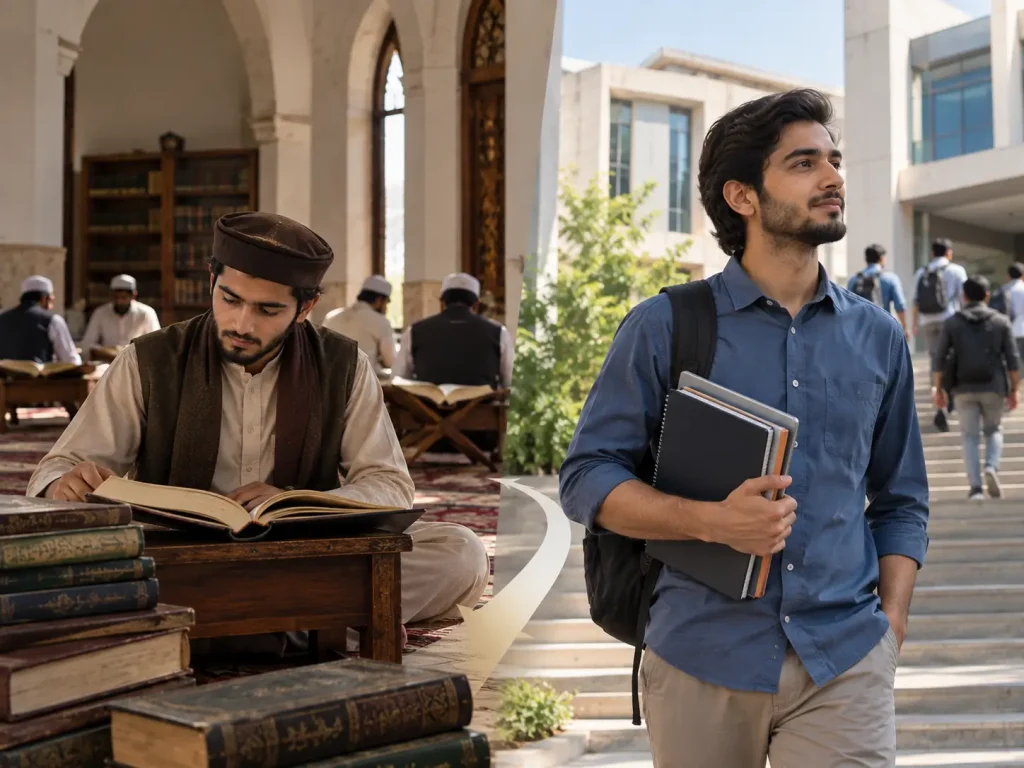
Students who prefer to focus on one academic system at a time may choose the sequential pathway. Rather than studying both qualifications simultaneously, they complete one programme before moving to the second. Two common routes are:
| Route | Academic Progression |
| Seminary first | Dars-e-Nizami → Alimiyyah qualification → academic equivalence → postgraduate university study |
| University first | Bachelor’s degree → full-time or accelerated Aalim programme |
Track A: Complete Dars-e-Nizami First
Under the seminary-first route, students complete the traditional Dars-e-Nizami curriculum before entering formal university study.
The programme commonly takes six to eight years and culminates in advanced Hadith study, including Dawrah-e-Hadith. After earning Shahadat-ul-Alimiyyah, eligible graduates may apply for the relevant academic equivalence according to the requirements in force at the time.
Graduates who meet university admission requirements may then continue into postgraduate study in fields such as Islamic Studies, Arabic, or related disciplines.
The postgraduate route discussed in what is MS Islamic Studies explains how advanced university education moves students further into academic research, methodology, and specialised study.
Track B: Complete University First
Another option is to finish a bachelor’s degree before beginning full-time seminary education.
A student may first graduate in Computer Science, Business, English, Social Sciences, or another university discipline and later enrol in an Aalim programme designed for adult or university-educated learners.
The advantage is academic focus. Students complete one major qualification before taking on the demands of another.
The main trade-off is the total duration. Completing both qualifications one after the other may require ten years or more, depending on the length of the university programme, Dars-e-Nizami pathway, and any academic exemptions available.
For students who want both qualifications but don’t want to manage two full academic systems simultaneously, the sequential route offers a more concentrated approach.
Model 3: Integrated Dual-Track Education

An Islamic studies dual pathway places traditional Dars-e-Nizami and university education within the same institution or coordinated academic system.
Instead of managing two unrelated timetables, students follow one academic plan that accounts for both classical Islamic subjects and university requirements.
A typical integrated schedule may include:
| Part of the Day | Academic Focus |
| Morning | Arabic, Fiqh, Usul, Tafsir, Hadith, and other Dars-e-Nizami subjects |
| Afternoon | University degree courses and general academic requirements |
| Evening | Revision, Takrar, research, assignments, and supervised study |
How an Integrated Model Works
Students enrol in an institution combining classical Islamic scholarship with the requirements of an accredited university qualification.
Arabic grammar, jurisprudence, legal theory, Tafsir, and Hadith remain part of the seminary curriculum, while degree requirements such as academic English, research methodology, computing, quantitative subjects, and other university modules are incorporated into the broader academic plan.
The purpose of integrated Islamic studies is to reduce the conflict that often arises when students attempt to manage two unrelated institutions independently.
Why Integration Changes the Experience
A coordinated programme addresses several practical problems associated with parallel enrolment.
- Less commuting:
Students study both academic tracks at the same institution or through one coordinated system, reducing travel between separate campuses.
- Better exam coordination:
Academic planners account for both university assessments and classical examinations when preparing calendars.
- Less duplicated coursework:
Related subjects may complement one another where academic regulations permit, allowing students to connect university learning with their classical studies.
- More consistent academic planning:
Students follow one long-term study plan rather than managing separate administrative systems.
Understanding what is BS Islamic Studies also provides useful context for how university-level Islamic Studies differs from classical seminary education and where the two areas overlap.
For students considering a dars e nizami BS degree pathway, integration often becomes attractive because academic coordination is built into the programme rather than left entirely to the student.
Workload and Time Management: What Dual Study Really Requires
Studying two qualifications demands more than finding enough hours in a daily timetable. Students also need enough time for revision, assignments, reading, examinations, family responsibilities, rest, and personal commitments. The workload differs considerably across the three models.
| Study Model | Typical Academic Demand |
| Full-time seminary study | Regular classroom hours plus Takrar and personal revision |
| Full-time university study | Credit hours plus assignments, research, and examination preparation |
| Independent parallel study | Combined workload from both systems |
| Integrated pathway | Both curricula planned through one coordinated academic schedule |
Understanding the Weekly Academic Load
A full-time madrasa programme may involve approximately 25 to 30 classroom hours each week, alongside additional time for:
- Takrar
- Memorisation
- Reading
- Revision.
An undergraduate university programme commonly includes 15 to 18 credit hours, followed by additional time for:
- Assignments
- Projects
- Research
- Presentations
- Exam preparation.
Combining both independently may push the total academic commitment toward 50 to 60 hours in a demanding week. Travel between institutions may add further pressure.
The number itself doesn’t determine whether a student will succeed. Personal study speed, commuting time, family responsibilities, previous Arabic knowledge, academic ability, and the flexibility of each institution all affect how manageable the workload feels over several years.
The Cost of Taking on Too Much
Heavy academic pressure may eventually affect sleep, concentration, physical health, family responsibilities, and the quality of learning itself.
Islamic scholarship also recognises that seeking knowledge doesn’t require neglecting other responsibilities. Salman al-Farsi (may Allah be pleased with him) advised:
“Indeed, your Lord has a right upon you, your self has a right upon you, and your family has a right upon you, so give everyone possessing a right their due.” – (Sahih al-Bukhari 6139)
When the Prophet Muhammad (peace be upon him) was informed of the advice, he affirmed it and said, “Salman has spoken the truth.”
A sustainable dual-education plan therefore needs enough space for serious study without allowing academic pressure to damage health, family obligations, or the quality of either qualification.
The best pathway depends on how much academic responsibility you can realistically maintain for several consecutive years.
Academic Recognition: Understanding Sanad, University Degrees, and Equivalence
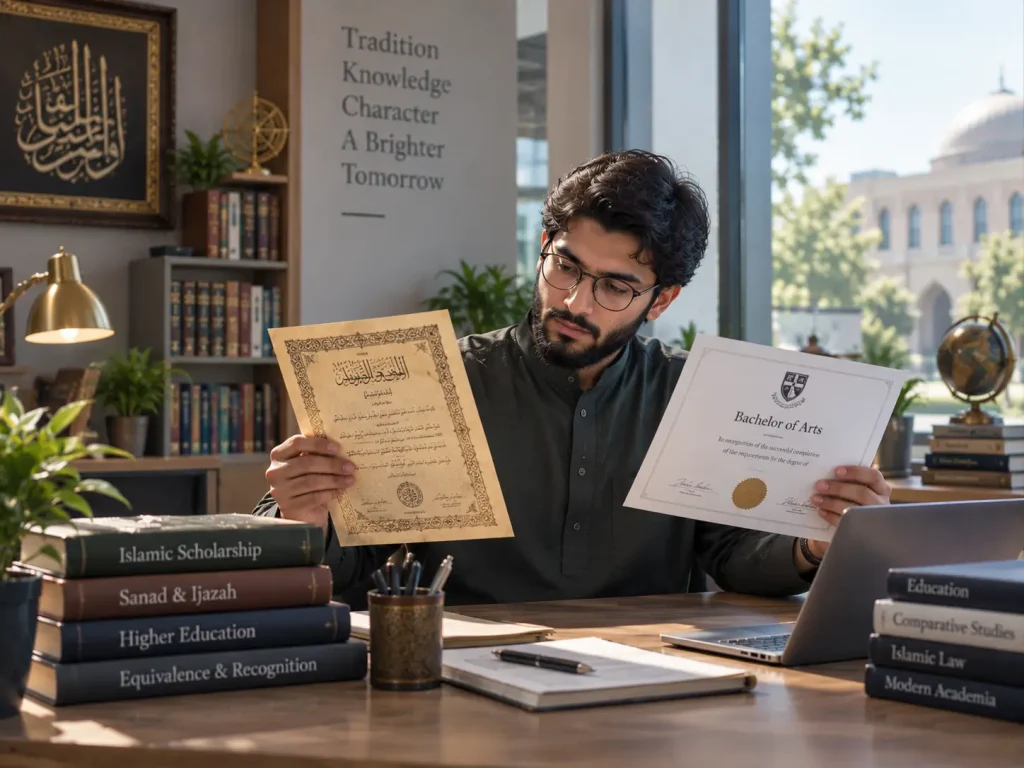
Before deciding how to combine Islamic education and university study, you need to understand how each qualification is recognised. A traditional seminary qualification and a university degree come from different educational systems.
Both carry academic value, but they serve different purposes and follow different recognition processes:
| Credential | Issuing Body | Primary Purpose |
| Shahadat-ul-Alimiyyah / Sanad | Recognised seminary board or Islamic institution | Certifies study of traditional Islamic sciences |
| BS / BA Degree | Chartered university | Provides recognised university-level academic qualification |
| Academic Equivalence | Relevant education authority | Establishes how one qualification corresponds to another within the formal education system |
The Traditional Sanad
A Shahadat-ul-Alimiyyah certifies that you have completed advanced study in traditional Islamic disciplines through the relevant seminary system.
Depending on the institution and field of study, students may also receive a Sanad or Ijaza documenting scholarly study and authorisation through recognised teachers.
Within traditional Islamic education, these credentials carry particular importance for students who intend to:
- Teach Islamic sciences
- Continue into advanced scholarship
- Pursue later specialisation in areas such as Ifta.
Understanding the difference between sanad and university degree is important because the two qualifications don’t serve exactly the same academic purpose.
The University Degree
A bachelor’s degree awarded by a recognised university follows the academic requirements of the higher education system.
Degree programmes are assessed through:
- Credit hours
- Coursework
- Examinations
- Research assignments
- Other university requirements.
The resulting qualification is used for:
- Postgraduate admissions
- Employment applications
- Professional opportunities
- Other areas where formal university education is required.
If you’re pursuing Dars-e-Nizami with a degree, university recognition matters because completing religious scholarship alone doesn’t automatically satisfy the qualification requirements attached to every profession or postgraduate programme.
Understanding what does HEC recognition mean also clarifies why the status of the university and degree programme matters when planning your academic future.
How Academic Equivalence Works
Students who complete Dars-e-Nizami through a recognised seminary board may apply for academic equivalence according to the requirements set by the relevant authorities.
In Pakistan, the Higher Education Commission provides an equivalence process for recognised Shahadat-ul-Alimiyyah qualifications, subject to specified academic and documentary requirements.
Depending on the applicable equivalence criteria, students may need to provide evidence of required general subjects, earlier educational qualifications, and verified certificates from recognised seminary boards.
Learning what is Wifaq certification provides more context on the role central seminary examination boards play in assessing and certifying Dars-e-Nizami students.
Equivalence therefore matters most when your future plans depend on moving between the traditional seminary system and formal higher education.
Planning Early: Starting After Matric or O-Levels
Your route becomes easier to plan when you think about both qualifications soon after secondary school.
Students entering Dars-e-Nizami after Matric and students coming from the Cambridge system face different academic requirements. Knowing those differences early may prevent unnecessary delays later.
| Secondary Education Route | Possible Next Stage |
| Matriculation | Begin Islamic studies while continuing Intermediate-level education |
| Cambridge O-Levels | Complete the required equivalence process and plan A-Levels or another HSSC pathway |
Starting After Matric
If you’ve completed Matric through a local education board, you may begin foundational Dars-e-Nizami subjects while continuing your formal secondary education.
Early seminary years often focus heavily on Arabic foundations, including Sarf and Nahw. Depending on your chosen academic pathway, Intermediate education may continue alongside these studies through an available college, private, or other recognised examination arrangement.
Planning Islamic education after matric carefully matters if you want to avoid unnecessary gaps between your religious and formal education. The earlier you understand which qualifications and subjects you’ll need later, the easier it becomes to plan both academic routes together.
Starting After O-Levels
If you’ve completed Cambridge O-Levels, the administrative process differs.
Students moving from the Cambridge system into local educational pathways generally need the relevant equivalence documentation from the Inter Boards Coordination Commission (IBCC).
After that stage, you need to decide how your higher secondary education will continue. You may remain within the Cambridge system through A-Levels or move into another recognised HSSC pathway.
That decision matters when you’re also starting Dars-e-Nizami because each academic route carries its own coursework, examination dates, and preparation requirements.
A-Levels, for example, require substantial independent preparation and fixed examination sessions. Combining them independently with seminary education therefore requires careful academic planning.
Reviewing your options for Islamic education after O Levels will allow you to compare the available routes before committing to a demanding dual-study schedule.
Parallel vs Sequential vs Integrated Study: A Complete Comparison

Once you understand the three pathways, comparing them side by side makes the differences clearer.
| Factor | Parallel Study | Sequential Study | Integrated Dual-Track Study |
| Typical Duration | Around 6 to 8 years when pursued concurrently | Often 10 to 12 years when completed separately | Depends on the programme, with some models designed around an 8-year pathway |
| Weekly Workload | Usually the heaviest because two institutions operate independently | More manageable because one programme is studied at a time | High, but coordinated within one academic plan |
| Schedule Coordination | Limited | Full, because the programmes are completed separately | Academic calendars are coordinated |
| Travel Requirements | May require travel between institutions | One institution at a time | Often one campus or coordinated learning environment |
| Qualifications | Seminary qualification plus university degree | Both qualifications completed consecutively | Both pursued within the same academic pathway |
| Academic Pressure | High during overlapping deadlines and exams | Lower during normal study periods | Reduced scheduling conflict, although the academic load remains demanding |
| Suitable For | Highly independent students with strong time-management skills | Students who prefer concentrating on one qualification at a time | Students who want both educational tracks planned together |
Parallel study may allow you to complete both qualifications within a similar period, but you carry most of the scheduling responsibility yourself.
Sequential study removes the pressure of handling both systems simultaneously, although completing them separately increases the overall duration.
An Islamic studies dual pathway attempts to address both concerns by allowing you to pursue traditional scholarship and university education within one coordinated academic plan.
The Integrated Pathway at SISL
The School of Islamic Scholars & Leaders (SISL) in Karachi follows the integrated approach through its eight-year onsite Islamic Scholar & Leaders Program.
The programme brings Dars-e-Nizami and university education into the same academic journey so students don’t have to manage two unrelated institutions independently. Its broader academic model combines:
| Classical Islamic Studies | University and Contemporary Studies |
| Dars-e-Nizami | BS Islamic Studies |
| Arabic | Academic research and writing |
| Fiqh and Usul al-Fiqh | University coursework |
| Hadith and Tafsir | Contemporary academic subjects |
| Traditional scholarly learning | Technology, research, and professional development |
Combining Both Areas of Study
Students progress through classical Islamic sciences while also completing university-level education within the same overall programme.
Dars-e-Nizami subjects develop Arabic proficiency and engagement with:
- Tafsir
- Hadith
- Fiqh
- Usul
- Aqeedah
- Other classical disciplines.
University study adds:
- Academic research
- Writing
- General education subjects
- Recognised higher education requirements.
For students specifically looking for a dars e nizami BS degree route, the main advantage lies in having both sides of the education planned together from the beginning. Both parts form part of the same long-term academic journey.
Managing the Academic Load
An integrated model doesn’t remove the demands of studying two substantial curricula.
Students still need to attend classes, review classical texts, complete assignments, prepare for examinations, and develop their research abilities.
The difference lies in coordination.
Rather than dealing with unrelated schedules from two separate institutions, classes and academic responsibilities follow one planned timetable. Takrar, university coursework, classical subjects, and academic assessments form part of the same educational schedule.
For students who want to complete an alim course with university education, coordination may make the workload easier to sustain over several years compared with managing two independent institutions.
Developing Skills Beyond the Classical Curriculum
SISL’s model also includes areas that extend beyond the traditional Dars-e-Nizami syllabus. Students encounter academic research, writing, technology, communication, and contemporary applications alongside classical Islamic disciplines. Tools and platforms such as Ilmverse.ai also form part of the wider educational environment.
The purpose is to prepare graduates for several possible directions. Some may continue into Islamic scholarship or teaching, while others may pursue postgraduate research, professional careers, community work, or leadership roles.
An integrated Islamic studies model therefore aims to preserve serious classical education while keeping students connected with contemporary academic and professional requirements.
Choosing the Right Educational Path
So, can you study Dars e Nizami and university together?
Yes, but deciding to pursue both is only the first part of the decision. You also need to choose a pathway that remains realistic across several years of study.
If you prefer concentrating completely on one area before moving to another, the sequential pathway may suit you better.
If you’re highly organised, comfortable managing separate academic systems, and prepared for a demanding weekly schedule, the parallel pathway allows both qualifications to progress simultaneously.
If your priority is completing Dars-e-Nizami with a degree while following one coordinated academic plan, an integrated pathway offers another option. Seeking knowledge remains one of the most valued pursuits in Islam. The Prophet Muhammad (peace be upon him) said:
“Whoever treads a path seeking knowledge, Allah makes easy for him the path to Paradise.” – (Jami` at-Tirmidhi 2646)
The strongest educational choice is one that you can sustain with consistency while giving proper attention to your studies, health, family responsibilities, and long-term goals.
Understanding how to combine Islamic and modern education allows you to compare those priorities before committing to a pathway and choose an approach that supports both serious Islamic learning and your wider academic future.
Frequently Asked Questions
Is It Permitted to Study Two Programmes at the Same Time in Pakistan?
HEC policies place restrictions on simultaneous enrolment in multiple regular university degree programmes. If you’re planning simultaneous enrolment, you should confirm the current rules of your university, seminary board, and relevant education authorities before admission. Policies may differ according to programme type and institution.
Can You Study Dars-e-Nizami Alongside Computer Science, Business, or Another Degree?
Yes. A Computer Science or Engineering programme may include laboratories, projects, attendance requirements, and daytime classes. Business and other university programmes may also involve presentations, group projects, internships, and regular coursework.
Which Study Model Has the Lowest Risk of Burnout?
Among routes where both qualifications are pursued together, an integrated model reduces many of the practical pressures associated with parallel study because calendars, classes, and assessments are coordinated.
Do Universities Give Credit for Madrasa Subjects?
Universities award academic credit according to their own recognised curricula, assessment systems, and programme requirements. A student who has studied Fiqh, Tafsir, Hadith, or Arabic in a madrasa shouldn’t assume that each subject will directly replace a university module.
What Happens If Madrasa and University Exams Clash?
If dates overlap, your available options depend on the examination policies of the institutions involved. A makeup exam, deferred assessment, or later examination session may exist in some cases, but students shouldn’t assume an alternative will always be available. An integrated model reduces that risk because both academic schedules are planned within the same system.